
Start in Tennessee. The state tried to execute Christa Pike by lethal injection last week, and failed. Her attorneys say she is conscious and speaking; The Washington Post reports she is still in the hospital.
From there the week moved fast: the first Senate debate in Maine, drones that hit two ships in the Black Sea and sank one of them, nearly 900 schools closed in France, a tropical storm building in the Gulf, the death of a researcher at a Russian anti-plague lab, and a diesel order that trucking groups called minimal relief.
This column takes those one at a time, names the sources, and leaves the conclusions to you.
Christa Pike: What We Know
Tennessee tried to execute Christa Pike by lethal injection last week. The attempt failed. She is still alive, and as of this week’s reporting she remains hospitalized.
Her attorneys say she is conscious and speaking. That is about the limit of what has been confirmed. Officials have not said what went wrong, what the state intends to do next, or anything more about her medical condition.
What we have is a short list of verified facts and a long list of unanswered questions.
| Timeline | Confirmed fact | Source |
|---|---|---|
| Last week | Tennessee tried to execute Christa Pike by lethal injection; the attempt failed. | The Washington Post |
| After the failed execution | Attorneys say Pike is conscious and speaking, and still alive. | The Washington Post |
| Now | She remains hospitalized. | The Washington Post |
A failed execution is not one person’s bad week. It leaves questions the death penalty system was not built to answer.
Medically: who treats a patient the state was midway through killing? Doctors who took an oath to heal end up part of the punishment whether they chose it or not.
Legally: an unfinished execution has no tidy procedure. Does a court set a second date? At what point does trying again become the cruel and unusual punishment the Constitution forbids?
For Pike herself, the result is a gap between verdicts. Not free, not dead.
None of this settles the argument over capital punishment. It shows that the process assumes it will work every time. When it doesn’t, the fallout lands on the doctors, the courts, and the woman in the hospital bed.

This Week, Briefly
-
In the first Maine Senate debate, Republican Susan Collins, one of the midterms’ most vulnerable incumbents, clashed with Democratic challenger Troy Jackson.
-
Drones hit two commercial ships in Bulgaria’s Black Sea waters, and one sank. Ukraine’s President Volodymyr Zelenskyy blamed Russia and warned of a looming “massive strike.”
-
France closed nearly 900 schools as education protests spread. Police fired tear gas and water cannons at roughly 250,000 students, parents, and teachers.
-
President Trump called higher gas prices from the Iran war “a small price to pay for keeping the world safe,” said Iran could “take out” Los Angeles or San Diego, and pointed to extra nuclear protection for certain U.S. cities.
-
Tropical Storm Isaias has formed in the Gulf and is forecast to strengthen into a hurricane before reaching the Gulf Coast late this week.
-
The World Health Organization said it is “actively following up” on the death of a researcher at a Russian anti-plague institute, as a reported second illness draws scrutiny.
Where the Systems Showed Strain
No single theme ties the week together, but a lot of institutions had a rough one.
A state tried to end a life and could not. France could not keep 900 schools open. A drone found two ships inside NATO waters and sank one. A storm got a name before it got a coastline. Cornell’s faculty moved toward a no-confidence vote over the administration’s handling of a rape case. Washington announced a new submarine shipyard in Maryland and opened red-dyed diesel to truckers, while the president told a rally that higher gas prices were a small price to pay for the war with Iran.
These stories do not share a politics. They share a pattern. Courts, classrooms, borders, weather, fuel, and the human body are all places where someone promised control. The week was a reminder of how thin that promise can get.
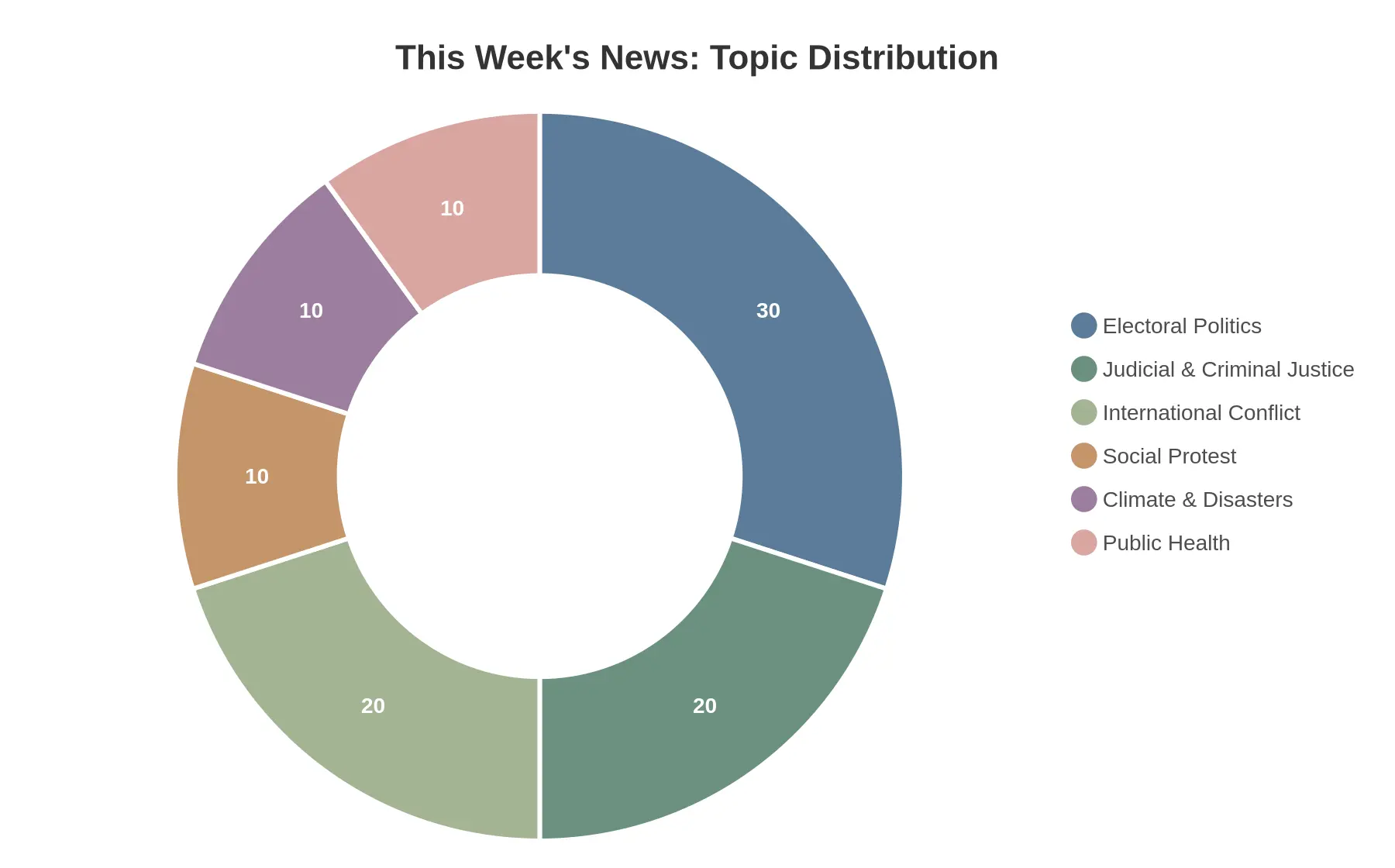
A rough read of the chart above: politics takes the largest share of the week’s stories, followed closely by courts and criminal justice and by international conflict, with climate, public health, and social protest in the smaller wedges.
The Debate Under the Execution
The fight over the death penalty was never only about whether the state should kill. It is also about how, and what that method asks of the people who carry it out.
A botched execution sharpens the question. Some people read one as proof the machinery cannot be fixed. Others read it as a reason to keep trying, more carefully. Neither side has the better of it, and both return to the same question: what are we willing to have done in our name?
Procedure gets the last word either way. When a state cannot execute cleanly, the focus moves from guilt to competence: who answers for the failure, and what it means that a method described as humane leaves someone alive to describe it. That gap between intention and outcome is where the argument stays. It rarely gets resolved. Usually another attempt is scheduled.

Frequently Asked Questions
What is Christa Pike’s condition now?
As of this week, her attorneys say she is conscious and speaking. Tennessee tried and failed to execute her by lethal injection last week, and she remains hospitalized.
What does a failed Tennessee execution mean?
It means the lethal injection attempt did not result in death. Confirmed details are still limited, and what comes next for the case is not yet clear.
What else made headlines this week?
A Maine Senate debate between Susan Collins and Troy Jackson; drones that hit two ships in the Black Sea off NATO member Bulgaria; France closing nearly 900 schools during education protests; Tropical Storm Isaias forming in the Gulf; and the death of a Russian anti-plague lab researcher that the WHO is examining.
Christa Pike is conscious and speaking, still in the hospital. It is an ending that does not end, the kind a headline tends to smooth over. The same week brought a Senate debate in Maine, two ships hit in the Black Sea, tear gas in France, and a storm gathering in the Gulf.
Reading slowly is not passive. It means letting one story finish before starting the next, and remembering that the week does not reset for the people living in it.