David Rush is a former CIA officer. FBI agents found hundreds of gold bars at his Virginia home, and on 6 October 2026 he pleaded guilty to wire fraud in a scheme the Justice Department values at about $194 million. That summary ran across the BBC, The New York Times, NBC News, ABC News and dozens of other outlets. The totals differ from one report to the next: $194 million at the Justice Department and Fox News, $195 million at The Washington Post, “nearly $200 million” at ABC News and Yahoo News, and $145 million at The New York Times. The shape of the story holds. A senior CIA executive, holding a top secret clearance and access to classified programs, invented a classified program to move public money to himself and ended up with a basement full of metal.
The gold is the part worth pausing on. The fraud is the charge, and the disclosure of a human source to a foreign official is the more serious part of the plea. But the gold is what people remember, and the choice of gold says something about how money gets hidden. Rush did not only buy metal. Prosecutors say he also put public money into luxury real estate in South Florida, and he was found with about $2 million in cash and 35 luxury watches, many of them Rolexes. That is a portfolio of things that hold value and resist a paper trail. Gold was one leg of it.
This article tries to answer a narrow question: what does a gold bar offer that other forms of wealth do not, and why does that appeal keep appearing in cases about people with something to hide?
Gold bars are not a criminal instrument. They are an old, unglamorous, deeply respectable way to store value, and millions of people buy them for ordinary reasons: inflation, distrust of banks, a hedge in a retirement account. Those same properties, the ones that make gold useful to a retiree, are what make it useful to someone moving a large sum quietly. The overlap is the interesting part.
Here is a source-by-source breakdown of the core facts as each outlet reported them. Every figure below is tied to the outlet that published it – nothing here is inferred.
| News Source | Report Time | Core Facts |
|---|---|---|
| The Guardian | ~4 weeks ago (Sept 11, 2026) | Reported federal prosecutors reached a tentative plea agreement with a former CIA officer accused of stealing gold bars. No total dollar figure cited at this stage. |
| The New York Times | Oct 6, 2026 | Reported the ex-CIA officer who stashed gold bars admitted to a scam it framed as a far larger $145 million scheme; entered a guilty plea. |
| NBC News | Oct 6, 2026 | Reported the CIA officer arrested with gold bars admitted he exposed a secret intelligence source to a foreign official; pleaded guilty to wire fraud. |
| ABC News | Oct 6, 2026 | Reported the former CIA officer pleaded guilty in the gold bars case and admitted to defrauding the government of nearly $200 million. |
| BBC | Oct 6, 2026 | Reported the ex-US spy found with $40 million in gold bars pleaded guilty to wire fraud. |
| Yahoo News | Oct 6, 2026 | Reported the former CIA officer pleaded guilty to stealing nearly $200 million in the gold bar case. |
| NewsNation | Oct 6, 2026 | Reported the ex-CIA officer found in possession of gold bars entered into a plea agreement. |
| WJLA (ABC7) | Oct 6, 2026 | Reported the ex-CIA officer pleaded guilty in the theft of nearly $194 million, including $40 million in gold bars. |
| Fox News | Oct 6, 2026 | Reported the ex-CIA officer found with over $40 million in gold bars pleaded guilty to a $194 million fraud. |
| New York Post | Oct 7, 2026 | Reported the CIA officer caught stealing millions in gold bars pleaded guilty to a “colossal” wire fraud scheme. |
On the numbers, so you can read the table honestly
- Total amount: Outlets diverge. The Justice Department puts the fraud at approximately $194 million; The Washington Post says $195 million; ABC News and Yahoo News cite “nearly $200 million”; Fox News and WJLA cite “nearly $194 million.” The New York Times reported $145 million. These figures are as-reported and have not been reconciled against one another.
- Gold bars value: The FBI seized 298 one-kilogram bars worth more than $40 million. BBC, WJLA and Fox News all cite roughly that figure (Fox says “over $40M”).
- Main charges: Rush pleaded guilty to wire fraud. As part of the plea he also admitted disclosing a clandestine human source, and top secret information, to a foreign government official.
- Plea progress: Began as a tentative agreement reported in mid-September (The Guardian), then moved to guilty pleas reported across ABC News, BBC, NBC News, Fox News, WJLA, NewsNation, and the New York Post on 6 and 7 October.
Why Gold Bars
The detail that lingers is not the dollar figure. It is the form the money took.
According to court filings, Rush asked the government for tens of millions of dollars in gold bars and a significant quantity of foreign currency between November 2025 and March 2026, describing the request as work-related expenses. The CIA later could not find the bars or most of the currency, and could find no record of Rush accounting for what happened to them. FBI agents found the gold at his home in Ashburn, Virginia, on 18 May 2026. He was arrested the next day.
That choice says something about how a person in his position thinks about storage. A bank balance depends on an institution honoring it, and a wire leaves a record at both ends. A gold bar depends on no one. It has no issuer and no counterparty, and it does not need a government to leave it alone. Prosecutors said there was “strong evidence” Rush was trying to hide the money and that he was moving funds into commodities that could be easily traded. A one-kilogram bar is one of the most portable forms that kind of value takes.
The bars were not a random ending. They were a preference for an asset that cannot be watched, frozen, or reversed by a keystroke. For someone who spent a career inside classification and feared being seen, gold was a logical last stop.

Why Gold Bars Earn Their Place in a Safe-Haven Portfolio
Start with the physical facts. Gold does not corrode, rust, or decay. A bar struck decades ago still holds the same weight and purity it had on the day it was made, which is not true of many financial promises. It is dense, can be divided, and is recognized almost anywhere, so it is straightforward to store and, when the time comes, to sell.
A gold bar also carries no issuer and no counterparty. Its value does not depend on a bank staying solvent or a government keeping its word. That independence tends to matter most when institutions are under stress.
The long record is mixed but consistent in direction. Through currency debasement and market shocks, gold has tended to hold purchasing power while paper assets wobbled. It has not moved in a straight line, and it has had long flat stretches.
For an ordinary investor, the practical reading is modest. A small allocation can act as ballast in a portfolio. Premiums, storage costs, and the absence of any yield make it a hedge rather than a growth engine. For retirement savers, bars are value that sits outside the digital ledger – worth understanding, not idolizing.
Three Numbers, One Case
Before the headlines blur together, the dollar figures are worth lining up side by side. They do not move in a straight line, and that is the point: the gold is the image you remember, but it is not the biggest number in the room.
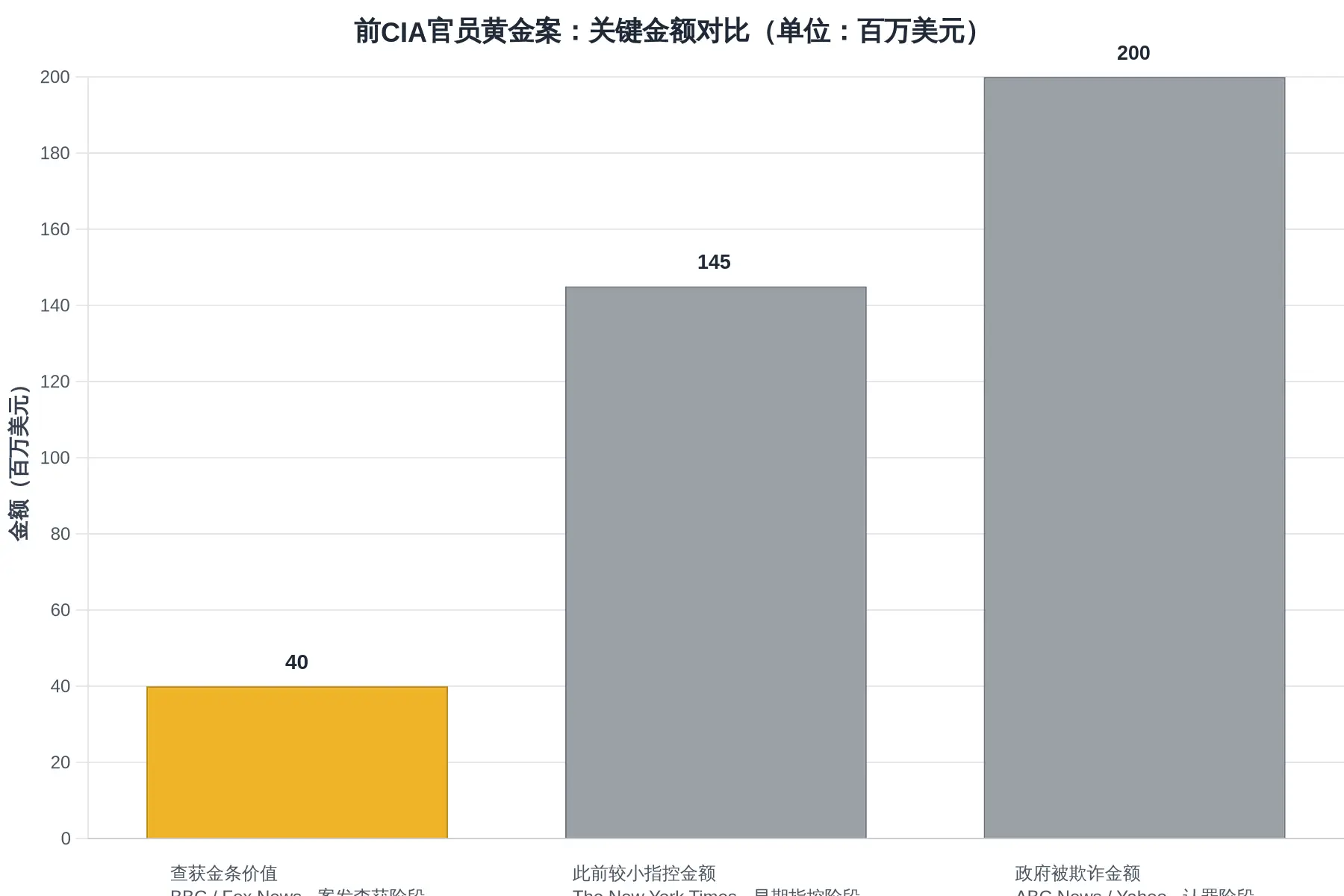
| Item | Amount | Source | Stage |
|---|---|---|---|
| Value of gold seized | about $40 million | BBC / Fox News / WJLA | search and arrest |
| Figure cited by The New York Times | about $145 million | The New York Times | plea |
| Amount the government says it lost | about $194 million (some outlets say nearly $200 million) | DOJ / Fox News / WJLA; ABC News / Yahoo News | plea |
The gold, roughly $40 million, is about a fifth of the roughly $194 million the government now points to. The $145 million that The New York Times reported sits below that figure as well. The estimate grew as investigators worked, and the gold stayed the same size. That gap is the story the numbers tell: the metal drew the cameras, but it was never the whole amount.
The case is a sequence, not a single moment. A tentative plea deal in September. A guilty plea in October. A sentencing hearing set for 28 January, on a charge that carries a maximum of 20 years. Look at the gap between the gold and the total, and you see how much of the scheme had nothing to do with gold at all.
For anyone who buys gold as a store of value, the story deserves a second look. The headline is about fraud, not about gold. The metal did not fail anyone here; a person did, and that distinction matters.
Physical gold bars work for wealth preservation because they sit outside the banking system, are portable, and cannot be inflated away. Those same traits make them appealing to people trying to hide money they should not have.
What the case reveals is a logic, not a verdict on the metal. Gold is a neutral tool. Its value to a retirement saver worried about uncertainty comes from scarcity and liquidity, not from whatever drama is in the news.
If you hold bars, the practical takeaway is unglamorous and useful: keep your records, buy from reputable dealers, store securely, and treat gold as one part of a diversified plan rather than a hiding spot. The news does not change what gold is for. It only shows why the details of owning it matter.

Gold turns up in stories about people who want to disappear from view. The instinct is less about greed than control: a brick of metal you can hold, hide, and trust.
Frequently Asked Questions
Who is David Rush?
David Rush is a former CIA officer at the center of a federal fraud case. He was a senior executive in the agency’s Directorate of Science and Technology, which builds technical collection tools, and he held a top secret clearance. He was arrested on 19 May 2026 after FBI agents searched his home in Ashburn, Virginia, and found hundreds of gold bars. He has since appeared in federal court on charges tied to defrauding the U.S. government, and on 6 October 2026 he pleaded guilty to wire fraud. Outlets including The Guardian, NBC News, and the BBC have reported on the case.
What was he accused of, and what did he plead guilty to?
Prosecutors accused Rush of a scheme that defrauded the government of approximately $194 million, according to the Justice Department, with other outlets reporting figures between $145 million and nearly $200 million. He pleaded guilty to wire fraud. As part of the plea he also admitted disclosing a clandestine human source, and top secret information, to a foreign government official. A tentative plea deal was reported in September, before the plea was formally entered in October.
Why were the gold bars such a memorable detail?
When Rush was arrested, authorities found 298 one-kilogram gold bars worth more than $40 million, along with about $2 million in cash and 35 luxury watches. Gold is compact, portable, and easy to trade, which makes it appealing to anyone trying to move or conceal wealth. That physical quality is why the gold bars, rather than the dollar figure, became the image people remembered.
What does this case mean for gold investors and precious metals buyers?
It is a reminder that gold is a neutral asset; its legitimacy depends on who holds it and why. Buy from trusted dealers, keep clear records of your purchases, and treat any scheme that uses gold as a cover story with caution. The metal is not the problem. The intent behind it is.
What the Gold Was For
Why gold bars? Not a number in a bank, not a wire, not a ledger entry in a shell company. Gold is the oldest way to make wealth feel real, and for someone who spent a career inside systems built on trust and classification, that tangibility is the point. There is no counterparty, no disclosure, and no one whose word stands between the owner and the money. Ordinary savers reach for the same thing at a smaller scale, for ordinary reasons. The metal was not the crime. It was how he chose to keep what he took.