
President Donald Trump named conservative commentator Katie Zacharia as the next White House press secretary on October 9. She replaces Karoline Leavitt, who stepped down at the end of August to spend more time with her family; Leavitt’s second child, a daughter, had been born in May. Zacharia comes to the podium after a short stint as a deputy assistant secretary for public affairs at the Department of Homeland Security and, before that, years of cable commentary for Newsmax.
The job inverts the one that made her name. On television, her task was to argue a position and hold it under attack. At the lectern, reporters ask the questions, and she is the one who has to answer them, follow-ups included, on the record.
Who Is Katie Zacharia?
Katie Zacharia is Trump’s pick for White House press secretary, the official who speaks for the administration in the daily briefing. Reporting since the announcement has filled in more of her background than the first stories did.
-
Conservative commentator and attorney. She worked as a commentator for Newsmax. She graduated from Pepperdine University in 2007 and from its law school in 2011.
-
A short stay at the Department of Homeland Security. Trump made her deputy assistant secretary of homeland security for public affairs in February 2026. She resigned the following month; CNN reported that she told an associate the commute from California to Washington was not sustainable.
-
Trump Media. She became a communications adviser to the Trump Media & Technology Group in June 2026 and was still in that job when Trump announced the appointment.
-
Age 41. She was born in 1984 or 1985.
-
Family. She married Tyler Zacharia, a film producer, in 2011. They have four children.
-
“Devoted fan.” That is how Trump described her in the announcement. In the same statement he called her “a loyal and brilliant supporter.”
-
She succeeds Karoline Leavitt, who left the job at the end of August 2026.
Earlier in her career she spent three years in Beijing as outside counsel for the World Bank Group and worked in the White House Office of Political Affairs during the George W. Bush administration. She later served as legal counsel to the political organization Fix California and on the advisory board of White Rose Resistance, an anti-abortion group.
Commentator and press secretary are different jobs, not just different titles. The table below sets out where they part ways.
| Dimension | Conservative Commentator | White House Press Secretary |
|---|---|---|
| Core goal | Win the argument; amplify a point of view | Represent the administration; deliver answers on the record |
| Primary audience | A loyal, like-minded following | The press corps, and through it the public |
| Daily actions | Critique, provoke, broadcast opinion | Brief, clarify, field and absorb questions |
| Reaction to pushback | Push back harder; reject the premise | Respond directly; defend and account for the record |
| Accountability | To an audience and a personal brand | To the President, the institution, and the public |
The telling difference is in the last row. A commentator’s work often ends when the segment does. A press secretary’s work begins when the questions come back.
The Central Contradiction
Zacharia is moving from a job that rewards attack to one that requires her to account for what she says. A commentator’s value lies in taking a position and defending it against critics; the format rewards conviction and speed. A press secretary stands in a more exposed spot: she takes questions from reporters and is answerable for whether the podium’s account is true. In the first role, Zacharia set the terms of the argument. In the second, reporters largely set them, and she is judged by how well her answers survive repeated follow-ups.
Zacharia has spent her public career on the asking side. The briefing room puts her on the answering side, the part she has practiced least. Whether she can make that switch is the question the next few months will answer.
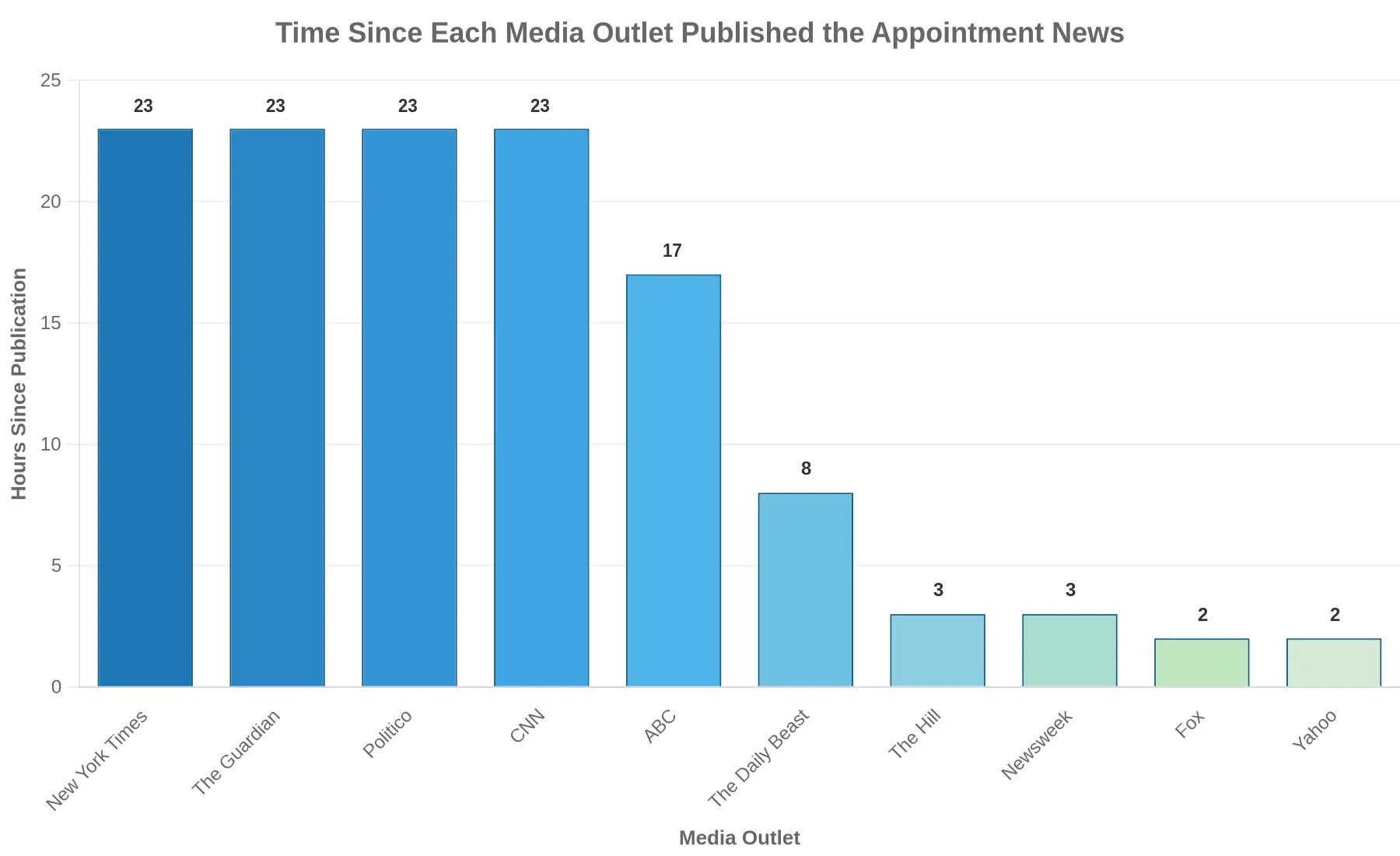
The chart above measures how recently each outlet published something about her, in hours. Four outlets — the New York Times, The Guardian, Politico and CNN — sit at roughly the 23-hour mark, meaning their most recent story was the original announcement. ABC follows at 17 hours. The Daily Beast is at 8, The Hill and Newsweek at 3, and Fox and Yahoo at 2. Read the other way, those shorter bars are not late arrivals but outlets still filing: since Friday’s announcement, The Daily Beast has published on her deleted posts and the Kalshi inquiry, Fox on her remarks about diesel and the midterms, Yahoo on her criticism of fellow Republicans, and Newsweek on her criticism of the Michigan Democrat Abdul El-Sayed.
The Frame Arrives Before the Briefing
The first headlines show how differently the same appointment can be framed. The Daily Beast went with “ICE Barbie Aide, 41,” sorting her into a familiar Trump-world cast before readers reached a single policy position. The Guardian borrowed Trump’s own wording, quoting his description of her as a “devoted fan,” which recasts the hire as a matter of loyalty rather than qualification. The New York Times and Politico stayed closer to neutral, calling her a “conservative commentator” who “briefly worked at the Department of Homeland Security.”
The three versions invite readers to see a cast member, an acolyte, or a credentialed outsider. Which one sticks may matter less than what she does with the podium. But the framing does point to the measure that will follow her: the distance between what she said as a commentator and what she has to defend now.
Two other stories landed in the days after the appointment. In public comments after the announcement, Zacharia criticized her own party and cast doubt on Trump’s polling numbers, telling Republicans they needed to do more (Yahoo News). She is taking a job defending a president whose approval ratings are soft while publicly pressing his party to sharpen its message.
Separately, The Wall Street Journal reported that Kalshi was examining suspicious trades placed shortly before Trump named her, and Kalshi confirmed it was investigating (WSJ; The Hill). Market activity ahead of a personnel announcement is not by itself evidence of wrongdoing, and the inquiry is ongoing, but it adds another thread to a transition that moved quickly.
She starts the job with a combative media record, an administration whose poll numbers are unsettled, and an unanswered question about how the announcement itself came together.

The hand goes up before the answer comes. That is the job now.
Frequently Asked Questions About Katie Zacharia
Who is Katie Zacharia?
Katie Zacharia is a conservative commentator and attorney who has been named White House press secretary. She worked as a commentator for Newsmax, spent a few weeks as a deputy assistant secretary for public affairs at the Department of Homeland Security in early 2026, and was a communications adviser to Trump Media & Technology Group when Trump announced the appointment on October 9. She graduated from Pepperdine University and its law school.
How old is Katie Zacharia?
She is 41. She was born in 1984 or 1985.
Who is Katie Zacharia’s husband?
Tyler Zacharia. They married in 2011, and he is a film producer whose credits include Young Washington, David and The Irishman. The couple have four children. Some early coverage left her marital status unclear, but The Independent and Business Insider have both reported the details.
Is “Katie Zachariah” the same person as “Katie Zacharia”?
Yes. “Katie Zachariah” is a common spelling variant that appears in search results, but the reporting consistently uses “Katie Zacharia.” Both searches point to the same person: the incoming White House press secretary.
Who is the new White House press secretary?
Katie Zacharia. Trump announced the appointment on October 9, 2026.
Who did she replace?
Karoline Leavitt, who left at the end of August 2026 to spend more time with her family. Her second child, a daughter, was born in May.
What did Katie Zacharia do before this job?
She was a Newsmax commentator and an attorney. She spent three years in Beijing as outside counsel for the World Bank Group, worked in the White House Office of Political Affairs during the George W. Bush administration, and later served as legal counsel to the political organization Fix California and on the advisory board of White Rose Resistance, an anti-abortion group. In February 2026 she became a deputy assistant secretary for public affairs at the Department of Homeland Security, resigning about a month later, and in June 2026 she became a communications adviser to Trump Media & Technology Group.
Why are people searching for her now?
A cable-news face moving into the briefing room draws attention on its own, and the details around this appointment added to it: the quick exit from the Department of Homeland Security, the Kalshi inquiry into trades made before the announcement, and early reports that disagreed about her personal life. The confirmed facts are narrower than the volume of coverage suggests.
What to Watch Next
A few things will show whether Zacharia can make the shift from commentator to press secretary.
- How she handles the daily briefing, where she has to answer questions rather than deliver an argument from a safe distance.
- What happens when old clips resurface, as they already have, and reporters press her on them.
- Whether the press operation changes its tone, its pace, or how much access it grants under a new voice.
- Where the Kalshi inquiry leads, and whether the White House says more about how the pick was made.
The open question is not whether Zacharia can argue; her record suggests she can. It is whether someone whose instinct is to push back can also absorb a question and answer it. A sharp rebuttal can end a television segment. At the podium, a deflected question usually produces three more.
The test will not be the set pieces of her first week. It will be the smaller moments, and whether the briefings start to look less like a debate she is trying to win and more like a conversation she is having with the people asking.