At 12:56 p.m. local time on Friday, October 9, a magnitude 7.7 earthquake broke beneath the Azuero Peninsula in southern Panama. The U.S. Geological Survey put the epicenter near Pitaloza Arriba, in Herrera Province, about 12.6 kilometers down. It was shallow, and strong enough to be felt across Panama, in Costa Rica, and in several Colombian cities. Panama’s National Civil Protection System estimated that 4.5 million people felt the shaking.
The mainshock was only the start of it. At 3:25 that afternoon a magnitude 6.6 aftershock struck, the largest in a sequence that passed 80 recorded tremors within a day and more than 100 by the weekend. Seismologists at the University of Panama said most were too weak to feel, though several reached magnitude 5.8, 5.5, and 5.2.
By Saturday the damage was clearer than the first bulletins suggested. A hotel and several homes collapsed in Tonosí. A government building, a church, and the Dos Continentes hotel partially collapsed; the Iguana Mall took minor damage. Nationwide, officials counted at least 142 damaged homes, four residential buildings, 188 schools, 20 health facilities, 26 government buildings, 13 churches, seven hotels, nine bridges, and multiple road sections. Power failed in six provinces. Tocumen International Airport halted operations while crews inspected its runways and terminals. In Veraguas, the towns of Arenas, El Cacao, and Quebro were cut off after roads caved in. At least 27 people were injured, 17 of them in Coclé. No deaths had been confirmed by Sunday, when President José Raúl Mulino declared a state of emergency.
Reuters had reported early on Friday that the country was shaken but had avoided major destruction. By the weekend that framing no longer fit. Between “no confirmed deaths” and “significant damage” sat the thing that shaped the next two nights: a great many people whose homes were still standing, but whose confidence in them was not.
| Category | Details |
|---|---|
| Main shock magnitude | 7.7 (USGS moment magnitude) |
| Date and time | Friday, October 9, 2026, 12:56 p.m. local (17:56 UTC) |
| Epicenter | Near Pitaloza Arriba, Herrera Province, on the Azuero Peninsula |
| Depth | 12.6 km |
| Largest aftershock | Magnitude 6.6, about two and a half hours later |
| Areas affected | Panama; also felt in Costa Rica and several Colombian cities |
| Tsunami warning | Issued for Panama’s Pacific coast, Colombia, Ecuador, and much of the Central American Pacific coast; lifted the same day |
| Damage | Collapsed buildings in Tonosí; at least 142 homes, 188 schools, and 20 health facilities damaged nationwide; power out in six provinces |
| Casualties | At least 27 injured; no deaths confirmed as of October 11 |
| Government response | State of emergency declared by President José Raúl Mulino |
| International aid | U.S. Southern Command and State Department; Red Cross/IFRC; rescue teams from Los Angeles County and Fairfax County, Virginia |
Why People Chose to Sleep in the Streets
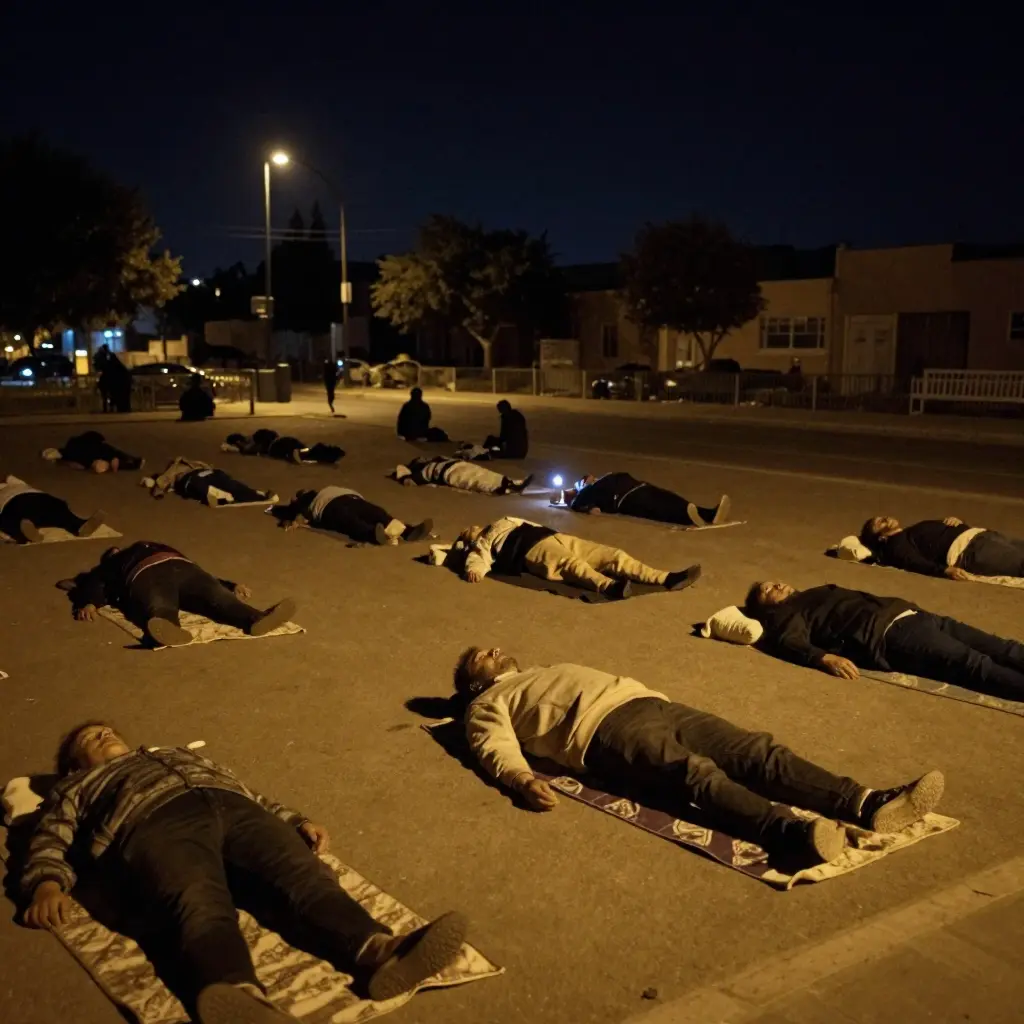
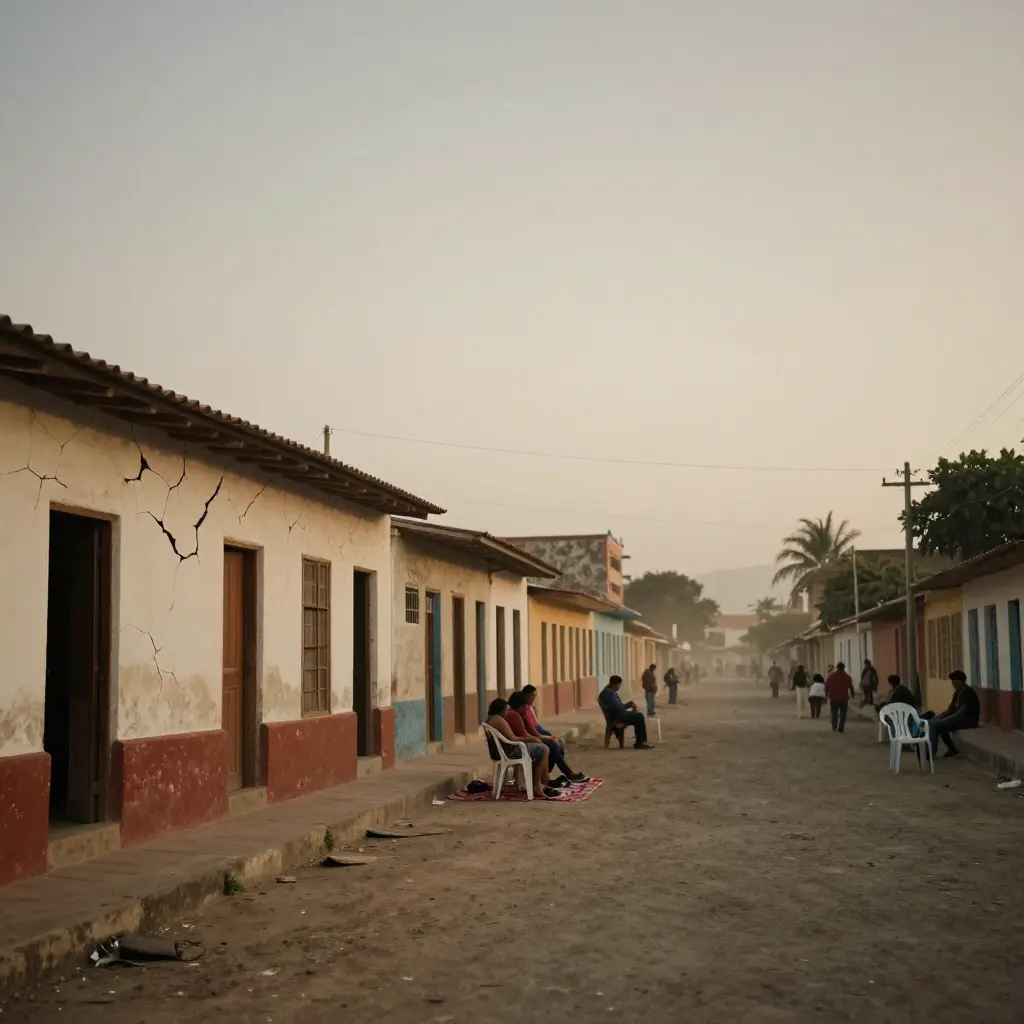
The pictures from the Azuero towns were striking. Families dragged mattresses, plastic chairs, and sheets into plazas, parking lots, and the middle of streets, and settled onto the pavement for the night. From a distance it looked like panic. It was closer to arithmetic. The ground was still moving, no one had checked their building, and a tsunami warning had been in force for hours.
The aftershocks kept coming
Aftershocks follow a rough pattern. They arrive in a burst right after the mainshock, then thin out over days, weeks, or months, and they do not stop on a schedule. Panama’s sequence held to that shape. More than 40 tremors of magnitude 4.5 or larger were logged in the first 30 hours, clustered around the same patch of the Azuero Peninsula, and they kept coming through the weekend.
Each new jolt did two things to anyone indoors. It confirmed that the fault was still active, and it reset the question of whether it was over. That is hard to sleep through. You can rest in a quiet house; you cannot rest in one that keeps announcing it might not stay quiet.
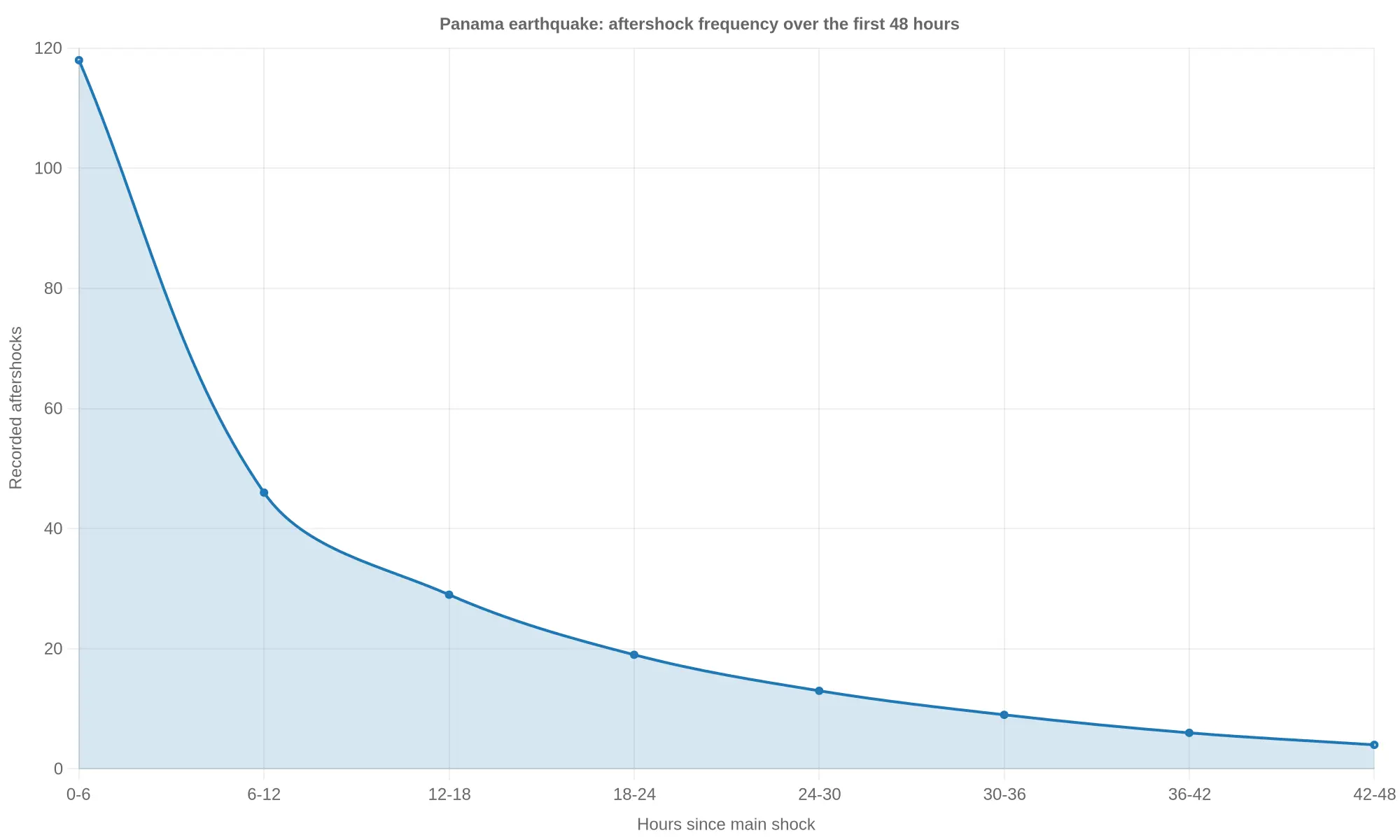
How an aftershock sequence typically decays: a spike at the start, then a long tail. Exact counts vary by location and how close the nearest monitor is.
Nobody had checked the buildings
Damage is something you can inspect. Structural safety, on a dark street with no engineer around, is not.
A wall that looks intact can hide a crack. A ceiling that held once may not hold twice. Most residents had no way to judge, in the dark, whether the building they slept in was still sound, and no engineer had come down their street with an answer. Officials had counted hundreds of damaged structures by Saturday, but they had not gone door to door through every neighborhood.
Faced with that, people fell back on the one option that removed the uncertainty: open ground. That is not an overreaction to a crack you cannot see. It is what you do when you cannot rule the crack out.
The tsunami warning changed what “inside” meant
Before the quake, indoors meant shelter. Once a tsunami alert is up, it can mean sitting in the wrong place.
The warning covered Panama’s Pacific coast and reached as far as Colombia and Ecuador. It was lifted later that same day, but by then it had already moved people. In Los Santos province alone, about 300 residents were evacuated over fears of a wave. Coastal families went inland or uphill and stayed there. A warning does not have to become a wave to change where a person sleeps.
Indoors became the wrong side of the risk
An earthquake turns the things that shelter you into the things that can fall on you. That is the plain logic behind a night outside: remove the overhead variable entirely.
- No ceiling, no beams, no wardrobe to come down in the dark.
- No stairs or doorway to find your way through while the floor is moving.
- Neighbors together, watching one another’s homes and children.
None of that is a plan for a week. It is a plan for the hours when the information is bad and the aftershocks have not stopped.
A defensible calculation
It is tempting to read images of people sleeping on pavement as an overreaction. The evidence points the other way. When the ground is still shaking, the buildings have not been checked, and the last official message mentioned a tsunami, sleeping outside trades some discomfort for the removal of the worst outcome. That is what a risk calculation looks like when the numbers are missing.
Why a Tsunami Warning Was Issued at All
Six minutes after the mainshock, at 18:02 UTC, the U.S. National Weather Service issued a tsunami warning covering Panama’s Pacific coast along with Colombia, Ecuador, and much of the Central American Pacific shoreline. It was lifted later that day. The U.S. West Coast was never under threat.
The warning was precautionary, and the geology explains why agencies erred toward caution. This was a shallow, strike-slip earthquake on land, the kind that usually produces little or no tsunami, because the ground moves sideways rather than lifting a column of water. But the magnitude was 7.7 and the epicenter sat close to the coast. Waiting to confirm the wave is not an option when a coastline is minutes away. The cost of a false alarm is a few disrupted hours. The cost of missing a real wave is not comparable.
For people on the coast, the alert was an instruction, not a headline. They moved inland or uphill and stayed off the shore until it was lifted. A tsunami from a nearby quake can arrive within minutes, and it often comes as a series of surges rather than one wave, with later surges larger than the first. By the time a wave is visible, the time to leave has usually passed.
The Response, at Home and Abroad
The first useful thing any government can provide after a quake is an honest answer to a simple question: how bad is this? Panama’s answer arrived over two days, and it changed as crews reached more places.
Outside help
U.S. Southern Command, which oversees American military operations across Central and South America and the Caribbean, said it delivered relief supplies and deployed personnel and aircraft to support Panama’s response. The State Department said it had mobilized an immediate response. The Red Cross Society of Panama and the International Federation of Red Cross and Red Crescent Societies began distributing humanitarian assistance, and search-and-rescue teams from Los Angeles County and Fairfax County, Virginia, were sent to the country.
Panama’s own accounting
The Panamanian government’s tone stayed measured even as the damage count rose. President Mulino declared a state of emergency and visited the hardest-hit towns. Authorities reported the Panama Canal safe, and early loss estimates ran into the billions of dollars. The country had taken a serious hit; it had not, so far, suffered the mass-casualty event that a 7.7 near a population center can produce.
What officials put out, and when
- U.S. Southern Command confirmed the delivery of relief supplies and the deployment of aircraft and personnel.
- A tsunami warning was issued for Panama’s Pacific coast, Colombia, Ecuador, and much of Central America’s Pacific shoreline, then lifted the same day.
- Panama’s civil protection agency and the University of Panama kept publishing aftershock counts as the sequence continued.
- Local authorities repeated the same message through the weekend: the shaking was severe, the aftershocks were ongoing, and damaged buildings should not be reoccupied until they were checked.
If the Ground Moves Again
Panama sits on an active plate boundary, and the aftershocks from this event will continue for weeks or months. If you live in the region, are visiting, or have family there, a short list of habits does more good than a long one.
During the shaking
- Drop, cover, and hold on. Get under a sturdy table, protect your head and neck, and stay away from windows and tall shelves until the shaking stops. Running outside mid-shake is how a lot of injuries happen.
- Skip the doorway. The old advice to stand in a doorframe is outdated. If you are in an elevator, get out at the nearest floor.
- Keep a flashlight where you sleep. Power cuts out, and broken glass makes dark floors dangerous.
If a tsunami warning is issued
- Move inland and uphill, on foot if the roads are jammed. Cars stuck in traffic near the coast are the worst place to be.
- Do not wait to feel it first. Treat the warning as real and go.
- Stay off the shore until officials give the all-clear. The first surge is not always the largest, and surges can arrive over several hours.
- Know whether you are in an evacuation zone. Coastal areas near Panama City, the Canal, and the offshore islands are the ones most likely to be told to leave.
Keep a small, real emergency kit
- Water and food for at least three days – about a gallon of water per person per day, plus food you will actually eat.
- A battery or hand-crank radio for official updates when the phone network is down.
- Medications, first-aid supplies, and copies of IDs in one waterproof bag.
- Cash in small bills, because card readers and ATMs fail when the power does.
- Charged power banks. Text messages often get through when calls do not.
Check your building before you sleep in it
- Look for new cracks, doors that no longer close, or walls that lean. Anything that changed shape needs a professional look.
- Leave if you smell gas or see sparks, and do not flip switches on the way out.
- Sleeping outside or with neighbors for a night or two is a judgment call, not a failure. If you do not trust the building yet, do not sleep in it.
Plan how you will reach each other
- Pick one out-of-town contact everyone calls or texts. Local lines overload first.
- Agree on two meeting points – one near home, one farther away in case the neighborhood is closed off.
- Put the plan on paper and keep it in your kit and your wallet. Phones die.
- Walk your evacuation route once, so you know it in the dark.
Frequently Asked Questions
How strong was the earthquake?
The USGS reported a moment magnitude of 7.7, with a second quake of magnitude 6.6 about two and a half hours later, followed by more than 100 aftershocks. Some early bulletins listed it as 7.5 or 7.6, which is normal in the first hours as seismic readings are reviewed. For the current figures, check the USGS and Panama’s civil protection agency.
Why was a tsunami warning issued for an earthquake on land?
Because the warning has to be issued before anyone can know. The quake was large and close to the coast, and waiting for confirmation would leave no time to evacuate. A warning that is lifted without a damaging wave is not a false alarm; it is the system working as designed. A lifted warning also does not mean it is immediately safe to return to the water, so follow local guidance.
Will there be more aftershocks, and how long will they last?
Yes. A quake this size typically produces aftershocks for days to months, with the frequency generally declining over time. Occasionally a strong aftershock follows, as the magnitude 6.6 did here. Shaking in the coming weeks is expected, not a sign that something new has begun.
Why did so many people sleep in the streets?
Mostly because they could not get a straight answer about whether their homes were safe. Aftershocks kept the ground moving, the tsunami warning had pushed coastal residents inland, and no engineer had inspected most buildings. Sleeping outside removed the question.
Was there major destruction?
There was significant damage: collapsed and partially collapsed buildings in Tonosí, hundreds of damaged homes and schools, power outages in six provinces, and roads cut in Veraguas. No deaths had been confirmed as of Sunday. Early assessments can still change as crews reach remote areas.
Where can I get reliable updates?
The USGS publishes the earthquake data and aftershock lists. Panama’s National Civil Protection System issues local guidance. For anything safety-related, use official sources rather than social media.
What the Night in the Streets Actually Says
The earthquake did real damage: buildings down in Tonosí, hundreds of homes and schools cracked, roads cut, power out across six provinces. As of Sunday, no deaths had been confirmed, though crews were still working through remote areas.
What the nights that followed showed is narrower. A warning system that errs toward caution moved people off the coast. An aftershock sequence that would not stop kept them from trusting walls nobody had inspected. When both of those are true, sleeping on the pavement is not hysteria; it is what people do when the information is incomplete and the cost of being wrong is high.
The practical lesson is not to prepare for a night outside. It is to make the next decision easier: know your evacuation zone, keep a bag ready, and get your building checked before you have to choose whether to sleep in it.