After nearly a decade of delays, Tesla finally put its next-generation Roadster on a stage. The debut was billed as a “flying” one. Tesla says the car reaches 60 MPH in under a second, and Musk brought SpaceX into the story, tying the machine to the rocket company he also runs.
So the car exists and the demo happened. Whether it should exist as a car is the harder question. Once a vehicle lifts off the road, it stops being only a car. It becomes something else, governed by rules nobody has finished writing and expectations nobody has settled.
That is the tension worth sitting with. Not whether Tesla can build it, but whether a car should fly at all.
So Is Any of It Actually Real?
Before arguing over whether a car should fly, it helps to separate what has been reported from what is still guesswork. Some of what you have seen is on the record. A lot of what is swirling around is not.
What we can reasonably confirm
- Multiple outlets – including CNBC, NBC News, Fox Business, The Wall Street Journal, and Barron’s – reported that Tesla unveiled its next-generation Roadster in what several described as a “flying” debut.
- Several of those same reports place the reveal after nearly a decade of delays.
- The New York Post reported that owners of the new “flying” Roadster may need more than a standard driver’s license to operate it.
- Fox Business reported the car hitting 60 MPH in under a second. Treat that as the outlet’s description of the demo, not a number we can verify ourselves.
- Investors.com reported that Tesla’s stock popped on the demo but didn’t hold the gain, and that Elon Musk cited a SpaceX collaboration.
What’s still unverified
- Whether the “flying” demonstration points to a feature you will actually be able to buy, or to a one-off showcase, isn’t clear from the reporting so far.
- No confirmed production price, release date, or regulatory path exists that we can point to.
- The word “flying” is doing heavy lifting. Coverage describes a demo, not an FAA-approved aircraft or a road-legal flight capability.
So “is this real?” has a mixed answer. The event happened and the coverage is real. The bigger claims – that this is a car you can own and fly – are still up in the air.
The table below collects what Tesla and Musk have said about the next-gen Roadster, what people keep asking, and where each item actually stands.
| Item | Known / Official Claim | Common Public Question | Status |
|---|---|---|---|
| 0-60 mph | Under 1 second, per Musk | Is sub-1-second even possible on the street? | Claimed, unverified |
| Price | Around $200K, plus base reservation | How much will it really cost at launch? | Stated earlier, likely changed |
| Release date | Roughly a decade of delays; 2026 demo | When can buyers take delivery? | Repeatedly delayed, unconfirmed |
| Flying ability | Shown “flying” at the 2026 event | Is the video real? Can it truly fly? | Demonstrated, real use unclear |
| SpaceX tie-in | Musk cites SpaceX collaboration | What exactly does SpaceX supply? | Mentioned, details unconfirmed |
| Legal / license | Regulators still catching up | Will owners need more than a driver’s license? | Open question, unconfirmed |
The Part Nobody Demos
A car lifting off a stage makes a great visual. What it is not is a vehicle you can legally drive or fly on an ordinary Tuesday.
Between “the engineers showed it working” and “you can own one” lie two legal worlds that have spent a century carefully not talking to each other.
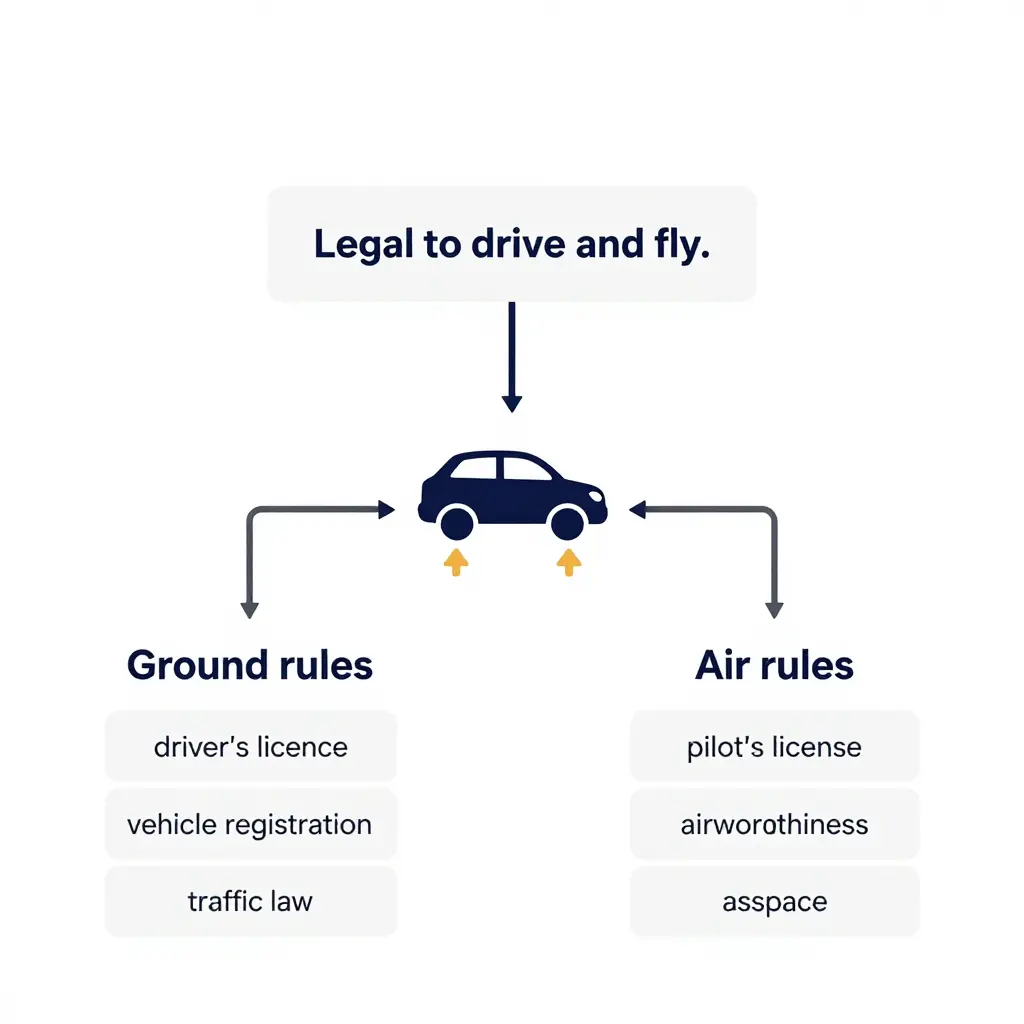
Two Rulebooks, One Machine
Ground vehicles answer to traffic law: licensing, registration, crash standards, and the DMV counter where ordinary people get permission.
Aircraft answer to a different authority entirely – airworthiness, pilot certification, flight rules, and the coordination of shared airspace.
A flying car sits on both desks at once. That is not a feature. It is the friction.
When reports suggest the new Roadster might require more than a driver’s license, that is the polite version. Depending on how a vehicle moves between road and sky, regulators may treat whoever is at the controls as a driver, a pilot, or both at different moments, each with its own tests, paperwork, and standards.
The Certification Path Is a Marathon, Not a Reveal
Certifying an aircraft is slow, deliberate, and expensive. It rewards patience and documentation, not launch-night spectacle.
An automaker built for over-the-air updates and fast iteration is not naturally built for that process. Neither is a buyer used to driving off a lot the same afternoon.
Then there is the classification question. A vehicle designed mainly to hop might steer clear of full aircraft certification while still being far too airborne for ordinary road rules. Nobody has cleanly settled where that line sits, and the line matters more than the horsepower figure.
Who’s Liable When It’s Half Car, Half Aircraft
Liability splits along the same fault line. A ground collision pulls in auto insurance and state traffic law. An aviation event pulls in a different rulebook, a different investigation culture, and often a different court’s logic.
A single incident could belong to both. Insurers dislike that ambiguity. So do courts.
You don’t have to imagine a specific crash to see the shape of the problem. The question is simpler: which rulebook do you open first, and who decides? That answer is still being written.
The Demo Is the Easy Part
Demonstrations get to skip the boring chapters – the licensing, the insurance, the airspace coordination, the sign-off nobody claps for. A stage is not a road. A brief hop is not a certificate.
None of this means the technology is fake. It means the part that would make it usable has barely started.
That is the gap worth watching: not whether a car can fly, but whether anyone has decided what it legally is.

Before any vehicle is allowed to leave the ground, it has to earn the right to. Airspace comes with rules, altitude comes with paperwork, and certification comes before the demo.
Where Tesla Fits in the Electric Flight Race
Tesla’s Roadster demo didn’t happen in an empty room. It dropped into a space that is already crowded, unevenly funded, and loosely defined, where nobody fully agrees on what “flying car” even means and the finish line keeps moving.
A day of headlines explains the confusion. One says the Roadster “flies” and hits 60 mph in under a second (Fox Business). Another asks whether owners might need a pilot’s license rather than a driver’s one (New York Post). A third says the obvious discomfort out loud: A Tesla Flying Car? I Don’t Know, Man (Wired). And the stock? It jumped on the demo, then gave most of it back (Investors).
That whiplash is the point. The race breaks down into a few lanes, and Tesla sits in an awkward one.
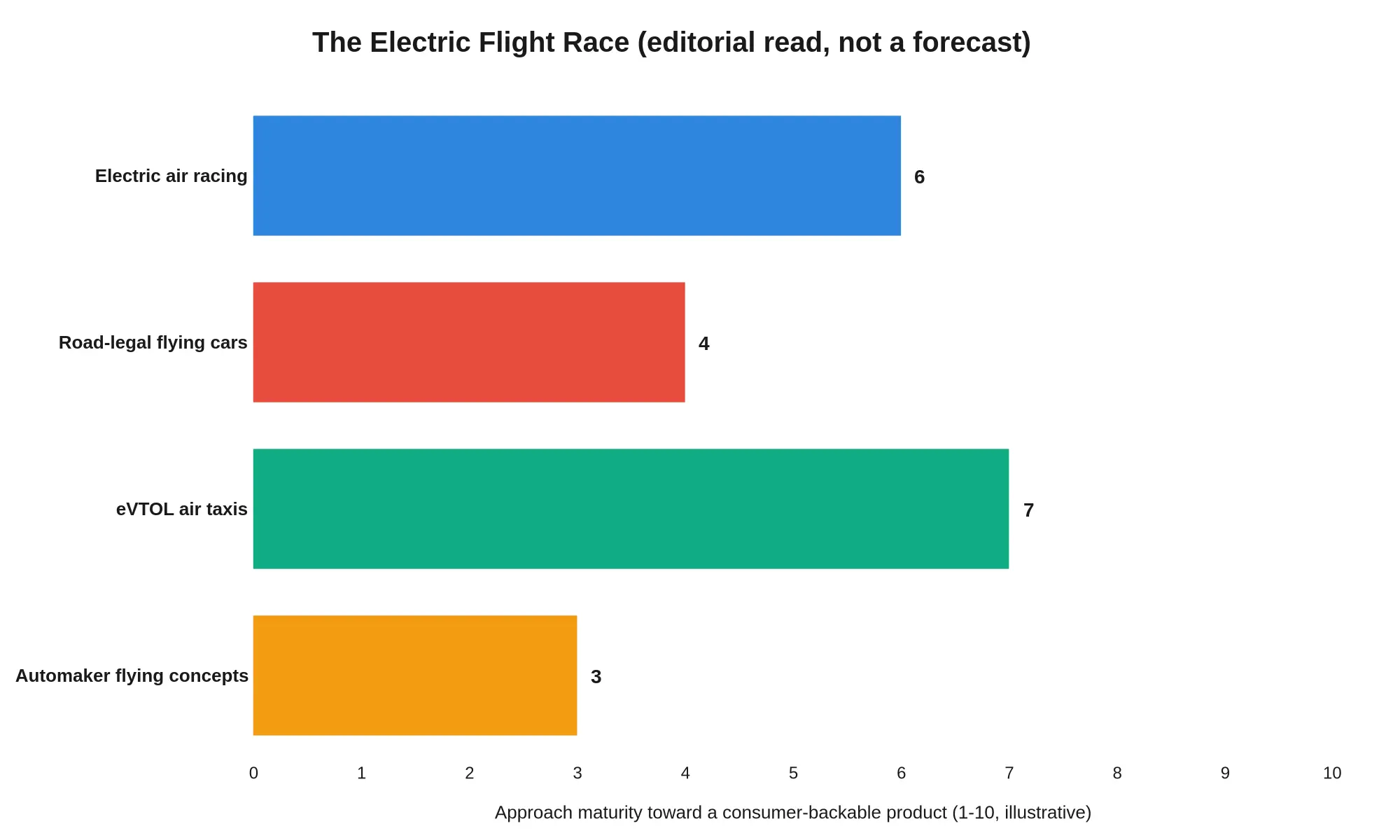
The race has more than one lane
- Electric air racing is the closest thing to a working product. Airspeeder runs a flying-car racing series and is preparing its first crewed season, and its newest addition is telling: DeLorean Motor Company joined the International Series as its first American constructor, with the 2026-27 season opening in November. A legacy name, borrowed nostalgia, a real calendar of events.
- Road-legal flying cars are where Tesla and the Roadster live, and where the word “flying” does the most marketing work and the least technical work. Alef and PAL-V have chased this for years with modest results.
- eVTOL air taxis (Joby, Archer and peers) are the quiet, unglamorous favorite. They don’t sell the fantasy of your driveway lifting off; they sell certification, routes, and operators.
- Automaker flying concepts (Toyota, Hyundai, XPeng and others) mostly stay in concept-video territory, and that is fine, because concepts are cheap and press cycles are free.
The chart above is an editorial read on which lanes look closest to something a customer could actually back, not a forecast – just a way to see the spread.
Legacy names vs. new players
The DeLorean news is the useful contrast here. The revived marque enters electric flight as a constructor, but its first season is mostly livery: DeLorean-styled race aircraft built on Airspeeder’s standardized Mk3C platform. From the 2027-28 season, its engineering role expands, working with university teams including UC Berkeley and Georgia Tech on future aircraft. That is a low-risk way to look futuristic without owning the hardest parts.
Startups like Airspeeder, Joby, and Archer take the opposite trade: they carry the certification burden and the capital risk, and they own the credibility if it works.
Tesla is doing something stranger than either. It is a legacy-scale company acting like a startup, leaning on its own brand and a claimed SpaceX collaboration (Investors) to imply capability, without publishing the regulatory path that the air-taxi crowd treats as its whole business.
What this means for Tesla
- The contest isn’t really about flight. It is about who gets to define the category while the rules are still unwritten. Racing series and eVTOL firms are writing those rules; Tesla is writing headlines.
- Certification is the moat. Air racing and air taxis live inside FAA and EASA frameworks. A “flying” Roadster that privately bumps into licensing questions (per the pilot’s-license reports) tells you the hard part has not been finished, only deferred.
- Delays are now part of the story. After nearly a decade of waiting (WSJ), every new claim carries a discount. DeLorean’s racing debut is small, but it is real and dated; that contrast is unkind to vaporware.
- Tesla’s edge is narrative and capital access – the ability to make the whole industry react to one demo. Its risk is the same: reacting isn’t competing, and attention decays fast, as the fade in TSLA showed.
The bottom line
Tesla didn’t enter a race so much as a conversation, and it is very good at that. But the electric flight space is quietly sorting itself into two kinds of players: those building certification and those building anticipation. DeLorean just picked the first role. Tesla, for now, is still auditioning for the second.
| Camp | Representative players | What they’re really selling | Regulatory reality |
|---|---|---|---|
| Electric air racing | Airspeeder, DeLorean | Spectacle, brand revival | Crewed series, defined venues |
| Road-legal flying cars | Tesla Roadster, Alef, PAL-V | Halo car, the “what if” | Unsettled; licensing questions |
| eVTOL air taxis | Joby, Archer | Certified transport | Deep FAA/EASA pipelines |
| Automaker concepts | Toyota, Hyundai, XPeng | Imagination, PR | Mostly pre-certification |
What People Actually Feel About a Flying Roadster
The demo landed, the clips went viral, and the reaction split the way you would expect when a car grows wings. Curiosity leads, excitement trails just behind, and a smaller but vocal group stays skeptical. These are relative impressions, not measured data.
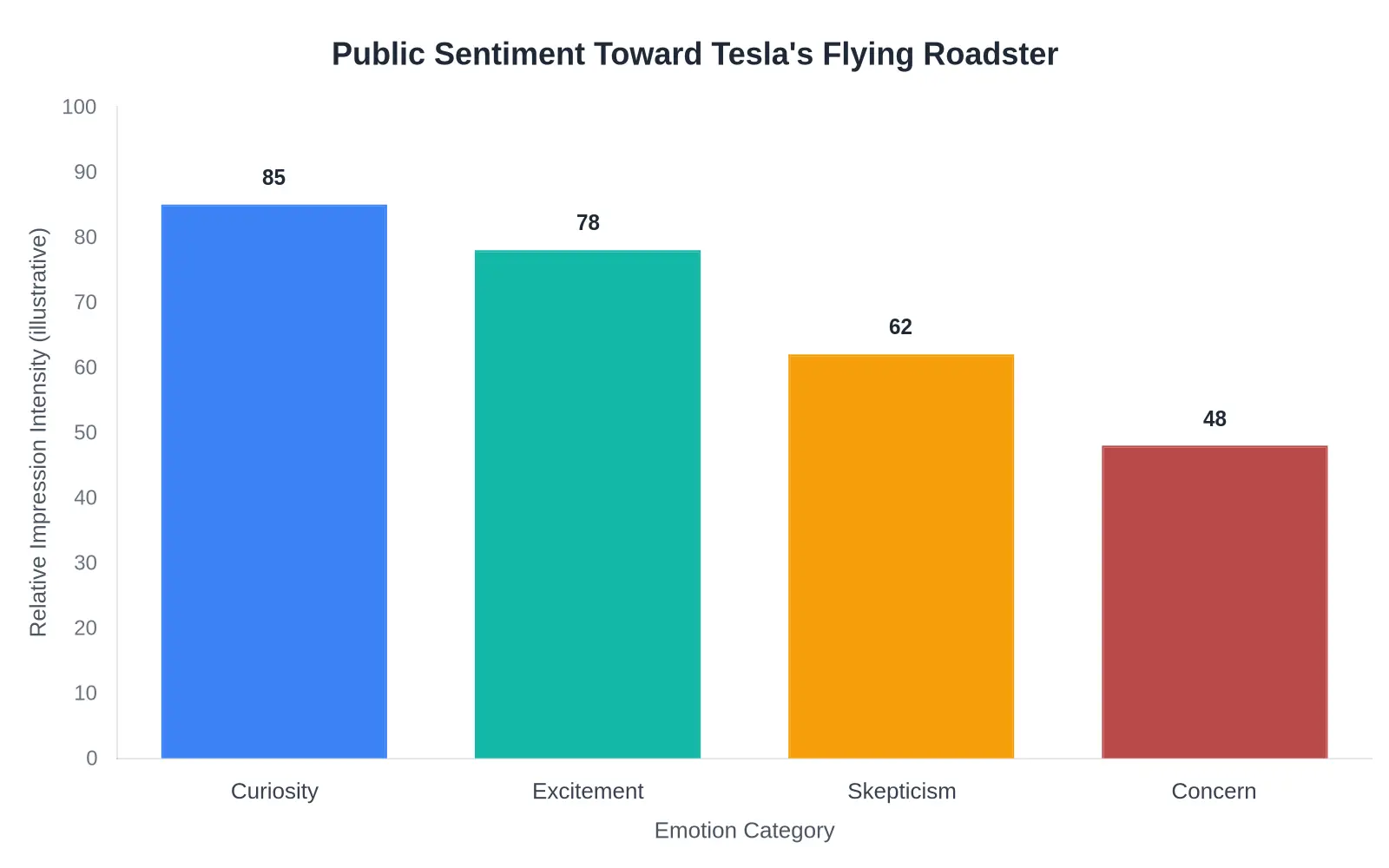
| Emotion | Relative Strength (illustrative) |
|---|---|
| Curiosity | 85 |
| Excitement | 78 |
| Skepticism | 62 |
| Concern | 48 |
How to read this
This is not a poll. It is an impressionistic summary built from search-term patterns (“can the Tesla Roadster fly”, “is the Tesla flying car real”) and from how news coverage framed the reveal. Treat the numbers as directional signals, not statistics. The two questions doing the heavy lifting online – can it fly, and is it real – sit at the heart of both the curiosity and the skepticism bars, which is why they are nearly as loud as the excitement.
A few caveats worth stating:
- Categories are broad and overlap. Someone can be curious and skeptical at once.
- Coverage skews toward launch-week energy; sentiment often cools after the spectacle fades.
- Values are capped at four emotions on purpose, to keep the signal readable rather than exhaustive.
So, Should a Car Fly at All?
I watched the Roadster lift off, hover, and settle back down, and my honest first thought was not “wow” but “why.” Not why build it, exactly. Why did anyone decide that the missing piece of the car was the sky?
There is a difference between a machine doing something remarkable and a machine doing something we actually need. The demo was the first. It does not automatically become the second.
Engineering spectacle is not a travel need
A car that hops, a car that skips over a pothole, a car that briefly leaves the road and lands again: that is a capability. It is fun to watch, and it says a lot about what the engineers pulled off. But capability is a starting point, not an argument. Rockets are capable, and we don’t commute in them.
The Roadster has spent the better part of a decade in the “still coming” pile. When something finally appears after that long, the instinct is to treat every new trick as inevitable progress. I would slow that down. The fact that it can fly tells me what it can do. It doesn’t tell me whether I should want it to.
Does flying solve a real problem, or just move it around?
Traffic is the obvious justification, and it is a real frustration. But congestion is a two-dimensional problem solved by density, timing, and planning. Lifting it into a third dimension doesn’t remove the jam; it relocates it to a space with no lanes, no shoulders, no traffic lights, and almost no tolerance for error.
Making a car airborne doesn’t create open sky. It creates demand for airspace rules, flight corridors, and a regulator that suddenly has millions of new vehicles to track. The Wired headline essentially shrugged at the whole thing, and that reaction is telling. The sky isn’t empty real estate waiting for us. It is a managed, crowded environment that a single new category of vehicle can’t casually join.
| What flying promises | What it quietly adds |
|---|---|
| Escape from traffic | New rules for shared low-altitude airspace |
| Point-to-point freedom | Noise, and neighbors who notice it |
| A shortcut over obstacles | Energy spent lifting mass instead of moving it |
| Novelty and prestige | Training, licensing, and liability |
None of these are dealbreakers on their own. Together, they describe something other than a simpler commute.
The cost of defying gravity
Lifting a car off the ground costs far more energy than rolling it. Wheels fight friction. Rotors and thrust fight gravity itself. That gap doesn’t disappear just because the battery is big. It shows up in range, in price, and in everything you give up to make one trip possible.
Then there is access. Reporting already suggests owners of a flying Roadster may need more than a driver’s license to operate it. That single detail changes who this car is even for. A car you need to be trained and certified to “drive” is drifting away from the whole idea of a car, which is the one machine almost anyone can use to get to work.
And the price. A limited, exotic Roadster was never going to sit in everyone’s driveway. That is fine, but it does mean the flying feature is not solving a universal pain point. It is solving a very specific, very wealthy one.
If it flies, is it still a car?
This is the part I keep circling back to. A car is a set of promises: you sit in it, you steer it, you park it, and you own it the way you own a bicycle. The moment it needs airspace clearance and a pilot’s credential, those promises break. What is left is a light aircraft wearing a car’s silhouette.
That isn’t a flaw. It might be the most interesting thing about the project. But we should be honest about the category. Calling it a flying car lets us keep the comfort of the word “car” while the thing itself has already left that definition behind.
What the Roadster actually tells us
The question in the title isn’t really technical. It is about whether the sky is the right answer to a problem that mostly lives on the ground. My read: for the daily school run, no. For a handful of people and a lot of headlines, maybe. And as a way to prove what Tesla and SpaceX can engineer together, sure, that part works.
So should a car fly? Not because it can. If it flies, it should be because someone somewhere has a trip that genuinely needs the sky, and a person willing to accept everything that comes with it. Otherwise it is a stunt with a very good marketing budget, and there is nothing wrong with saying that out loud.
FAQ: The Tesla “Flying” Roadster, Answered Straight
Is the Tesla flying car actually real?
Partly, and the distinction matters. Tesla did stage a reveal event and put a next-generation Roadster in the air, and major outlets covered it. So the car is real and the demo is real. What is still open is what “flying” means here. Coverage describes a brief lift-off and hover during a controlled demo, not the sustained, free flight you would expect from an aircraft. Think of it as a demo moment, not a car you can buy and fly today.
Was the Roadster flying video real?
The footage shown at the event appears to be genuine Tesla demo footage, not a CGI hoax, since several outlets reported on the same happening. But “real video” and “a real flying car” are not the same claim. The video shows what Tesla chose to show. Independent, unedited proof of sustained flight has not been confirmed, and some coverage was openly skeptical. Short version: real footage, unproven capability.
Can the Roadster actually fly?
Not in any way you could use for a road trip, at least not that has been confirmed. The demo showed a lift-off and hover. Whether it can climb to real altitude, travel a distance, and land safely again and again is still to be confirmed. It has been demonstrated, not verified for everyday flight.
How much will the Tesla Roadster cost?
Unconfirmed. Tesla has not published a final, official price for this Roadster. Earlier talk floated figures in the six-figure range, but those numbers predate this demo and should not be treated as the real price. Wait for an official number.
When will it be released?
Also unconfirmed. The Roadster has been teased and delayed for nearly a decade, and this week’s event was a reveal and demo, not the launch of a car you can order. No firm, verified date has been given. Treat any specific date you see circulating as unconfirmed until Tesla says otherwise.
Do you need a pilot’s license?
Possibly, and that is a big “possibly.” One report suggests owners may need more than a standard driver’s license to operate it, which lines up with the idea that anything genuinely leaving the ground falls under aviation rules. Regulators have not issued a confirmed requirement yet. For now, treat license rules as reported, not official.
Quick reference
| Question | Status |
|---|---|
| Is the flying car real? | Real demo; real flight capability unconfirmed |
| Is the video real? | Real footage shown at Tesla’s event |
| Can it actually fly? | Lift-off demonstrated; sustained flight unconfirmed |
| Price | Unconfirmed |
| Release date | Unconfirmed |
| Pilot’s license required? | Reported as possible; not officially confirmed |
If you came here for a clean yes or no, the honest answer is that the show was real and the product is not yet. That gap is worth holding onto before anyone starts reworking their driveway.
Where This Leaves the Roadster
The Roadster Musk rolled out in October 2026 does fly, briefly and theatrically, and it left the room buzzing while the skeptics kept squinting. After nearly a decade of delays, that alone is something to witness. But watching it doesn’t answer the question the demo raised. A car that hops, floats, or pulls off a short aerial stunt is still a long way from a car that flies as a matter of routine.
My honest read: the interesting part isn’t whether Tesla can make a Roadster leave the ground. It is whether flying belongs in a machine people drive every day. Aircraft and cars obey different physics, different rules, and different ideas about who is allowed to operate them. Reports that owners may need more than a driver’s license point straight at that tension. The engineering can be impressive and the question can still stay open.
The things worth watching are quieter than the launch event. How will the FAA and other regulators treat a vehicle that blurs the line between road and sky? How much of the promised performance survives into the version customers actually receive? And can Tesla build these at a pace that means anything beyond a few showroom moments? DeLorean joining an electric air racing series suggests the idea has momentum elsewhere, too.
None of this resolves soon. The Roadster asked a good question. It just hasn’t answered it yet.