Coco Gauff was serving at 4-5 in the first set against Sun Xinran at the China Open when a panel in the LED boards along the side of the court started flickering. Sun thought she had hit a winner. Gauff had already raised her hand to stop the point. She asked for a video review, the umpire ruled there had been a hindrance, and the point was replayed. Gauff won it, held for 5-5, and finished the match 7-5, 6-1.
What came next had nothing to do with the lights. Within hours, racist comments and messages began arriving, and Gauff answered them herself, in public, on X.
The two things are being merged in the retelling, and they do not belong together. A flickering panel is a fault in the building. A replayed point is an umpire’s decision under the hindrance rule. Neither says anything about who Gauff is. The abuse aimed at her skin color is a different act: a choice, made by people, one message at a time.
Keeping those apart is not splitting hairs. Lights fail and calls get argued about somewhere on tour most weeks. Turning a tennis result into a license for racist harassment is neither an equipment fault nor a borderline call. It is a decision to do harm, and it should be named as one.
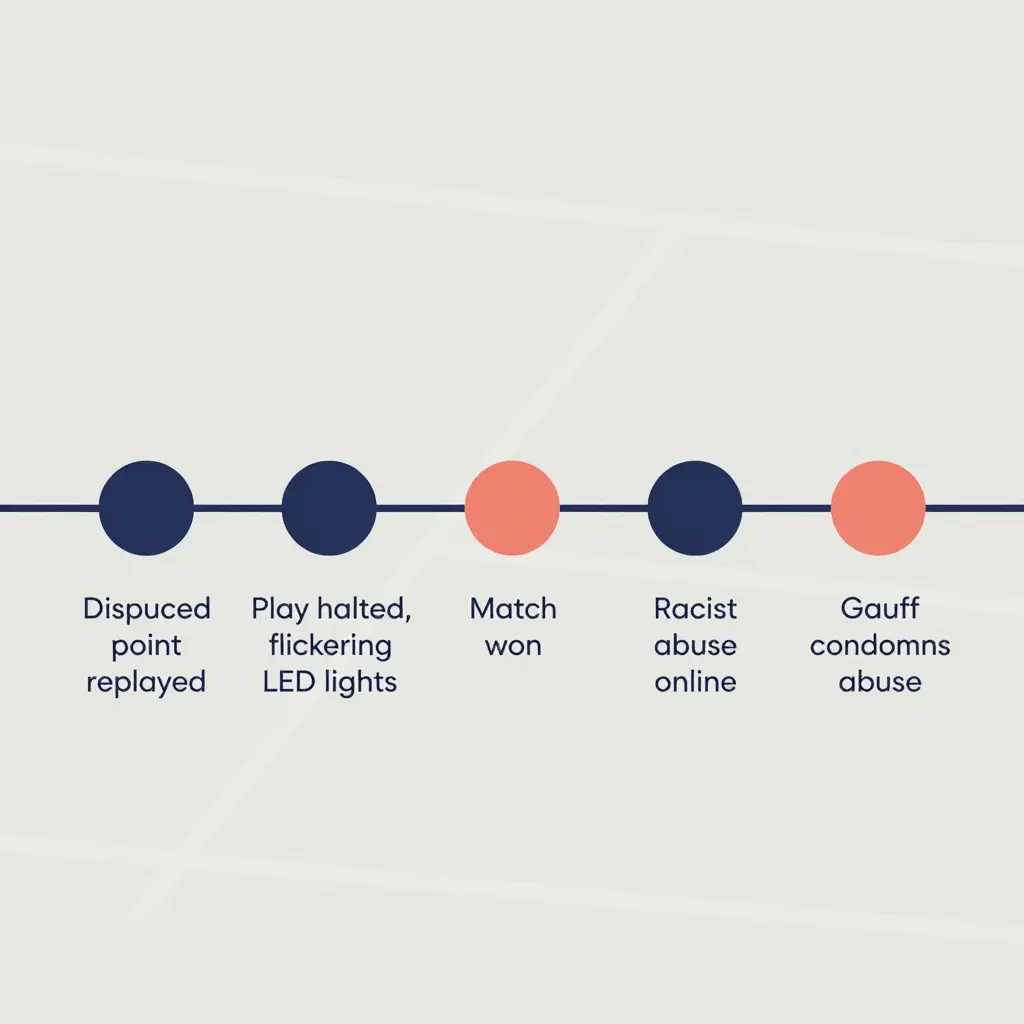

The Two Things That Got Mixed Up
Two stories got tangled together in Beijing, and treating them as one misreads both the match and what followed.
The first is a genuine gray area, and a familiar one in tennis: a point replayed because a light was flickering. Fans and players argue about calls like that all the time. Victoria Azarenka, a two-time Grand Slam champion, weighed in on Gauff’s side. Video review is a “very new addition to tennis,” she said, and players deserve more grace while the procedure around it is still being settled; the umpire, not the player, carries the responsibility. She called it unfair to “assign bad intentions” to anyone. “I don’t think that makes it fair,” Azarenka said. You can think the review was wrong. You can think the panel should have been fixed before the match. That argument belongs to the game. It is a debate about procedure, and procedure is fair game.
The second is the abuse itself, which Gauff described as “insane.” It was not the rules controversy boiling over, and it was not the natural, inevitable output of a disputed call. No hindrance rule and no flickering panel produces a racist message. Those messages came from people who chose to send them. The replayed point may have been the occasion. It was not the cause.
The line runs here:
- Being angry about a call is an argument about the game.
- Attacking someone’s race is an attack on the person, and it is a deliberate choice: someone decided the quickest way to register frustration was to aim at who she is rather than at what happened.
One is a disagreement about tennis. The other is an assault wearing a complaint as a disguise. Collapsing them lets the abuse pass as a byproduct of a bad call, as if a flickering panel could explain a slur. It cannot. The call is debatable. The abuse is not.
Who Said What: Mapping the Reactions
Laid side by side, the reaction splits into four positions, and the fault line is easy to see: the argument is about a rule; the abuse was a separate choice.
| Party | Position | Key statement / core attitude |
|---|---|---|
| Coco Gauff | Stopped a point at 4-5 in the first set when a side panel flickered, won the hindrance review and the replayed point, and beat Sun Xinran 7-5, 6-1 | Went public on X to condemn the abuse: an “insane” amount of racist comments and messages, and said, “I’m not a cheater or a thief.” |
| Victoria Azarenka | Defended Gauff, calling video review a “very new addition to tennis” and saying the umpire, not the player, bore responsibility | Said players deserve more grace and it is unfair to “assign bad intentions” to anyone: “I don’t think that makes it fair” |
| Tournament / rules | Reviewed Gauff’s hindrance claim and ordered the point replayed under the existing rule; the flickering panel was the reason play stopped | Let the review decide whether the distraction counted, then applied the hindrance rule |
| Public & opinion | Sharply divided, some debating the call, others directing a wave of online racist abuse at Gauff | Backlash that Gauff called an “insane” amount of racism |
The table makes one thing hard to overlook. Gauff’s anger was aimed at the abuse, not at her opponent or the replay. Azarenka’s was aimed at the rush to blame her. The umpire applied the rule. And the public split, roughly, between people arguing about tennis and people who crossed a line that has nothing to do with tennis.
That gap is the story. A replayed point is a judgment call you can debate. The abuse was not.
The Line Between Frustration and Abuse
Gauff stopped a point in Beijing over a light she could not play through, something mundane and mechanical. What followed had nothing mundane about it. Sun Xinran, 16, was visibly upset after the replay, and Gauff dropped only one more game. Then the conversation around the match curdled, and racist messages started arriving. Gauff called the volume “insane” and condemned it directly. That she had to say anything at all is the part worth sitting with.
It is easy to treat online abuse as noise, the price of visibility. Athletes cannot. A WTA and World Tennis study counted more than 12,000 abusive posts and messages aimed at players in 2025, up from about 8,000 the year before. Gauff’s next match, against Elise Mertens, ended in a 6-3, 6-3 defeat, and afterward she told reporters the abuse had been “draining”: she turns off her phone and moves on. She did not attribute the loss to it, saying only that she had been “a bit flat.” Still, the abuse does not stay outside the sport. It becomes part of the conditions players compete under.
Being upset about a call, a replay, or a result is normal. Fans argue about officiating constantly; that argument is part of what makes sport alive. But disappointment with a decision and an attack on a person’s race are not points on the same spectrum. One is a reaction to what happened on the court. The other invents a target that has nothing to do with tennis and everything to do with who the player is. Treating them as “strong opinions” or “passion” blurs a line that should not be blurry. You can think a point was handled badly and still recognize that no version of that opinion requires dehumanizing the athlete.
Gauff did not only defend herself. She apologized to Sun at the end of the match and called her an “incredible player,” and said Sun understood the situation. That is the boundary drawn cleanly: criticize the call, debate the rules, question the ruling if you want. Just do not confuse a disputed point with a reason to attack someone’s identity.
Sport runs on emotion; that is the appeal. But emotion aimed at a person’s race is not fandom with the volume turned up. It is a different thing wearing fandom’s clothes, and the sooner it is said plainly, the safer the people we claim to admire will be.

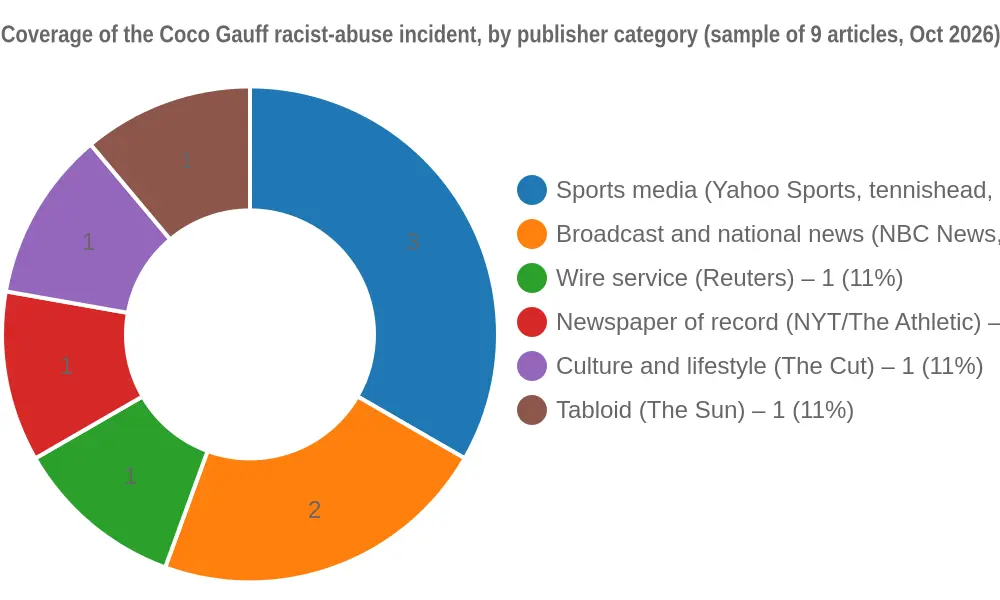
What this shows. I took the nine reports on the Coco Gauff racist-abuse incident (Beijing, early October 2026) that are gathered for this piece and sorted them by the kind of outlet that ran them: Reuters (wire), NBC News and USA Today (broadcast and national news), Yahoo Sports, tennishead and OutKick (sports media), The New York Times / The Athletic (paper of record), The Cut (culture and lifestyle), and The Sun (tabloid).
Sports desks carried the most – three of the nine. National news followed with two. The rest are one report each, which is roughly what you would expect in the first 24 hours: the wires and the tennis beat move first, then the general-news and lifestyle desks pick it up once “a controversial point” becomes “racist abuse.”
A caveat, stated plainly. This is a small, hand-checked sample collected while reporting, not a census of every article filed worldwide. It is a snapshot of how the story surfaced, not a scoreboard of who covered it best. The counts come straight from the publishers and timestamps listed for the sources in this story. On the abuse itself, one finding turns up again and again in studies of athlete harassment and is worth holding onto: a very small number of accounts generate the bulk of abusive posts – which is exactly why “the internet” is not the same thing as “everyone.”
Conclusion
The lights flickered on their own. The messages did not.
Coco Gauff stopped a point, not the match, because a panel in the LED boards was stuttering; the umpire ordered the point replayed under the hindrance rule. That is a rules question: messy, debatable, worth arguing about. Victoria Azarenka said the review procedure is too new to punish anyone over, and plenty of fans agreed. Fine. Tennis lives on these arguments about hindrance calls and replayed points. That debate is the sport breathing.
The abuse was something else entirely. No one sent a slur because a light blinked. Those messages came from people making a choice, and making it about who Gauff is rather than a call they disliked.
Keep the two apart. You can think the official got it wrong and still refuse to attack a person. You can feel for Sun Xinran, a 16-year-old who had every reason to be upset after a strange sequence, without turning that feeling into a weapon aimed at her opponent. Criticizing a ruling is a comment on the game. Attacking an athlete’s race, her humanity, is not criticism at all, and waving it off as “just the internet” only gives it a longer leash.
Athletes read what lands in their mentions; Gauff and Sun both do. Cruelty does not bounce off because someone can hit a forehand at a hundred and twenty kilometers an hour.
If you care about this sport, the ask is small. Argue about the point. Question the rulebook. Ask whether those lights should have been sorted sooner. Do all of it. Just leave the cruelty out. That is not much to expect, and it is the least any player, on any court, deserves.
Frequently Asked Questions
Why did Coco Gauff stop play at the China Open?
Late in the first set of her third-round match against Sun Xinran in Beijing, Gauff was serving at 4-5 when a panel in the LED boards along the side of the court started flickering. She raised her hand to stop the point and asked for a video review, arguing the light had distracted her. The umpire accepted the hindrance and ordered the point replayed. Gauff said afterward that she was following the rules, not bending them.
Why was the controversial point replayed?
The point came at 4-5 in the first set, not late in the match. Gauff asked for a review, saying the flickering panel had interfered with play; after watching the footage, the umpire ruled there had been a hindrance and ordered the point replayed. That decision was the flashpoint. Some saw it as the rule applied correctly; others thought Gauff should have played on. Victoria Azarenka defended her, saying the review procedure is new and it is not fair to assign bad intentions to anyone. Either way, the replay was an umpire’s call, not something Gauff controlled from her side of the net.
What kind of abuse did she face?
After the match, Gauff was hit with a wave of racist abuse online. The volume was described as “insane.” It’s the familiar, ugly pattern in sports: a player follows the rules, a controversy follows, and the reaction turns into something far beyond the game.
How did she respond publicly?
Gauff explained the hindrance call in a post on X, then replied to a racist response to it: “You can dislike me or disagree about what happened without being racist… The amount of racist comments/dms I’ve received in the last few hours is insane. Lastly, I’m not a cheater or a thief.” She also apologized to Sun Xinran and praised her. When she lost her next match, she said the abuse had been draining.