The shooting at Silver Rail Elementary School began shortly before 1 p.m. on Thursday, October 15, 2026, in Bend, Oregon. By the time it ended, three children and a teacher were dead.
The shooter was a 16-year-old carrying a shotgun. A bystander who heard the gunfire went toward it, followed him into the school, and shot him.
By nightfall, the confirmed facts were these: four people dead — three children and one teacher — and a teenage gunman stopped by someone who moved toward the sound instead of away from it. The attack was the deadliest K–12 school shooting in Oregon’s history.
Here is what has been confirmed, and what has not.
What We Know So Far
The shooting happened at Silver Rail Elementary School in Bend, a city in the high desert of Central Oregon. Bend-La Pine Schools canceled classes the next day, Oregon Public Broadcasting reported.
Three children and one teacher were killed, according to CBS News, CNN, and The New York Times. The children were 5, 8, and 11.
The shooter was 16. NBC News, citing sources, identified him as John J. Griffin II and reported that the shotgun used in the attack had been purchased by his mother. Police have not confirmed a motive.
He was stopped by a bystander who was already on or near campus. CNN reported that the teenager was fatally shot by a bystander; the BBC said the man had “heroically intervened” at the scene. His family identified him as Kaylub Giamanco, 36, a carpenter and the father of two students at the school. Police did not immediately release his name.
Those are the confirmed outlines: four lives lost, a 16-year-old suspect, and a father who went toward the gunfire. Questions about how the weapon was obtained, and what led up to that afternoon, remain under investigation.
Key Facts at a Glance
| Topic | Confirmed Detail |
|---|---|
| Location | Silver Rail Elementary School, Bend, Oregon |
| Fatalities | Three children, ages 5, 8, and 11, and one teacher |
| Suspect | John J. Griffin II, 16 |
| Firearm source | A pump-action shotgun purchased by his mother, a law enforcement source told the Associated Press |
| How it ended | Kaylub Giamanco, 36, followed the shooter inside and shot him |
| Community response | Bend-La Pine Schools canceled classes; a vigil was held that night |
The bystander who ran toward the gunfire
In the first hours, the details competed for attention: the death toll, the timeline, the questions with no answers yet. The one that held was simpler. A man near campus heard the shooting and went toward it.
The record of what he did is short. He was a parent — his two daughters attend Silver Rail — and he was carrying a concealed handgun. He went toward the gunfire, followed the shooter into the building, and shot him, ending an attack that had already killed three children and a teacher.
That is the part Bend has kept returning to. Not the gunfire itself, but the fact that someone moved against it. Most people, when the worst arrives, freeze, run, or call for help from a distance. Going toward the sound is not what the body asks for. It is a decision made in seconds, and it is the reason the shooting stopped when it did.
Nothing about that decision brings back the three children or the teacher who died with them. It only changed what happened next.
Governor Tina Kotek praised him, and President Trump called him a “great hero.” The plainer description is that he crossed the distance between himself and danger. Because he did, a town burying four of its own was spared worse.
That is why the town keeps coming back to it. Not for the drama. For the proof.
How the Afternoon Unfolded
The attack lasted about three minutes. This is the sequence, as confirmed by police and reported by local and national outlets.
- The shooting begins. Shortly before 1 p.m., a gunman opens fire at Silver Rail Elementary School. Students and staff are on campus, and classes are in session.
- Three children and one teacher are killed. The gunman shoots his way through locked doors and kills four people inside the school.
- A bystander intervenes. Kaylub Giamanco, a parent of two students, goes toward the gunfire and follows the shooter into the building.
- The shooter dies. Giamanco shoots and kills the 16-year-old. Police arrive at 1:02 p.m.
- Law enforcement responds. Officers and emergency crews secure the campus. The FBI’s Portland field office later joins the investigation.
- Classes are canceled. Bend-La Pine Schools closes its campuses, giving families space to absorb what happened and to find each other.
- The community grieves. Neighbors, parents, and students gather at a vigil in a local park that night. Governor Tina Kotek and Bend mayor Melanie Kebler speak.
The shooting was over in about three minutes. What follows will not be.
A Community in Mourning
Word that three children and a teacher had been killed at Silver Rail moved through Bend faster than any official statement. It reached group chats and grocery store lines and the reunification site at Journey Church, where parents waited to be matched with their kids.
Bend-La Pine Schools canceled classes across the district. OPB described Central Oregon as grieving, and by evening it was clear the loss belonged to more than one family or one school.
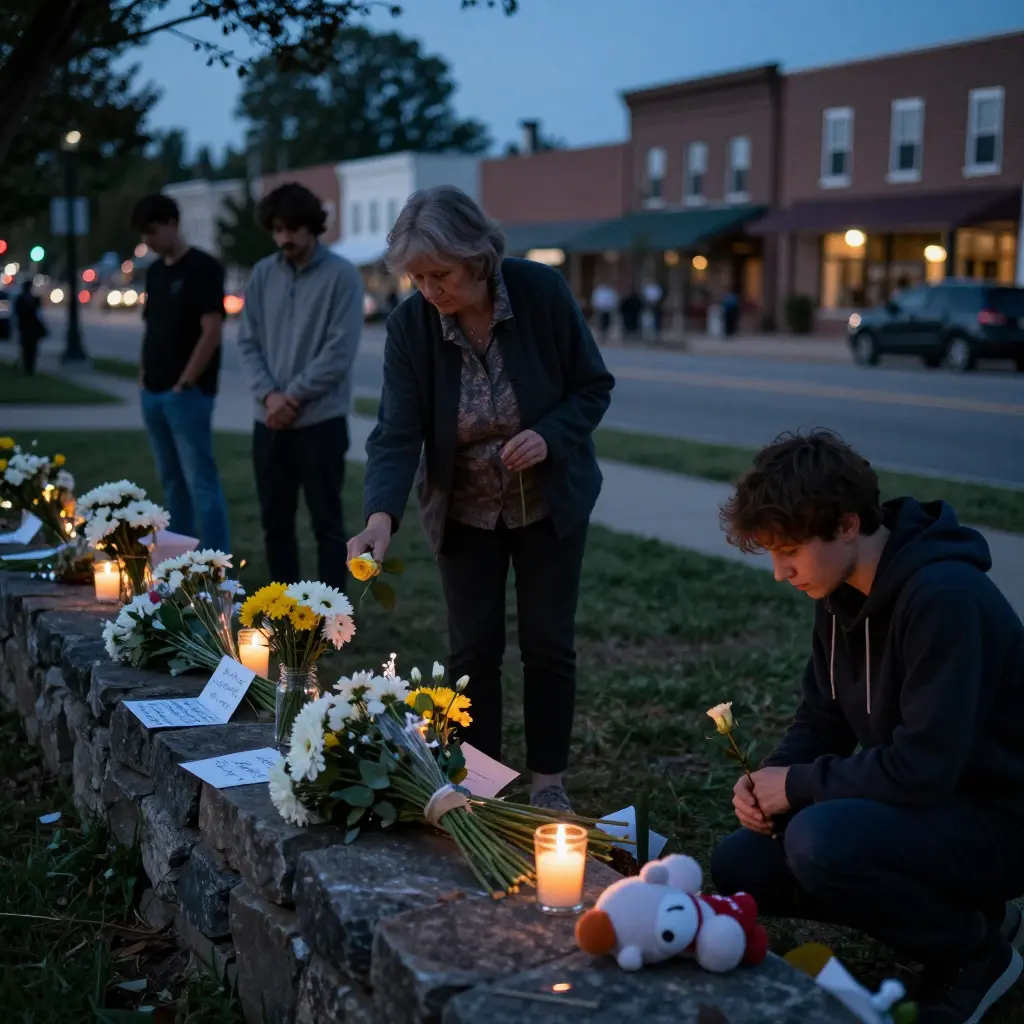
People gathered on their own. Flowers and candles appeared near the school, and hundreds turned out for a vigil at a local park, where Kotek and Kebler spoke. Kebler called it “a dark day, an awful day, and a day that will impact so many of us, so deeply.”
Bend does not move past a day like this. It carries it. On the second day, schools were still closed.
What the Numbers Actually Show
Five people died at Silver Rail on October 15: three children, one teacher, and the 16-year-old gunman.
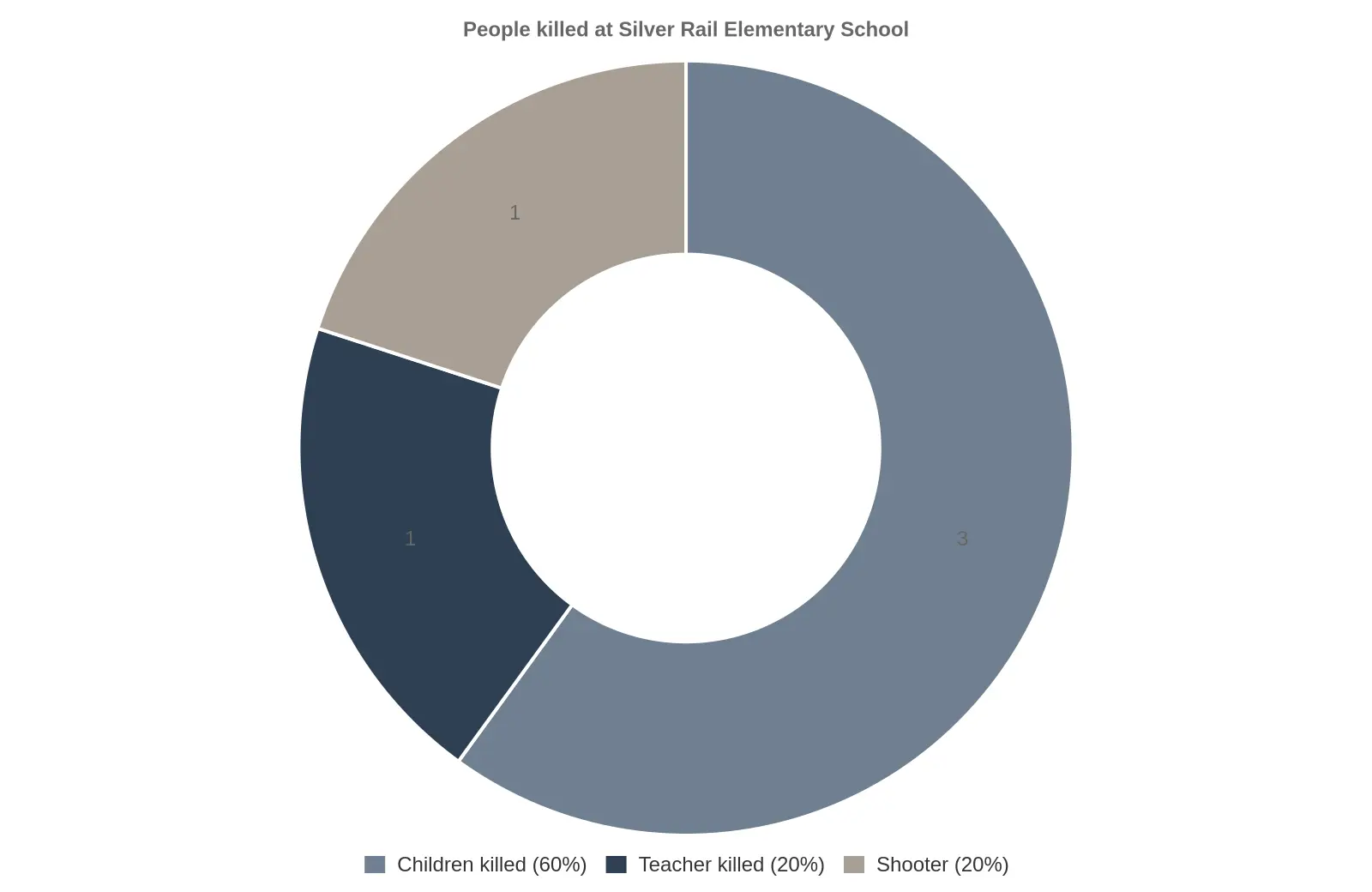
The chart breaks down the five deaths. Three children — ages 5, 8, and 11 — one teacher, and the gunman.
The shooter’s name surfaced quickly in the coverage. The families waiting at the reunification site, the classmates who heard the shots through the walls, the officers who reached the school minutes after the first call — they are the ones carrying this town’s grief. The numbers give you scale. They don’t tell you what it cost.
The district canceled classes across Bend-La Pine the next day. Not because buildings were damaged, but because a community needed room to gather.
The family of the 5-year-old killed has identified him as Rhoam Summer, a kindergartner. In a town this size, the arithmetic is small, and the absence is enormous.
The Shooter and the Gun
By the afternoon of October 16, investigators had confirmed the first details about the person behind the shooting. Bend police identified the suspect as a 16-year-old male; NBC News, citing sources familiar with the investigation, named him as John J. Griffin II.
The clearest verified thread runs through the weapon. Police Chief Mike Krantz described it as a “long gun.” A law enforcement official told the Associated Press it was a pump-action shotgun that the shooter’s mother had purchased legally. That detail has not been confirmed at a formal briefing.
Police have not described a motive. No confirmed information has been released about the shooter’s mental health or any earlier contact with law enforcement, and this account will not speculate about either. What is documented is narrower: a 16-year-old had access to a shotgun that, by multiple accounts, his mother bought.
The question of how he got the gun began shaping the political response within hours, with lawmakers and advocacy groups weighing in. That debate is covered below. The families at Silver Rail are carrying something no policy argument can reach tonight.
A Town That Looks Like Any Other
Before the headlines, Bend was — and still is — a place where people live.
Away from the school, Bend looks like this: low storefronts, a corner grocery, pickup trucks at the curb, ponderosas and bare autumn trees along the sidewalk, the Cascades far off on the horizon. High-desert light. Clean streets.
The plainness is the point. It is easy to read the words “in Bend,” and move on. This is what it looks like: a particular street, a particular school a few blocks from a coffee shop where neighbors nod at each other in the morning.
The grief in Central Oregon isn’t abstract. It’s this street, these trees, that horizon.
Political Reactions
Within hours of the shooting, grief in Bend began to run alongside a familiar political current. Democratic lawmakers pointed to a detail investigators had begun to circulate: the shotgun, which law enforcement sources say was purchased by the shooter’s mother. Democrats argued the case shows why storage requirements, expanded background checks, and limits on minors’ access to household firearms deserve another look.
Oregon already has among the more restrictive gun laws in the country, including a voter-approved measure that requires a permit and training to buy a firearm. Supporters of those rules said the shooting underscores the gap between what is written and what is enforced, and that a gun kept in a family home is exactly the kind of access safe-storage laws are meant to address. Opponents pushed back, noting that the state’s existing rules did not prevent this outcome and that a determined teenager with a lawfully purchased weapon is not necessarily a problem a new statute resolves.
The pattern is familiar. After a mass shooting, one party tends to treat the moment as a policy opening while the other calls for mourning first and legislating later. Republicans and gun-rights advocates have generally cautioned against acting in the immediate aftermath, arguing that measures drafted in grief can miss the particulars of a case and add burdens for law-abiding owners. They point instead to mental health services, school security, and earlier intervention.
What makes Bend different is the setting: a small central Oregon city where the school, the families, and the first responders are neighbors. The debate will play out in the statehouse and on national television, far from the hallway where the shooter was stopped. For residents, the political argument is arriving at the same time as the funerals.
The Choice to Run Toward
What people in Bend seem to keep returning to is a decision made in seconds. A man near campus heard gunfire and moved toward it.
The BBC described him as having “heroically intervened,” confronting the shooter and ending the attack. Governor Tina Kotek praised him. He was 36, a carpenter, the father of two students at the school, and he was carrying a concealed handgun. He followed the shooter into the building and shot him. Around that decision sits the rest of what happened: three children and a teacher killed, a 16-year-old gunman dead, a shotgun his mother had bought, classes canceled across Bend-La Pine, a community holding grief and gratitude at once.
The arguments that follow days like this are loud and familiar, and they matter. But the day itself belongs to quieter things: a man who went toward the sound, and neighbors who carried each other through the hours after. In a country that keeps living through this, both belong in the record.
Bend School Shooting: Frequently Asked Questions
Here is what has been confirmed about the shooting at Silver Rail Elementary School, and what is still unknown. Details are developing, and officials may release more.
Where did the Bend shooting take place?
At Silver Rail Elementary School, part of the Bend-La Pine school district, in Bend, Oregon, a city in Central Oregon.
How many people were killed?
Three children — ages 5, 8, and 11 — and one teacher died in the attack. The 16-year-old gunman was also killed. A 7-year-old student and a 54-year-old teacher were hospitalized with critical injuries.
Who was the shooter?
John J. Griffin II, 16, of Bend. He was identified by police and, earlier, by NBC News and other outlets citing law enforcement sources.
Where did the gun come from?
Bend Police Chief Mike Krantz described the weapon as a “long gun.” A law enforcement official told the Associated Press it was a pump-action shotgun purchased by the suspect’s mother. The department has not confirmed the type of weapon at a formal briefing.
How was the shooter stopped?
Kaylub Giamanco, 36, a father of two students at the school, went toward the gunfire, followed the shooter inside, and shot him. The shooter died at the scene. Governor Tina Kotek praised Giamanco’s actions; President Trump called him a “great hero.”
Are Bend-area schools closed?
Yes. Bend-La Pine Schools canceled classes. The district and local agencies have been supporting students, families, and staff since.
Has a motive been confirmed?
Not publicly. Investigators have not released a confirmed motive, and officials have urged people not to spread unverified claims.
What happens next?
The investigation is ongoing, and officials are expected to release more information. For now, the town is focused on the victims, their families, and the man who went toward the danger instead of away from it.
A note on accuracy: this Q&A reflects confirmed reporting at the time of writing. If new details emerge, treat official sources as the final word.