David Surkamp, singer and cofounder of Pavlov’s Dog, died unexpectedly on October 13. He was 73. The band’s violinist and mandolinist, Abbie Steiling, shared the news in a post on the group’s Facebook page. No cause of death has been made public.
Surkamp was never a household name. What he had instead was a voice that did not sound like anyone else’s in 1970s rock: a high, quavering tenor that could be wounded, theatrical and oddly beautiful inside the same line. On Pampered Menial and At the Sound of the Bell it was the first thing you noticed and the thing you kept coming back to.
Fact Check: Confirmed and Unconfirmed Details
When a death is reported within hours, the band’s own words and the headlines built on them blur together. Here is what has been said on the record, and what is still being repeated secondhand.
| Item | Confirmed Information | Status / Notes |
|---|---|---|
| Date of death | Oct. 13, 2026, per the band’s announcement | Reported by multiple outlets citing the band’s Facebook post |
| Age at death | 73 | Stated consistently across all reports |
| Announcement channel | The band’s official Facebook page | Multiple outlets quote or reference the post directly |
| Who announced it | Attributed to the band; several outlets name Abbie Steiling, the band’s violinist and mandolinist, as the person who shared it | Reported but not independently verified; other outlets credit the band collectively |
| Cause of death | Not disclosed | Unconfirmed; nothing has been released by the band, family or representatives |
| Nature of death | Described as unexpected in the band’s post | Reflects the band’s own wording, repeated by outlets |
| Follow-up official statement | None as of the latest reports | Memorial or funeral arrangements have not been announced |
| Net worth and other figures | No verified figures | Unsourced numbers circulating online are not repeated here |
Anything outside these rows is still open. Read the table as a snapshot rather than a final account; it will change if the band, family or representatives say more.
The Voice Was the Signature
His voice arrived before anything else in the mix. Higher than most male singers in progressive rock, thin at the top and unusually clear, it was almost unplaceable: a tone that listeners either settled into within seconds or never settled into at all. That split is what made it useful. Before a guitar figure or a violin line had a chance to register, the voice told you whose record this was, and the recognition came from timbre rather than from a riff.
The arrangements grew around it. When a lead voice sits in the upper register, guitars and keyboards have to live somewhere else, often lower and heavier, and Pavlov’s Dog’s instrumental weight came out of working around him rather than competing with him. A voice that unusual makes a band easy to describe and hard to imitate. Copying the songs is simple enough; copying the sound is not.
Being identifiable and being easy to listen to are different things, and Surkamp’s voice never pretended otherwise. Identity is the rarer of the two, and he had it in the first bar.

Placement: full-width, about a third of the way in, after the paragraph on his voice on the early records and before the section on the band’s later years. Leave at least 40px above and below, keep it uncropped, and do not cut the upper left, where the negative space sits.
Caption: David Surkamp of Pavlov’s Dog, remembered through the records he left behind.
Some voices settle into a band like another instrument. A few refuse to. Surkamp’s belonged to the second kind, and the divide it opened among listeners never really closed.
He sang high, largely in a tenor-to-falsetto range, with a fast, wide vibrato that kept the pitch in constant motion. The violin and mandolin writing moved further toward the theatrical than the songs strictly asked for, so the voice worked less like a narrator than like a fourth string part. High male voices were not unusual in mid-1970s progressive rock, but they generally stayed inside a recognizable rock delivery; this one leaned closer to a choirboy or a baroque ornament. Listeners divide on it. For one set, it is the signature, the reason a track like “Julia” is identifiable within a bar, before any chorus arrives. For another, sustained high-register vibrato lands exactly where the ear expects warmth, and no amount of arrangement softens the reflex.
Both reactions describe the same fact. A voice that can be loved and resisted inside the same phrase is doing something a smoother one cannot, and that is the argument for distinctiveness over adaptability when a body of work has to last.
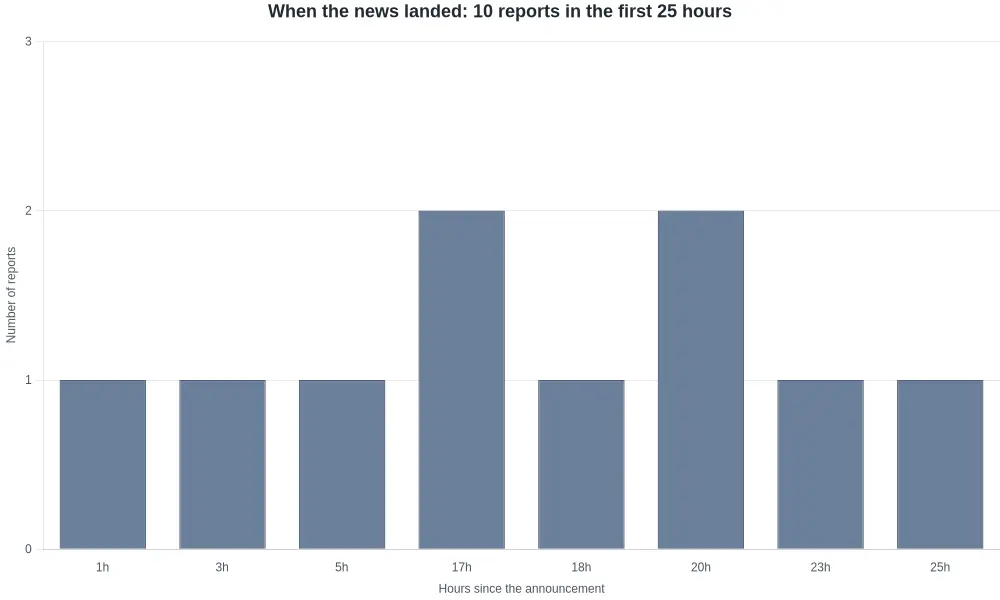
The ten reports in this set fall into three groups: three written within five hours of the band’s Facebook announcement, a dense run between 17 and 25 hours, and two double entries at hours 17 and 20, each from different outlets. What the spread tracks is syndication timing, not new information. Every one of the ten repeats the same two facts: that Surkamp was 73, and that no cause of death has been made public.
Source: the ten headlines and publication times in this set. The four with clock timestamps were converted to hours against the same reference point.
| Hours since announcement | Outlets | Reports |
|---|---|---|
| 1 | WFTV | 1 |
| 3 | Variety | 1 |
| 5 | Detroit Free Press | 1 |
| 17 | Merca20, Hindustan Times | 2 |
| 18 | USA Today | 1 |
| 20 | Fox 13 News, Men’s Journal | 2 |
| 23 | Hit Channel | 1 |
| 25 | Vice | 1 |
A Long-Running Band, and Who Told the Fans
Pavlov’s Dog were never a band that arrived and left in a hurry. They were, as Variety put it, long-running: a progressive-rock outfit that kept returning to recordings and to audiences across decades. That kind of endurance changes what a death means. A band shaped like that is not a fixed object you can shelve; the records stay put and the exchange around them keeps moving. Remove the founding voice, David Surkamp, dead at 73, and the room around the music shifts while the catalog sits exactly where you left it. For anyone who found those albums late, that is the odd arithmetic of it: the recordings are finished, the conversation is not.
The news traveled the way news does now. It did not come by press release but as a Facebook post from the band, with Steiling sharing that Surkamp died unexpectedly on Oct. 13. Fans heard it from the people who made the music, in the same place they have been talking for years. The band has not announced further details.

Caption: Grooves that keep turning even after the needle lifts.
Placement: full-width and centered, roughly two-thirds of the way in, after the section on Surkamp’s later years and before the closing paragraphs on what the records leave behind. No caption box.
Where to Start With That Voice
- Start with the albums most often named as the band’s signature work before hunting for deep cuts. Pampered Menial and At the Sound of the Bell carry the violin and mandolin writing that shapes the group’s sound and gives the voice room to move.
- Give the high tenor three or four songs before you decide. It sits well above where most rock singers live, and once your ear settles into it, the phrasing starts to sound less like a quirk and more like an instrument.
- Listen for the strings as a counterweight, especially where violin and mandolin trade lines with the guitar. Much of the arrangement work happens there.
- For the band’s history, lean on interviews, liner notes, the band’s own statements and archived music-press coverage. Aggregator summaries are useful as signposts, not as sources to quote.
Where He Sits in the Picture
Set against the wider arc of 1970s progressive rock, Surkamp’s place is easier to see now than it was when Pavlov’s Dog first appeared. The era prized virtuosity and grand architecture, and a voice like his, high and unguarded and almost fragile against the guitars, did not quite fit the frame. Voices that broke the rules usually waited a long time to be understood; listeners caught up years later, sometimes decades, and found the records already there.
What remains are the recordings. The tapes still hold his voice. “Julia” still rises the way it always did, Pampered Menial still sounds like nothing else from 1975, and no amount of remembering changes a single note of it. He sang in a register most singers avoided.
He is gone at 73. The songs stay, waiting for whoever comes along next and decides to listen twice.
Common Questions About David Surkamp
Who was David Surkamp, and how old was he?
David Surkamp was the frontman and cofounder of Pavlov’s Dog, the progressive rock band he led for decades. He was 73. Listeners tend to remember one thing first: that high, odd, instantly recognizable voice.
When did he die, and who shared the news?
He died unexpectedly on Oct. 13, according to a post from the band on Facebook. The band announced the loss, and its violinist and mandolinist, Abbie Steiling, shared the post. Outlets including Variety and USA Today picked the story up within a day.
Has a cause of death been made public?
No. The cause has not been disclosed, and reports describe the loss as unexpected without offering medical detail. No memorial or service details have been announced either.
What kind of music did Pavlov’s Dog play?
The coverage consistently describes Pavlov’s Dog as a progressive rock band. Surkamp was its lead singer and cofounder, and his voice is the thread running through the records fans keep returning to.