I watched Mike Flanagan’s new Carrie over three nights – eight episodes on Prime Video, with Summer H. Howell doing the quiet, heavy lifting. I showed up ready for the prom, the fire, the blood, and those scenes still land the way they should.
What followed me to bed was Margaret White, Carrie’s mother.
I kept thinking about the woman beside the bucket, not the blood in it – the one who locks the door and calls it love. Every time she reached for Carrie I felt cold. I’ve seen Carrie before, in its other versions, and this is the first time I couldn’t look away from the mother upstairs. Here the horror isn’t the prom. It’s what was done to Carrie at home, in a whisper, for years.
The basics, since there’s a lot of noise around this one.
It’s based on Stephen King’s 1974 debut novel, Carrie. Mike Flanagan adapted it for Prime Video as an eight-episode series, and all eight episodes arrive at once, so you don’t have to ration them.
- Based on: Stephen King’s Carrie (1974)
- Made for TV by: Mike Flanagan, for Prime Video
- Episodes: 8, released all at once
- Carrie White: Summer H. Howell
- Margaret White: Samantha Sloyan
That context matters, because Flanagan treats familiar horror stories as character studies first, and this time the attention lands on the two leads. Summer H. Howell plays the girl at the center; Samantha Sloyan plays her mother, Margaret. If you’ve seen Flanagan’s earlier work, you’ll recognize Sloyan. If not, she’s a big part of why so many viewers keep circling back to that mother-daughter relationship.
The Mother Is the Engine, Not the Prop
I walked into the new Carrie braced for the prom, and I keep leaving it stuck at the dinner table. Margaret White is the mechanism here, not a villain to boo between scares: shame drilled into a child, faith used as leverage, love that arrives only as punishment. The blood is what all of that looks like from the outside.
Read it as “kid gets powers, kid gets revenge” and it shrinks into a monster movie with extra steps, satisfying but thin. You watch a girl snap and leave knowing nothing about how girls get snapped.
- The telekinesis is the symptom; the mother is the disease, and it’s one plenty of homes still avoid naming in 2026.
Centering Margaret doesn’t soften the horror so much as move it. The story stops being about a girl who explodes and becomes about the small room where she was taught she deserved it.
After the new one I went back and rewatched the earlier Carries. What stuck with me was the mothers: same character, same Bible, three very different women standing in their daughter’s doorway.
| Version / Year | Actor | Core traits of the mother | Tone of the mother-daughter bond |
|---|---|---|---|
| 1976 film | Piper Laurie | A smile that flips into shrieking rapture; religion as performance; a woman playing righteous. | Suffocating surveillance. Discipline performed as love. Carrie is watched, rarely held. |
| 2013 film | Julianne Moore | Physical and raw; scarred skin, a body visibly punished by her own faith; survivor turned enforcer. | Tangled intimacy. Bruises and tenderness in the same scene. She wants to be close and can’t stop hurting. |
| 2026 series (Prime Video) | Samantha Sloyan | Soft-spoken, matter-of-fact, domestic; faith folded into daily routine rather than spectacle. Reads like someone you could pass on the street. | Slow negotiation. Long conversations, quiet bargaining, rules argued over the dinner table. The dread lives in the ordinary. |
Fifty years changed the volume, not the doctrine. Laurie’s Margaret is a spectacle, Moore’s is a wound, Sloyan’s is a neighbor. The older films asked us to recoil from her; this one asks us to sit with her, which is harder to shake.
Some houses keep the same silence no matter who lives in them.
Carrie’s body is changing on its own schedule, and her mother reads every change as proof of sin. Margaret doesn’t just control her daughter. She teaches her that her own flesh is the enemy: menstruation as curse, desire as damnation. Carrie is left with no word for what’s happening to her except shame.
This version handles it more delicately than the earlier films did. The horror is in small moments: a locked door, a whispered prayer, the way Margaret touches her daughter as if disinfecting her. The violence is spiritual long before it turns telekinetic.
Control wants obedience and puberty wants autonomy; shame wants silence and adolescence wants a voice. Faith asks for surrender, but a girl still needs a self.
This cuts deeper than the prom-night cruelty because most of us were never Carrie on that stage. Plenty of us do know what it is to be loved and diminished in the same breath.
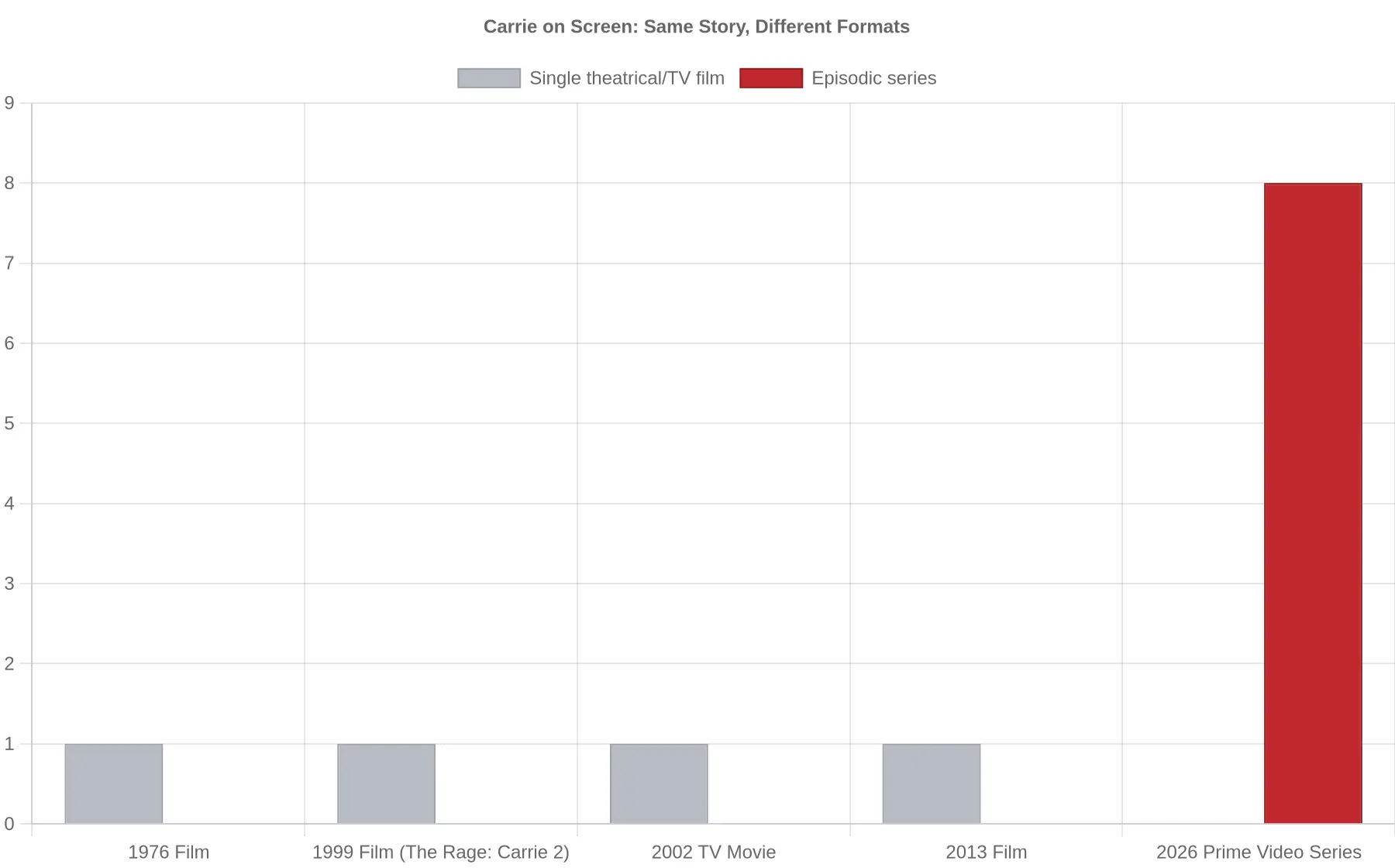
Carrie on Screen: Same Story, Different Formats
Every few years someone retells Carrie White’s story, and until now almost every telling fit into roughly the same screen time. The chart below shows how much room each adaptation had.
| Adaptation | Year | Format | Installments / Episodes |
|---|---|---|---|
| Brian De Palma film | 1976 | Theatrical film | 1 |
| The Rage: Carrie 2 | 1999 | Theatrical film (sequel) | 1 |
| Carrie (NBC) | 2002 | TV movie | 1 |
| Carrie (remake) | 2013 | Theatrical film | 1 |
| Carrie (Prime Video) | 2026 | Episodic series | 8 |
Legend
- Single theatrical/TV film (muted bars) – a story told in one sitting.
- Episodic series (highlighted bar) – the first time this material unfolds across a full season.
Four decades of adaptations, and every one of them had to fit into a single sitting. The 2026 series is the first with enough time to tell the story differently.
Note: the four films are counted as single installments; the 2026 series is counted at its confirmed 8-episode run. No other figures are inferred.
Somewhere in that quiet, a light stays on. It usually does.
Deadline reports that Flanagan has a three-season arc in mind, which reads to me less like a marketing promise than a confession about what actually scares him. Family trauma and love curdling into control run through everything he makes, so Margaret White is the engine here and not a side note. That’s why I can’t quite join the BBC’s “do we really need another Carrie?” shrug. The remakes that failed copied the blood; Flanagan keeps going back to the grief, and the grief lives in the mother. If season one is only a beginning, as the reports hint, then hers is the thread that deserves the runway. We’ve had fifty years of Carrie at the prom and barely two hours of Margaret alone in her kitchen, bargaining with a God she half-invented.
FAQ: The New Carrie, Answered
The questions I keep seeing since I hit play, answered quickly.
Where and when does the new Carrie come out, and how many episodes are there?
It’s streaming on Prime Video, and the first season runs eight episodes. The rollout has been the loudest thing on my feed all week, and for once I don’t mind the noise.
Who plays Carrie and her mother?
Summer H. Howell plays Carrie, and Samantha Sloyan plays Margaret. Those two are the heart of the whole thing for me.
How is this version different from King’s novel and the earlier films?
The biggest shift is time. An eight-episode series gives Flanagan room the movies never had, so the mother-daughter relationship and the build of dread can breathe. He also pulls on threads the films dropped, like the book’s suggestion that Carrie isn’t the only woman with these powers. It’s still Carrie, on a longer and quieter fuse.
Will there be a second season?
Nothing official yet. Flanagan has said he pictured three seasons in a “dream scenario,” so the ambition is there, but for now it’s talk, not a green light.
If you’re going in fresh, watch it for the two of them, not just the prom.
Where This Leaves Me
I sat down expecting the prom and the bucket. I got Margaret White instead, and I can’t shake how much sadder that makes everything. The series asks us to sit with the mother who made the carnage inevitable rather than flinch at it, which I think is the real horror in King’s story. It took a TV series for me to see it.
The gym floor wasn’t what stayed with me after the finale. What stayed was a woman who loved her daughter the only way she knew how, which was never love at all. That’s the grief I’d been missing, and it’s quieter than a scream.