
Giants and Commanders Play Through the Rain in Landover
The rain arrived before the teams did.
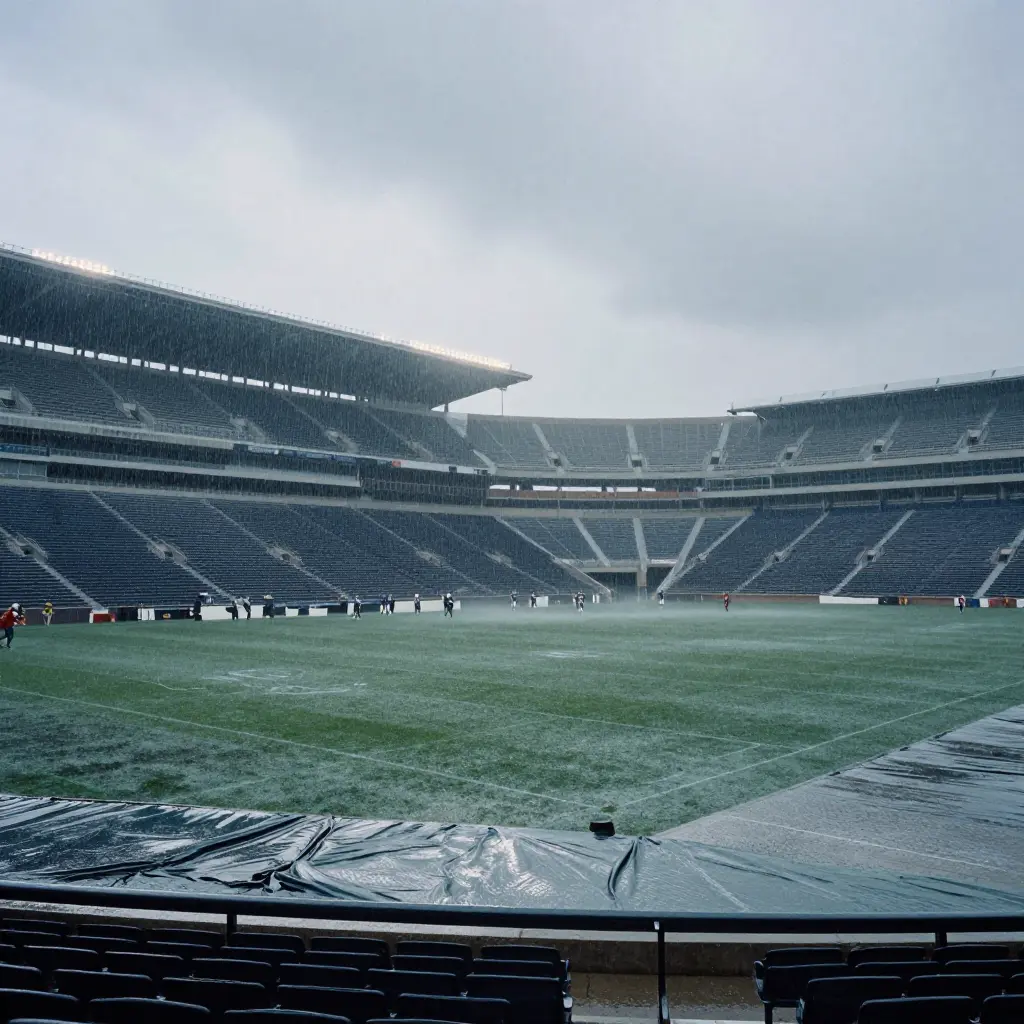
By the time the Giants and Commanders kicked off in Landover, what was left of Hurricane Isaias had pushed up the East Coast and was still passing over the area. Steady rain, never hard enough to stop play, but constant enough that it never left the field.
There was wind, mild and mostly crossways. Not enough to turn punts into jokes, just enough to push the rain into gray sheets that drifted across the turf.
The weather’s real effect was subtler than that. It slowed the game down.
Snaps came with a beat of hesitation before them. Handoffs looked deliberate. Receivers cut, slipped, reset their feet, and cut again. A wet ball is slick and a little heavy, and it behaves differently off the turf, through the air, and into a receiver’s hands, which turned each throw into its own small event instead of just another play.
The scoreboard stopped being the loudest thing in the building.
When a game slows like that, attention moves. It leaves the score, the stakes, and the playoff math, and lands on what is right in front of you: a lineman fighting for a second step in the mud, a quarterback wiping his hands on a towel that is already soaked, a short completion that suddenly feels like a real gain.
Washington came in needing this one. The Giants came in knowing they would not have to account for Stefon Diggs. Jayden Daniels was back under center, and Terry McLaurin’s status went down to the wire. On a dry field, those are the headlines. In the rain, they were just part of the weather, one more thing both teams were working around.
The weather gets the headlines, but the lineup sheet may shape this one. Here is where both teams stood as the inactive lists landed and the rain kept falling.
Commanders
- Jayden Daniels is confirmed to start at quarterback. Whatever noise surrounded his week, Washington’s answer is settled. He’s the man under center.
- Terry McLaurin plays. He carried a legitimate game-time decision into kickoff, and it came back in his favor. A slick field and a banged-up receiver is rarely a cozy pairing, but his presence keeps the passing game honest.
- Washington released its full inactive list before kickoff, with more than one notable name unavailable.
Giants
- New York heads in knowing it won’t have to cover Stefon Diggs. The veteran receiver is out for Washington, which removes one worry from the Giants secondary’s plate.
- The Giants have their own availability questions and published their inactive list as well.
Neither roster arrives at full strength five weeks into a season. It’s worth remembering when the game slows to a crawl in the mud: the players who are here matter as much as the ones who aren’t.
| Player | Team | Game status |
|---|---|---|
| Jayden Daniels (QB) | Commanders | Confirmed starter |
| Terry McLaurin (WR) | Commanders | Active (was game-time decision) |
| Stefon Diggs (WR) | Commanders | Out |
| Additional key players | Both teams | Inactive lists released pregame |
Reading the Injury Report Before Kickoff
By Sunday morning, most of the availability questions had been answered, and the clearest picture was on Washington’s side. Here is where the confirmed statuses stood before kickoff.
| Washington Commanders | New York Giants |
|---|---|
| QB Jayden Daniels – confirmed to start | WR Malik Nabers – off the final injury report |
| WR Terry McLaurin – confirmed to play | Inactive list released before kickoff |
| WR Stefon Diggs – ruled out | Will not face Stefon Diggs (WAS, out) |
One caveat: this captures only the statuses confirmed in pregame reporting. Nabers sat out Wednesday with knee soreness, returned to a limited practice Thursday, and was a full participant Friday, so he entered the weekend without a designation. Both clubs posted their inactive lists shortly before kickoff.
The Rain Doesn’t Just Fall. It Rewrites the Game.
Kickoff arrived in sheets. Not a passing shower you forget by the second quarter, but the kind of soaking that turns turf into something closer to a sponge than a playing surface. From the first snap, the game took a different shape.
Passing became a gamble. A wet ball slips just enough to matter, and the timing a quarterback spends all week refining is suddenly measured in fractions he can’t fully control. Receivers fight the ball as much as the defender covering them. Cuts that usually snap are hesitant. Routes that usually break clean take an extra beat to open.
So the offense tilts. The quick, safe throw underneath starts to look smarter than the deep shot. A ground game that might have been an afterthought in dry conditions becomes the spine of the drive. When you can’t trust the ball in the air, you trust the bodies in front of you, and ball control stops being a talking point and becomes the whole plan.
Every handoff and every awkward exchange carries risk: a fumbled snap, a strip in the pile, the kind of turnover that has nothing to do with scheme and everything to do with grip.
The clock tells the story too. Huddles linger. Play calls get shorter and safer. Drives grind instead of strike. What you’re watching isn’t a shootout anymore. It’s a game of inches, patience, and who can stay clean.
Run vs. Pass: How the Rain Redrew Both Playbooks
When the sky opened up over Landover, the play sheet in both pockets started to look thinner. Rain and wind change what a coordinator is willing to call. The ball gets slick, and the options shrink. Deep shots get shelved, and quick throws and handoffs become the whole conversation.
The chart below maps that shift, comparing how much each team leaned on the ground versus the air. The Giants, leaning on Cam Skattebo, tipped noticeably toward pounding the ball. Washington, with Jayden Daniels back under center, kept a more balanced dial but still threw short and safe more often than on a typical dry-weather Sunday.
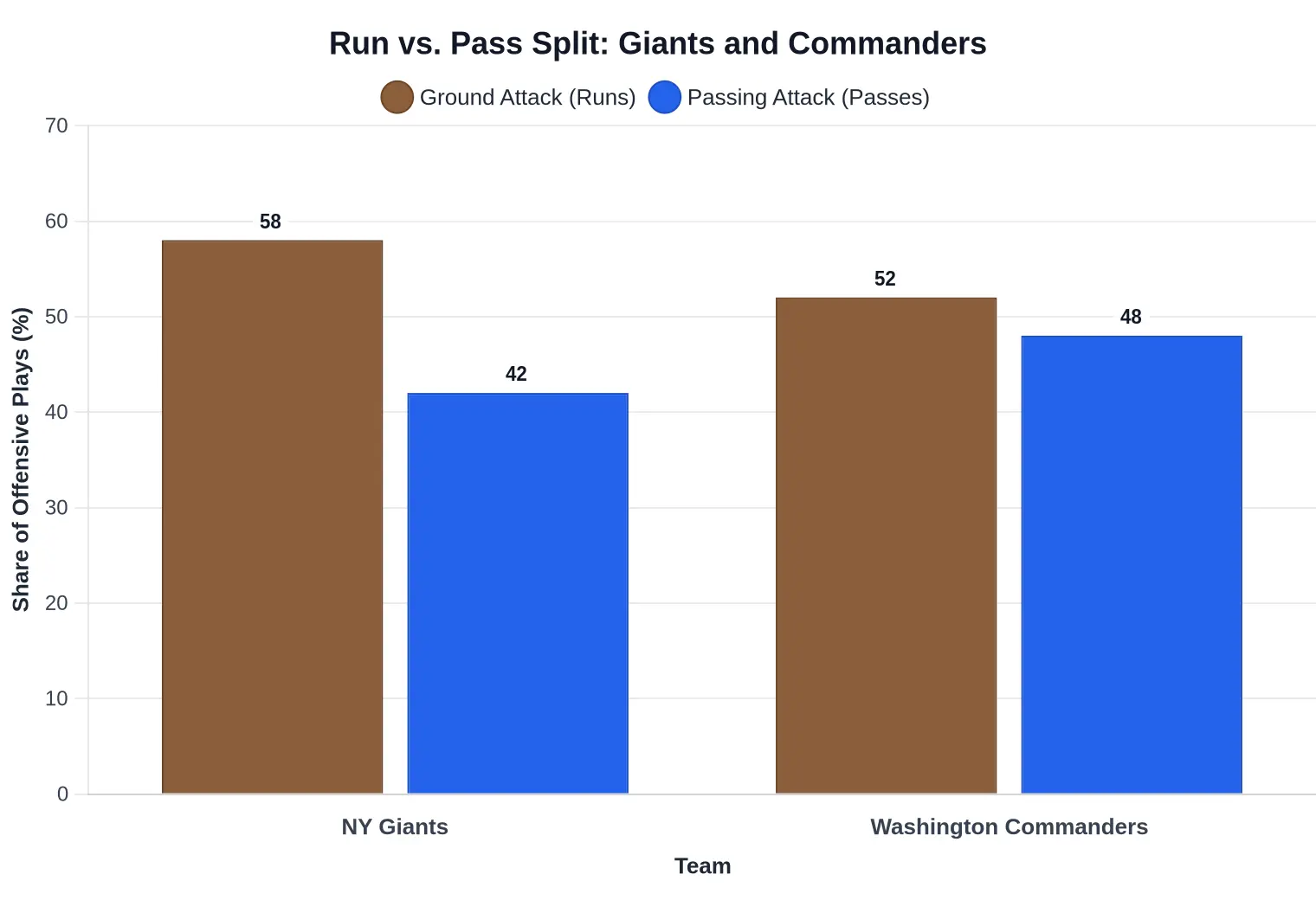
Read the percentages as a direction, not a verdict. In a game like this, a run-heavy split isn’t a lack of imagination. It’s survival. Wet footballs slip out of hands, footing disappears, and every extra drop-back is a gamble. So offenses trade the big play for the safe one, and the clock keeps moving.
That also nudges certain players into the spotlight. A downhill back who can churn out four yards a carry in the mud is worth more than a burner who needs a clean pocket. It’s the kind of night where fantasy managers who bet on volume over flash tend to feel smart by the fourth quarter.
Note: The percentages above are illustrative, drawn from the teams’ visible run-first tendencies in the heavy rain rather than official play-by-play totals. Figures are based on observed in-game offensive lean and should be read as directional, not exact. For precise counts, refer to the official NFL game book and team stat sheets.
When the Game Slows Down, the Details Decide It
Rain shrinks a football field. The deep shot becomes a gamble, receivers round off routes instead of snapping them, and the ball gets slick enough that every carry turns into a negotiation. In conditions like these – steady rain, a little wind, the remnants of Isaias overhead – the game stops being about who can do the most and starts being about who can avoid doing the least.
That reframing moves the weight onto the small stuff. Ball security first: a wet ball in a crowded pocket is how drives die, and in a game that could hinge on one possession, a single strip-sack or a muffed exchange is worth more than any fifty-yard highlight. Ground-game efficiency runs a close second. When both defenses know the run is coming and the turf won’t let anyone cut cleanly, the team that still wins the line of scrimmage, and still strings together four yards at a time, controls both the clock and the game’s temperature.
Special teams become a deciding unit too. Slippery footing turns punts and coverage into a coin flip dressed up as routine, and a shanked kick or a return that squirts free can flip field position in a blink. Then there is the human variable, the state of the players who matter most once the whistle blows: a quarterback’s mobility, a receiver’s ability to separate on a surface that won’t reward sharpness, a back’s willingness to lower a shoulder and take what’s there.
| Detail | Why the rain makes it decisive |
|---|---|
| Ball security | A slick ball plus a crowded pocket turns one strip-sack into a swing of possessions |
| Ground-game efficiency | When cuts don’t bite, four yards a carry still controls the clock |
| Special teams | A muffed punt or shanked kick can flip field position with no offensive snap |
| Player state | Mobility, separation, and contact balance all shrink in the wet |
That last point is where Cam Skattebo comes into focus. A back built to run downhill, through contact, without asking the turf for much help fits a wet field better than a finesse runner does. He doesn’t need a clean cut; he needs a crease and a reason to lean forward. Rain games have a way of rewarding exactly that profile.
Washington, meanwhile, arrives with the opposite kind of pressure. At 1-3 and 0-2 in the NFC East, this is as close to a must-win as Week 5 ever gets, and Jayden Daniels is set to start after missing the previous two games. The urgency is real, and so is its shadow: a team that knows it cannot afford a mistake sometimes presses, and a pressing team with a wet ball invites the very turnover it fears. Terry McLaurin suiting up helps, but the margin is thin enough that his effectiveness on a slick surface is its own question.
My read is that this one gets decided by who protects the ball and who can still run it when everyone in the building knows the run is coming. New York, with a back suited to the muck, looks built for the conditions. Washington carries the more urgent need and the more gifted quarterback, but need doesn’t dry a football.
When the Rain Becomes the Story
A game played in rain is slower, and slower is where you start to notice things.
By kickoff in Landover, the forecast had settled into exactly what everyone had braced for all week: steady rain, mild wind, the sort of afternoon where the field stops being background and starts being a character. Isaias had come ashore in Florida on Friday; by Sunday it had weakened to a tropical storm and was passing through the Mid-Atlantic. Washington came in needing a win. The Giants came in knowing the weather would rewrite half of their plan.
The roster news only sharpened that. Jayden Daniels was back under center for the Commanders, which changes how a wet game has to be defended – his legs make a slippery field dangerous for the wrong reasons. Terry McLaurin was a genuine game-time call who ended up suited up, the kind of decision that gets made in the final hour with a trainer standing nearby. On the other side, the Giants already knew they wouldn’t have to account for Stefon Diggs, and Malik Nabers had worked through knee soreness during the week before coming off the injury report.
When the ground is soft, everything simplifies. Deep drops become risky. Ball security becomes a full-time job. Teams lean on runs that go downhill, on linemen who can keep their cleats planted, on backs who don’t need a clean cut to gain three yards. You hear these afternoons called “a back’s game”, which is shorthand for the field rewarding patience over flash.
The part that never makes the highlight reel is where it shows. Watch a receiver come out of a break on a soaked field and you’ll see a half-step missing, the exact amount that turns a completion into a contested throw. Watch a lineman try to anchor on wet grass and you’ll see the whole geometry of a play shift by inches. The rain doesn’t blow up games. It edits them, frame by frame.
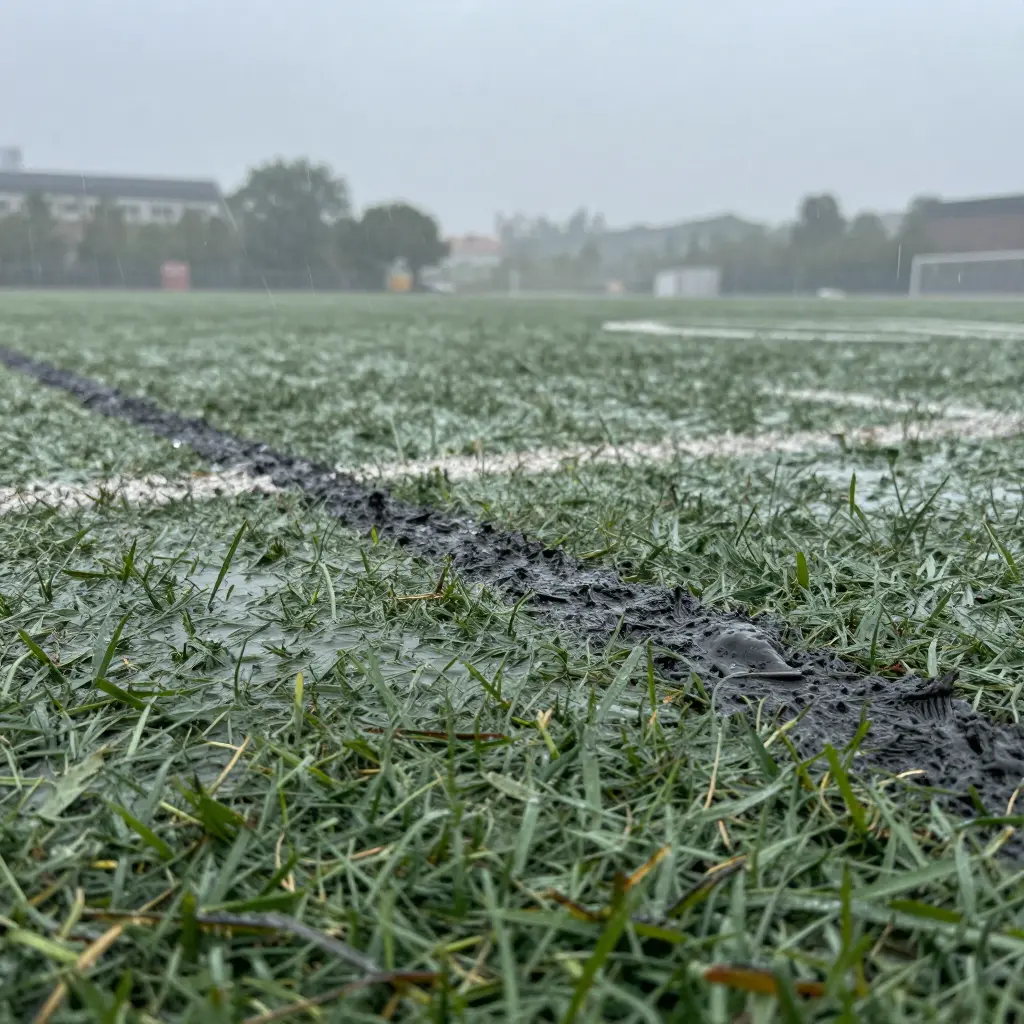
The ground-level version of that afternoon is not the scoreboard but the surface everyone was playing on: the churned turf, the standing water, the little splash that rises where the cleats bite. It’s the least dramatic image of the day, and somehow the most honest one.
Who the wet field put in the spotlight
The names that shaped the afternoon:
| Player | Team | Reported status |
|---|---|---|
| Jayden Daniels | Commanders | Cleared to start |
| Terry McLaurin | Commanders | Active after a game-time decision |
| Stefon Diggs | Commanders | Out |
| Malik Nabers | Giants | Off the final injury report |
None of that is a prediction. It’s the shape of the day: who was on the field, who wasn’t, and how a soaked surface tends to make the difference between them feel smaller and matter more at the same time.
Rain games get described as ugly, and sometimes they are. They’re also the rare kind of game you can actually watch closely. Everything is slower. Everything is closer. On a field like this, the game stops being about the big play and starts being about who can hold their ground.
What to Watch When the Rain Slows It All Down
- Jayden Daniels’ passing rhythm on a wet ball – whether he trusts his grip on throws over the middle or tucks it and runs the moment the pocket starts to close.
- Washington’s ground-game efficiency – with the field turning soggy, how cleanly their backs hit the crease between the tackles matters more than any deep shot.
- The inactive lists’ real footprint – Stefon Diggs is out for Washington and Terry McLaurin is a game-time call, so the Commanders are lining up with a reshuffled cast of targets.
- Ball security in the downpour – fumbles and bobbled snaps decide these muddy, low-scoring games far more often than a single highlight.
- Cam Skattebo’s workload – a heavy-rain script usually means a heavier dose of the Giants’ downhill back, so count his touches early.
- Washington’s safety play – with Nick Cross, Percy Butler, and Tyler Owens all inactive, the depth behind the starters will be tested by crossing routes and the occasional deep shot, and one bust can flip the afternoon.
- Field position and punting – in this kind of weather, the team that wins the hidden yards usually walks away with the win.
Where the Rain Leaves the Game
This one opened with a look at the sky over Landover and a question about how much of the game would actually get played and how much would just get endured. By the end, the answer had less to do with the scoreboard than with everything the water pulled to the surface. When a field turns heavy and a football gets slick, the margin between a clean Sunday and a messy one shrinks to a few inches and a few decisions.
That is what a rain game does. It slows everything down, and in that slower rhythm, the things we usually skip past start to matter. A receiver’s footwork at the top of a route. A lineman’s first step. The way a quarterback grips a ball he knows will not stay dry. The punt that lands and dies instead of rolling. None of these show up in a stat line, but on a day like this they decide drives.
The two variables that hung over the afternoon were the ones we expected: who was actually available, and who could execute the same way twice in the wet. Availability shaped the plan before kickoff. Execution decided whether the plan survived contact with the mud.
So the takeaway is not dramatic, and it does not need to be. The rain did not invent a new game. It just asked both teams the same quiet question: can you do the small things when doing them is harder? On a slow, soaked afternoon, that was always going to be the real test.
Frequently Asked Questions
Is Jayden Daniels playing this week?
Yes. Daniels is set to start for the Commanders against the Giants on Sunday. He missed the previous two games with an injury and was cleared to return for this one.
Is Terry McLaurin playing today?
Yes. McLaurin had been a game-time decision, but Washington’s inactives report confirmed he will play against the Giants. So the Commanders’ top receiver is on the field.
What factors shape a Commanders vs. Giants prediction?
A few things stand out. Washington comes in at 1-3 overall and 0-2 in the NFC East, which makes this effectively a must-win for them. Both teams may be without multiple key contributors, and the Giants head into the game knowing they won’t face Stefon Diggs. Between the stakes and the missing pieces on both sides, the matchup leans on depth rather than star power.
How will the rain affect the game?
Steady rainfall and mild wind from the remnants of Hurricane Isaias were in the forecast. Wet, heavy conditions tend to slow the game down and put more weight on the run game, which is why running backs like the Giants’ Cam Skattebo have drawn extra attention heading into kickoff.