RJ Mitte, the actor and producer best known for playing Walter “Flynn” White Jr. on Breaking Bad, died on October 12, 2026. He was 34. The news broke across major outlets, followed by tributes from his castmates and from disability advocates.
I’m not going to spend this piece on how he died. I’d rather spend it on how he lived, and on what he asked people to understand about him.
The RJ I’ll remember is Flynn: the kid at the breakfast table, the son who chose the name Flynn because Walter Jr. sounded like someone else’s. I’ll also remember an actor who spent his career refusing to let cerebral palsy speak for him. He had it. He talked about it. He never let it do the talking.

Flynn: The One Who Stayed Outside the Business
Walter White Jr., who asked his family to call him Flynn, is the eldest child in the White house. He has cerebral palsy and walks with forearm crutches. The actor who played him, RJ Mitte, also had cerebral palsy, though he had stopped needing walking aids by his teens: the crutches belonged to the character.
Flynn is one of the few characters the criminal world never really touches. He doesn’t cook, launder, or lie his way clear of danger. His worries stay ordinary: school, breakfast, the car his father keeps insisting on buying, whether his parents will stop shouting.
When the family breaks apart, Flynn is usually the last to know and among the first to feel it. He never gets a redemption arc, because he never needed one.
Mitte was clear about how he wanted Flynn read. The character, he said, is a teenager first and a teenager with a disability second. He pushed against pity, not toward it.
That framing mattered on TV between 2008 and 2013, when disability was often shorthand for tragedy or inspiration. Flynn was neither. He was moody, funny, irritating, hungry, and real.
For a lot of viewers he became a reference point: proof that a character can have a disability without the story making it the subject.
Cast and fans have kept naming him since, less as a symbol than as a kid at a dinner table, trying to hold together a family that was already gone.
When someone we’ve watched on screen for years dies, the internet moves faster than the reporting does. So here is a plain, boring table, the kind that helps keep the two apart: facts on the left, noise on the right.
| Reported Facts | Unverified Claims Circulating Online |
|---|---|
| Name: RJ Mitte (Roy Frank Mitte III). Age at death: 34. | Claims he was actually much older or younger than 34 – unverified. |
| Multiple outlets – Variety, The New York Times, NPR, USA Today, TMZ, and People – reported his death in October 2026. | Posts saying he “died years ago,” or mixing him up with other actors’ deaths – unverified. |
| His death has been reported as a suicide. The method has not been described by his family, and I won’t describe it here either. | Detailed accounts of exactly how and where he died, beyond official statements – unverified. |
| His family and representatives asked for privacy and have not released additional personal details. | Screenshots and “sources say” posts about his final days – unverified. |
| He is best known for playing Walter “Flynn” White Jr. on Breaking Bad. | Claims that “Flynn” was played by someone else, or that the role ended his career – unverified. |
| He became engaged to Kennedy Suarez in October 2025 (first reported by People). | Unconfirmed rumors about his relationship status, wedding plans, or breakup – unverified. |
| He had cerebral palsy and was a long-time advocate for disability rights and better representation on screen. | Insinuations that his disability caused or shaped his death – unverified. |
| Tributes came from Bryan Cranston and other Breaking Bad castmates. | Circulating figures about his net worth and finances – unverified. |
If a claim isn’t in the left column, treat it as unconfirmed until a named source stands behind it.
Refusing to Let Cerebral Palsy Speak for Him
RJ Mitte never treated cerebral palsy as a secret, and he never let it write his whole story. He talked about his own diagnosis in plain terms – the leg braces and crutches he used as a child, the way his body moved – without trading on sympathy. In interviews he named the condition, said what it did and didn’t mean, and moved on to the work. When he pushed for change, it was usually on behalf of other people: disabled actors cast in disabled roles, scripts that give a character with a disability the same interior life as everyone else, a screen where a wheelchair is a fact of the scene and not a plot device. Hiring disabled actors isn’t charity, he argued. It’s accuracy. Mitte didn’t spend his career proving he could “overcome” cerebral palsy. He simply refused to let it speak on his behalf.
- Name it, then move on.
- Real roles, not symbols.
- Partnership, not pity.

The Work Beyond Flynn
For a lot of us, RJ Mitte will always be the kid at the breakfast table – Walter White’s son, Flynn (later Walter Jr.), rolling his eyes at his dad across a bowl of cereal. He was there for all five seasons of Breaking Bad. That part was a breakout, not a ceiling, and it never covered the full range of what he kept doing afterward.
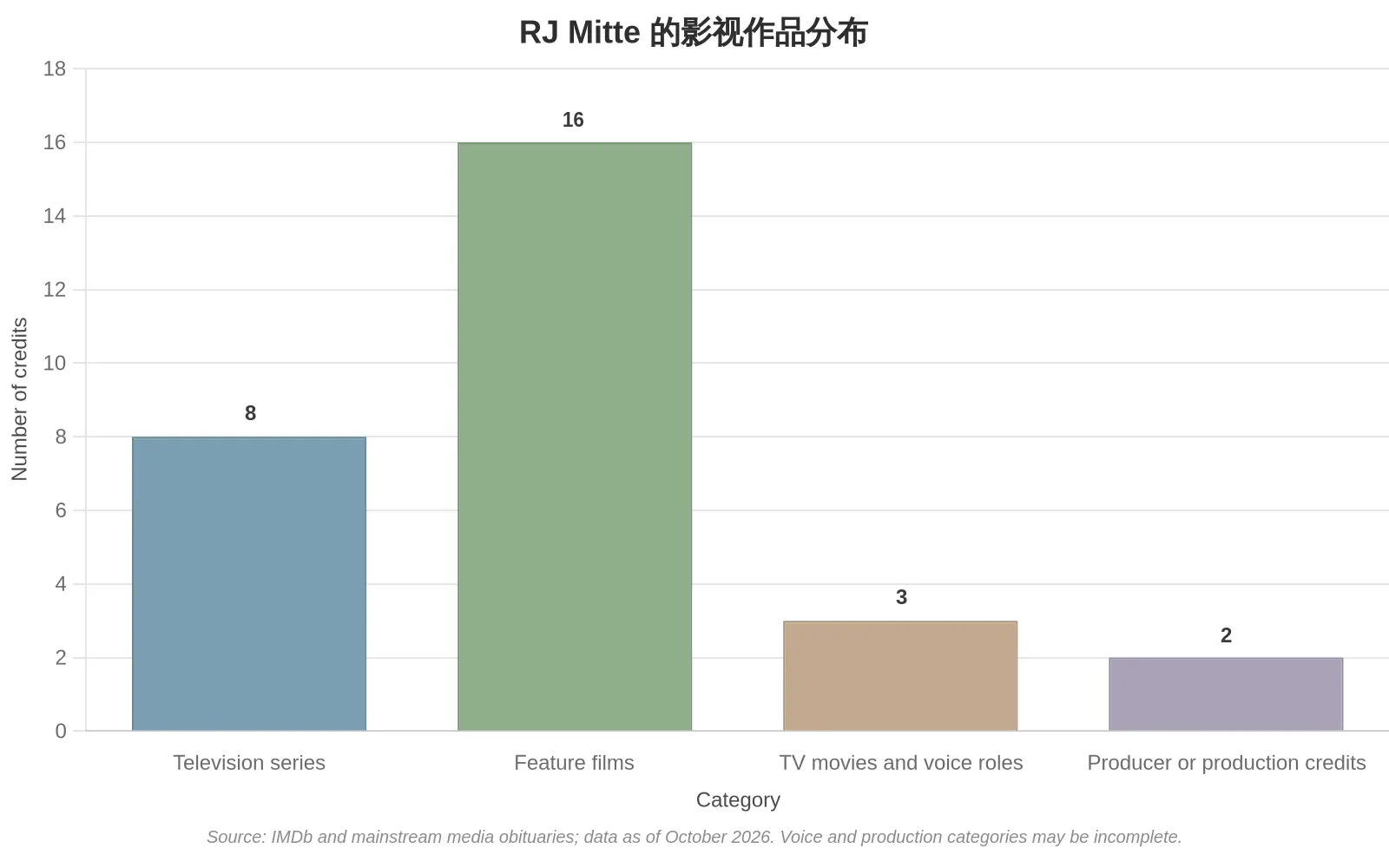
Most of the work that followed lived in smaller rooms: independent film, guest spots on other series, a bit of voice work, and time behind the camera as a producer. Here’s a rough picture of his screen credits by category.
What the Numbers Say
| Category | Approximate credits |
|---|---|
| Television series | 8 |
| Feature films | 16 |
| TV movies and voice roles | 3 |
| Producer or production credits | 2 |
Data source and timing: Figures are compiled from his IMDb filmography and mainstream media obituaries, with statistics as of October 2026.
A note on the gaps: The counts for TV movies and voice roles and for producer or production credits are grouped from sparsely documented public records. Exact totals could not be fully verified, so those two categories are marked as 公开资料不完整 (public information is incomplete). Treat their numbers as a floor, not a finished total.
Why the Breadth Matters
People with disabilities are still often handed one kind of role: the inspirational story, the lesson for someone else, the part defined entirely by a diagnosis. Mitte’s résumé pushed against that. He played characters where cerebral palsy was simply present rather than the plot, and he moved between genres instead of getting parked in one lane.
The chart isn’t meant to rank him against anyone. It’s just a way to see how much was there once you step past one very famous name on one very famous show.
The Industry Speaks
Word travelled fast, and the tributes came from the people who knew him best on set.
Bryan Cranston, who played the father who kept failing Flynn, was among the first to speak. He called Mitte his “sweet son” and led the tributes, his grief carrying a single, unanswered word: “Why?” Aaron Paul and Dean Norris, his co-stars, also shared public reactions, as did Marlee Matlin and Lea Thompson, who worked with him on Switched at Birth. Their words stayed close to the person, not the plot.
Disability advocates responded on their own terms. NPR described him as a “disability rights champion,” a framing that matters, because that’s how much of the community saw him too: not a symbol, not a lesson, just someone who kept pushing the door open for others who came after.
What the industry said was simple: he was loved, and he will be missed.
If you or someone you care about is in crisis, please contact a local mental health crisis line. You don’t have to carry it alone.
The Flynn I’ll Remember
The Flynn I’ll remember isn’t a lesson or a symbol. He’s the kid who asked for the chance to be a person on screen, who insisted his cerebral palsy was one part of him, never the whole of him. RJ Mitte spent his adult life making that point – in interviews, on sets, and in rooms where nobody expected him.
So the way to remember him isn’t another headline or a week of tributes. It’s the work he kept asking for. Let disabled characters be funny and furious and ordinary, not just noble or tragic. Cast disabled actors in roles that have nothing to do with disability. Give people the same shot at the job, the line, the life – in front of the camera and behind it.
To the fans who loved Flynn, to readers who live with cerebral palsy, to the advocates still pushing: keep the argument going. No body should get to speak over the person inside it. A person is, first, themselves. That was the argument he kept making, and it still holds.
Frequently Asked Questions
Who is RJ Mitte?
RJ Mitte was an American actor and producer, best known for playing Walter “Flynn” White Jr. on AMC’s Breaking Bad. He was also a prominent disability rights advocate.
Does RJ Mitte have cerebral palsy?
Yes. Mitte had cerebral palsy and spoke about it openly, and he pushed for more authentic disability representation in film and television.
How did RJ Mitte die, and how old was he?
Mitte died at 34. His representative confirmed the cause of death as suicide. He is remembered by his family, friends, and Breaking Bad castmates.
What was RJ Mitte’s relationship with Kennedy Suarez?
Kennedy Suarez was Mitte’s fiancée. The couple announced their engagement in October 2025.