Tom Hanks’s favorite movie is one that plenty of people once walked out of. He has said more than once that Stanley Kubrick’s 2001: A Space Odyssey is his all-time favorite film. What makes the pick worth noticing is the history attached to it. When the movie opened in 1968, early audiences had no idea what they were watching. Some critics dismissed it, some viewers left before the final act, and a film that now sits on countless best-of lists was, at first, closer to a flop.
That gap between the walkout and the masterpiece is the real story. It says something about how taste gets built over decades rather than minutes, and about how one of Hollywood’s most mainstream actors ended up championing the most abstract, least crowd-pleasing science fiction ever put on a big screen.
It is back in the conversation because Hanks is, again. Warner Bros. is developing an adaptation of Allen Levi’s novel Theo of Golden, with Hanks in talks to star. He turned up in October for a one-night Script in Hand reading at the Westport Country Playhouse in Connecticut alongside Tony Shalhoub and Wendie Malick. And That Thing You Do!, his 1996 directorial debut, just turned thirty, which sent writers back through his career. Add an appearance on Barack Obama’s podcast A Great Book and the usual tabloid noise around his son, and the pattern holds: whenever Hanks resurfaces, people start talking about his taste, his instincts, and the way he thinks about movies. The thread runs through the film he loves most, and the odd company it keeps.
The Night They Walked Out
When 2001: A Space Odyssey opened on April 2, 1968, at the Uptown Theater in Washington, D.C., it did not arrive like a monument. It arrived like a question mark. The reviews split almost down the middle. Some critics praised Stanley Kubrick’s ambition; others had no idea what to do with it. Pauline Kael, writing for McCall’s, called it “a monumentally unimaginative movie”, a line that has aged badly but captures the confusion of the moment.
Then came the walkouts. At early screenings, people left mid-film: some baffled, some bored, some checking their watches. Rock Hudson reportedly walked out of an early Los Angeles screening asking, “Will someone tell me what the hell this is about?” The film was not a clean flop. It lost about $800,000 on its initial 1968 release, then turned profitable after a 1971 re-release. For a while, though, it carried the whiff of a misfire, a director’s vanity project that had drifted too far from what a science-fiction movie was supposed to be.
The disconnect had a few causes.
The pace refuses to hurry. The “Dawn of Man” sequence runs roughly twenty-five minutes with almost no dialogue, just apes, a monolith, and Richard Strauss. That is an eternity for an audience raised on rockets and laser beams.
The film explains almost nothing. Kubrick and co-writer Arthur C. Clarke deliberately left the monolith, the Star Gate, and that final room unexplained. No narrator holds your hand. There is no villain to boo. Even HAL, the closest thing to a character you can argue with, speaks in a calm, reasonable voice.
The language is visual and abstract, not plot-driven. Meaning arrives through image and sound rather than exposition. For a 1968 crowd expecting “a space movie,” it was less a story than an experience, and not everyone wanted one.
Time sorted out the argument.
2001 has one of the strangest arcs in film history: walked out of at first, then folded into the canon. Stage by stage:
| Time period | Mainstream reception | Audience reaction | Spread and word-of-mouth |
|---|---|---|---|
| 1968 premiere | Reviewers split hard: some praised its ambition, others dismissed it. Renata Adler of The New York Times wrote that it was “somewhere between hypnotic and immensely boring”; Pauline Kael, in McCall’s, called it “a monumentally unimaginative movie”. | Walkouts at the New York premiere became part of the film’s legend; Keir Dullea recalled 250 people leaving. Rock Hudson reportedly walked out of an early Los Angeles screening asking what the hell it was about. | MGM relaunched it with the tagline “the ultimate trip,” and younger, counterculture audiences helped turn it into a commercial success. |
| 1970s-80s | A slow critical re-evaluation moved it from oddity to landmark. | Became a midnight-movie and repertory staple with a devoted following. | Circulated through repertory screenings, TV broadcasts, and home video; added to the National Film Registry in 1991. |
| Contemporary | Widely ranked among the greatest films ever made; a regular top-ten finisher in Sight & Sound polls and #1 on AFI’s 2008 science-fiction list. | A canonical classic; filmmakers and fans cite it constantly – Tom Hanks calls it his all-time favorite. | Sustained by restorations, home video, and streaming, and endlessly referenced across film culture. |
The paradox is easy to state: the movie Hanks calls his all-time favorite is one a lot of 1968 audiences could not sit through. 2001: A Space Odyssey was shrugged off on release, slow and spare and wordless where crowds wanted drama. For Hanks, that patience is the whole appeal. It is a film about wonder that trusts you to do the feeling yourself.
That pick makes sense for a man who has spent his career circling the same questions: what we are, what we build, and how small we get against the dark. He played Jim Lovell in Apollo 13, a story about calm equations and duct tape rather than conquest. He helped bring From the Earth to the Moon to television, more interested in engineers and their families than in flag-planting. Band of Brothers put ordinary people up against the machinery of war. Even That Thing You Do!, his own directorial debut, is about a small human moment getting swallowed by something bigger than anyone planned.
None of that is coincidence. Hanks is not drawn to space as spectacle; he is drawn to it as a mirror. Kubrick’s film asks, without ever answering, where the human ends and the tool begins, and Hanks has quietly been asking the same thing his whole career. His love for it reads less like fandom than recognition. He keeps returning to it the way you return to a song that said something true before you knew how to say it yourself.
That Thing You Do! at 30: The Slow Bloom of a So-Called Misfire
The movies we dismiss too early often turn out to be the ones that stick around. Hanks has lived that from both sides of the camera.
His 1996 directorial debut, That Thing You Do!, is the case in point: a modest, nostalgic little film about a fictional one-hit-wonder band called the Wonders. At 30, it keeps finding new audiences. Salon called it “the perfect fake one-hit wonder,” noting that Hanks’s debut “produced a fake song that was undeniable.” Gold Derby marked the anniversary with a feature on how the Wonders built what it calls “the ultimate pop music earworm.” Thirty years on, people are still humming a tune by a band that never existed, a song that made it to No. 41 on the Billboard Hot 100 anyway.
Now set that against Hanks’s all-time favorite film, 2001: A Space Odyssey, which he has publicly championed for years even though it once ranked as walk-out bad. Kubrick’s epic genuinely baffled and bored early audiences before it became the most revered science-fiction film ever made.
Hanks clearly carries that lesson with him. A film’s first reception is just a first draft. What matters is whether it earns a second life, and whether its maker trusts the work enough to let time do its job. That Thing You Do! opened to modest returns, $34.6 million against a $26 million budget, and then spent three decades finding people anyway.
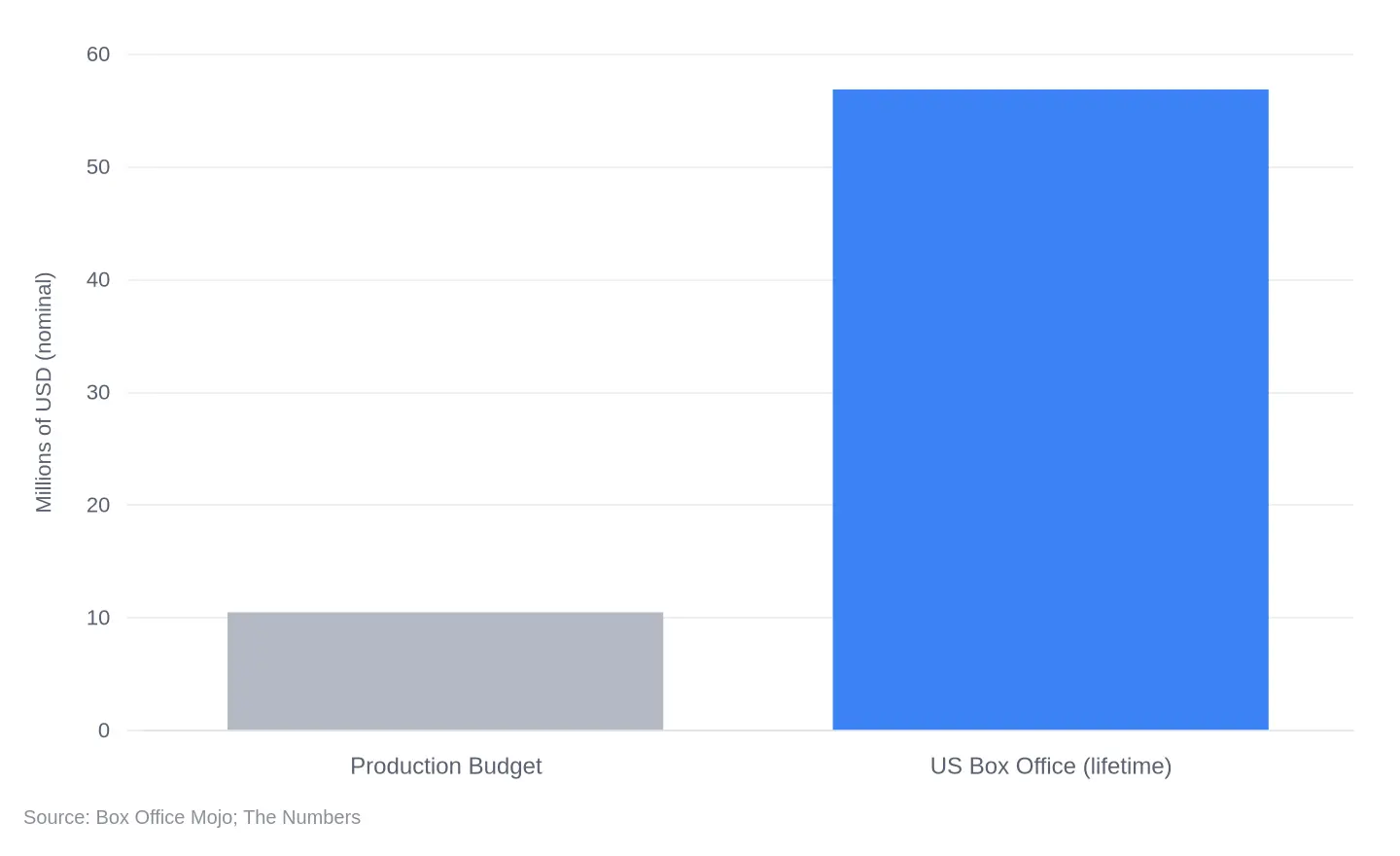
The chart shows the gap between what the film cost and what it eventually earned in US theaters. The truer measure of its value is the half-century of re-releases, restorations, and reappraisals that no opening-weekend tally could ever capture.
The same film, the same running time, two opposite verdicts. How 2001: A Space Odyssey managed both:
-
A mismatch of expectations. Audiences bought a ticket for a conventional space adventure and got something else entirely. Time let the film be judged on what it actually is rather than the promise on the poster.
-
An ending that refuses to close. The unresolved final stretch sent 1968 walkouts home confused. The same ambiguity is what keeps it in the conversation, decade after decade, fueling rewatches and arguments alike.
-
The critics caught up later. Early reviews were split and sometimes baffled, but younger filmmakers and fans kept pointing back to it, and reverence slowly replaced the shrug.
The walkout and the worship are not a contradiction. They are the same qualities landing on two different eras, which is why you can come to the film late, the way Tom Hanks did, and find the most important film you will ever sit through.

A few questions that keep coming up about Kubrick’s polarizing epic and the actor who calls it his favorite.
Why did audiences walk out in 1968?
2001 opened to baffled crowds. Long stretches without dialogue, an unhurried pace, and an abstract finale left plenty of viewers cold, and some simply headed for the exit. Kubrick offered no roadmap, deliberately. Audiences expecting a conventional space adventure got something closer to a dream, and not everyone wanted that. Over time the walkouts became part of the film’s legend rather than a verdict on it.
Why does Tom Hanks love it?
Hanks has called it his all-time favorite. For him it is a rare film that treats space with awe instead of action, letting silence and scale do the work. He admires Kubrick’s patience and the movie’s refusal to explain itself, trusting viewers to sit inside the mystery. That appetite for wonder, not easy answers, shaped how he approaches stories.
How did a flop become a classic?
Time did most of the heavy lifting. Counterculture crowds adopted it as a trip, repeat viewings rewarded patience, and the Star Gate sequence grew into a touchstone. Kubrick’s refusal to explain the ending kept arguments alive for decades, which was free publicity. Film schools, revival houses, and home video then cemented its reputation. A flop quietly turned into a permanent reference point.
Did it shape his own work?
In spirit more than style. Hanks tends to favor ambitious, patient storytelling as a producer and director, and his debut, That Thing You Do!, is nostalgic for a specific era. Sci-fi threads run through Cloud Atlas and Finch too. He rarely chases spectacle alone; he wants the awe feeling, the same thing Kubrick was after.
The thing to hold onto about 2001: it was not rejected because it was bad. It was rejected because it was early. The crowds that walked out in 1968 were not unsophisticated; they were meeting a movie that had not finished arriving yet. Time does not make a film better on its own, but it can make us better at watching. Public taste moves in slow waves, and what reads as failure on opening night is often just a gap between what a work needs and what its moment can give it. Kubrick asked people to sit inside ambiguity and trust images over explanations, a hard ask in any decade, let alone one still learning how to look at space at all.
That gap is where Tom Hanks sits now, calling it his favorite, decades after almost everyone else shrugged. He did not unearth a hidden masterpiece so much as grow into one. That is the quiet force of his choice: movies do not only wait on shelves, they wait on us. We change, and a film that once bored us suddenly sounds like it has been speaking our language the whole time.
So it is worth leaving a little room for the ones you walked out of. Not every abandoned movie is secretly great. But some are simply ahead of you, and the only thing standing between boredom and love is the years in between. If taste is a moving target, then being early to dismiss something is the most ordinary mistake there is, and the easiest one to quietly undo, much later, in a dark room, alone with a film that finally has something to say.