
A Focaldata/Financial Times poll released this week puts former Vice President Kamala Harris 15 points ahead of California Governor Gavin Newsom in the hypothetical 2028 Democratic primary. Other early surveys tell a similar story: Harris and Republican JD Vance lead their parties’ fields. Polls this far out mostly measure name recognition, and no major candidate has formally entered the race. The mismatch is the story: Harris leads by double digits, yet Democratic senators won’t endorse her and likely rivals keep their distance.
The numbers come from a Focaldata survey for the Financial Times, released October 11 and fielded October 2-5 among 2,553 U.S. adults. Every name in it is hypothetical. The midterms are still three weeks away, and no major candidate in either party has announced a 2028 run.
Among Democrats, Harris takes 30 percent to Newsom’s 15, with Pete Buttigieg and Alexandria Ocasio-Cortez tied for third at 9. On the Republican side, JD Vance leads with 38 percent.
Focaldata’s caveat is the usual one: with no declared field and no campaign spending, the survey measures how well-known the candidates are, not how much support they command. Harris, the 2024 nominee, is about as familiar as a Democrat gets. Rankings like these move once candidates start competing for attention, so read the lead as visibility for now, not as a verdict.
Still, the first round of surveys gives a rough sense of where everyone starts.
| Candidate | Current position or identity | Hypothetical primary support |
|---|---|---|
| Kamala Harris | Former Vice President; 2024 Democratic nominee | Leads the field |
| Gavin Newsom | Governor of California | Second; trails Harris by roughly 15 points |
| Pete Buttigieg | Former U.S. Secretary of Transportation | Upper tier, well behind the top two |
| Josh Shapiro | Governor of Pennsylvania | Mid tier; often cited as a moderate option |
| Gretchen Whitmer | Governor of Michigan | Mid tier |
| Andy Beshear | Governor of Kentucky | Mid tier; moderate-leaning |
| JB Pritzker | Governor of Illinois | Lower-mid tier |
| Cory Booker | U.S. Senator, New Jersey | Lower-mid tier |
| Bernie Sanders | U.S. Senator, Vermont; progressive standard-bearer | Progressive benchmark, single digits |
| Alexandria Ocasio-Cortez | U.S. Representative, New York; progressive | Frequently floated on the progressive flank |
| Tim Walz | Governor of Minnesota | Lower tier in early polling |
Sources: Focaldata/Financial Times 2028 poll, fielded October 2-5, 2026 (reported by Newsweek, The Hill, and NorthJersey.com); New York Times Democratic primary polls tracker. The 15-point Harris-Newsom gap comes from the Focaldata survey. Where no precise figure is public, standing is shown as relative position. These numbers track familiarity more than firm support: most voters have not settled on a candidate, and no major candidate has entered the race.
The silence looks less like a snub than a scheduling problem. Democratic senators watching Harris lead the early 2028 polls keep declining to endorse her, and one told Fox News the whole situation was “very messy.” With no declared field and a bruising 2024 loss still fresh, plenty of Democrats would rather wait than spend political capital on a race nobody has entered yet.
- Senators defer, saying it’s simply too early to weigh in on a contest with no announced candidates.
- The 2026 midterms come first, framed by many as the fight that actually decides the party’s near-term future.
- The 2024 defeat lingers, so attaching your name to Harris now means inheriting old arguments and old losses with no clear upside.
- Staying quiet keeps every option open, including the ones that don’t involve her at all.
Read together, the distance looks like caution rather than rejection. Whether it softens after the midterms is anyone’s guess.
Kamala Harris Leads the 2028 Democratic Polls, and Her Own Party Is Still Quiet
If polls could run campaigns, this one would already be over.
A fresh round of surveys puts Harris at the front of the 2028 Democratic field, ahead of California Governor Gavin Newsom by double digits in at least one national poll. By the numbers she is the front-runner, and the headlines keep saying so.
Then you look at the party, and the picture changes. Ask Democratic senators whether they’d back her and they reach for the exits. Potential rivals keep their distance. Nobody is rushing to stand beside her.
A lead in the polls, and silence from her own side.

What the early numbers actually show
These early polls, the kind that arrive long before anyone files paperwork, keep pointing the same way. But it’s worth being precise about what they measure: familiarity, not preference. The Focaldata survey put Harris at 30 percent and Newsom at 15, with Buttigieg and Ocasio-Cortez tied at 9. Harris has held a national profile for years, and the New York Times’ running primary tracker makes the same point – early primary polls mostly reflect name recognition.
So she is genuinely ahead. She is also, at this stage, ahead mostly because people know her name.
The quiet is the story
The louder signal isn’t in the percentages. It is in what party figures say, and don’t say, when microphones appear.
Asked whether they would back a 2028 Harris run, Democratic senators have been careful to the point of evasive. One called the whole thing “very messy.” Others simply moved on.
Meanwhile the party’s next generation is busy elsewhere. Potential candidates turned out in force for the National Action Network’s 35th annual convention in New York, a room full of ambition. What’s scarce is anyone willing to say so while standing next to Harris.
Why the silence
A few threads run through it.
- 2024 still stings. Harris lost, and losses like that don’t fade on a normal timeline.
- The party is saving its energy for 2026. Harris herself is out campaigning for Democrats in the midterms while her own decision waits. It is a convenient arrangement for everyone: she builds goodwill, the party keeps its options open.
- Nobody wants to move first. In a field this unsettled, declaring early mostly hands your rivals a target.
The lead comes with a catch
Her influence over the race carries a catch. Newsom has said he wouldn’t run if Harris does, telling interviewers he “wouldn’t waste everybody’s time.” Others aren’t sure they’d stand aside. The leadership is de facto, not declared, and a front-runner nobody is rushing to endorse has a fragile hold.
What to watch
Two dates matter more than any poll.
The 2026 midterms, where Harris is campaigning for other Democrats and, quietly, making her own case.
And South Carolina, which will hold the first Democratic primary of 2028. Harris hasn’t announced any trip there. The absence is its own signal.
Early polls are a snapshot of memory, not a forecast of will. They tell you who people know, not who they’ll choose. In a party this quiet, the choosing hasn’t started.
The front-runner is alone up there for now. Not because she’s been left behind, but because almost no one else has stepped onto the stage.
The Catch in Harris’s Front-Runner Status
Her lead is not a mandate; it’s a memory. Harris tops these surveys because she is the best-known name in a field almost no one has formally entered, and early numbers measure recognition before they measure anything else. That cuts both ways. To her supporters it proves she has earned another shot. To a party still bruised by 2024, it’s a reminder of a loss it hasn’t finished grieving. The senators dodging the question aren’t being disloyal; they’re reading a room that wants a new face it can’t yet name. My take: she enters 2028 as the front-runner by default, not by acclamation. Beating Newsom in a poll isn’t the test. Convincing a skeptical party that her fame is an asset worth spending, rather than a habit worth breaking, is.
Where the Two Parties Stand
The two parties’ early numbers look different. Among Democrats, the field is crowded but sloped: Harris on top, Newsom clearly second, then a long, flat tail of contenders still waiting for their moment. Among Republicans the gap is steeper, with JD Vance taking most of the oxygen while the rest cluster far behind.
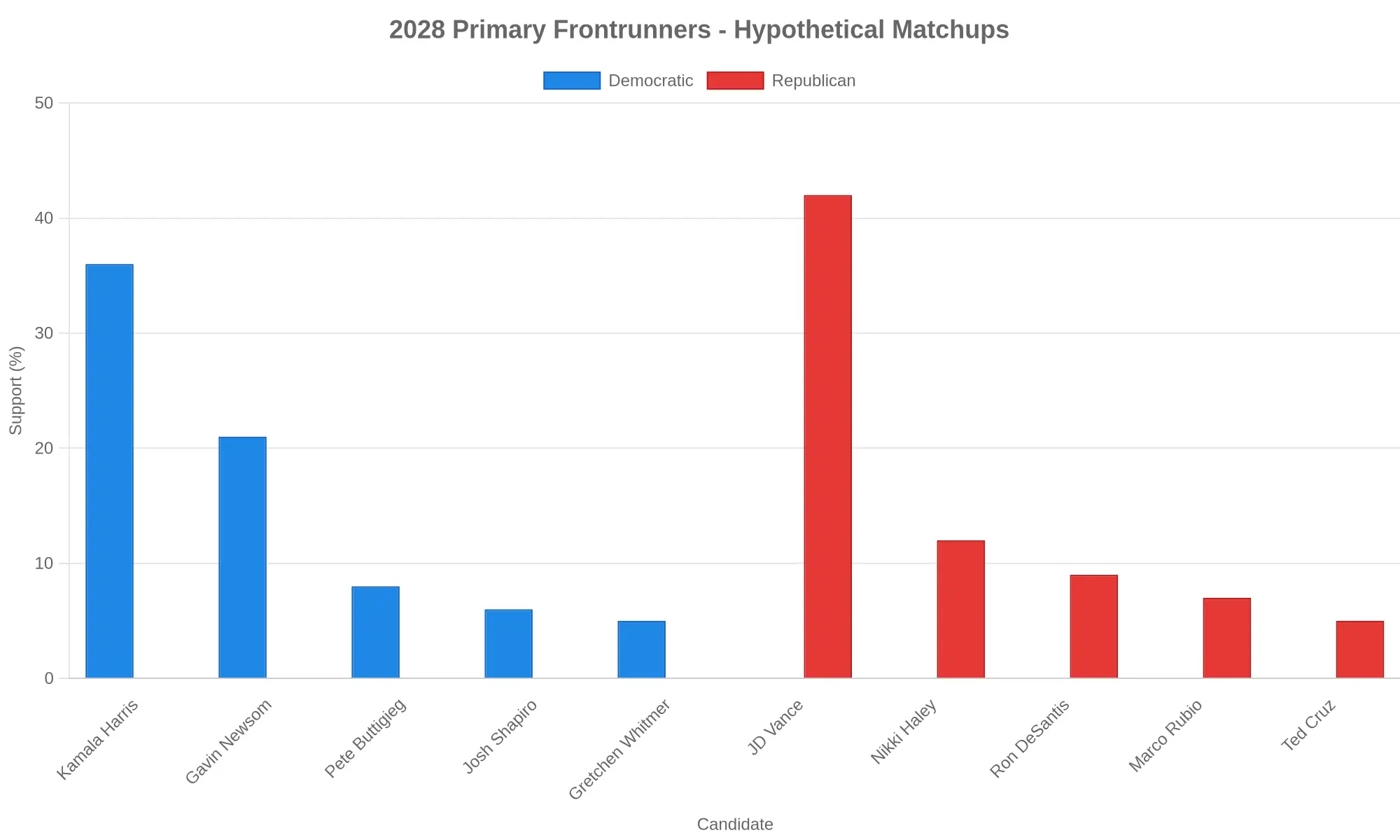
Two things stand out. The Democratic lead is real but not commanding: a 15-point margin over Newsom is what name recognition alone can produce this early. And Vance’s lead is wider still. In both parties, the front-runner is defined less by consensus than by the fact that no rival has broken away from the pack.
Treat these as a snapshot, not a forecast. It is October 2026, no major candidate has declared, and the first primary votes are more than two years away.
Harris’s near-term moves say something too. She’s spending her political capital on the 2026 midterms, campaigning for other Democrats instead of testing a national message. She still hasn’t announced a trip to South Carolina, which will hold Democrats’ first primary in 2028. That silence looks deliberate: an early visit would signal a campaign in waiting, and she seems in no rush to say so out loud.
What to watch, roughly in order:
- When she announces. Timing matters as much as the message, and a late entry carries different costs than an early one.
- South Carolina. Any scheduled stop would be the clearest signal yet of intent.
- Poll structure. Her name-recognition lead is real, but watch whether it holds once voters get to know alternatives like Gavin Newsom.
There is a particular stillness to a room like this, an hour before anyone shows up. The chairs are lined up, the podium is empty, and the room holds its breath.
Frequently Asked Questions
Who is leading the 2028 Democratic polls right now?
Kamala Harris. The Focaldata/Financial Times poll released October 11 put her at 30 percent to Gavin Newsom’s 15, opening a 15-point lead over the California governor (Newsweek). It’s an early snapshot, but she is the clear name at the top. On the other side of the aisle, JD Vance leads the Republican field.
Are these early polls actually reliable?
Not very – and the pollsters say so. The New York Times notes that early primary polls “broadly reflect name recognition” more than real support. With no major candidate officially in the race, a poll mostly measures who voters already know, not who they’d ultimately back. Think of it as a temperature check, not a forecast.
Has Kamala Harris announced she’s running in 2028?
No. She has said she’s “thinking about it,” but she hasn’t declared anything. She’s been out campaigning for Democrats in the 2026 midterms while her 2028 decision “looms” (PBS). She also hasn’t announced any trips to South Carolina, where Democrats will hold their first primary – a telling omission for anyone quietly building a national operation.
Why is the Democratic Party staying so quiet about it?
A few reasons, all tangled together. Some senators say it’s “very messy” to commit this early (Fox News). Newsweek reports that Newsom would “step aside” if Harris runs, while other Democrats keep their distance. Part of the silence is strategy – no one wants to be the first to move. Part of it is genuine uncertainty. And part of it is the reality that Harris’s influence over 2028 comes with a catch: she’s the front-runner, but the party isn’t ready to say it out loud.
Who else might run?
The list is still forming. A crowd of potential 2028 Democratic names gathered in New York City for the National Action Network’s 35th anniversary convention (ABC News) – plenty of people testing the waters, even if nobody’s jumping in yet.