The Philadelphia Eagles ruled out quarterback Jalen Hurts for Sunday’s game against the Carolina Panthers after a blood clot was found in his calf, and they put the decision in an official statement rather than letting it leak. The NFL later confirmed it had communicated with the Eagles about the situation before the game. Beyond those two things, the public record is thin.
The team has not said how many games Hurts will miss, or when he might return. Any number circulating is an estimate, not an announcement. Ruling a player out is a decision a team can make in an afternoon; a prognosis is not, which is why the Eagles have been explicit about the first and quiet about the second.
Tanner McKee moves up to starter, and reports have Philadelphia adding Joe Milton off the Cowboys’ practice squad. Both moves look like contingency planning: a backup who has been in the system, plus a third arm for practice. Neither carries a medical opinion about the length of the absence.
The medical conversation has narrowed to a single adjective. A former NFL team doctor said publicly that Hurts’ season turns on whether the clot is characterized as superficial, the term for clots in veins near the surface rather than in the deeper vessels that carry different risks. He was describing the category, not the case. Whether it fits Hurts is a question for the team and its physicians, and neither has said so on the record. Fans and fantasy managers can read the word, but they cannot fill it in for him.
Games missed are the visible cost, and the easiest thing to count. What the clot is called decides the treatment plan, the clearance process, and how much of the season Hurts can play at his usual level. A few weeks is a scheduling problem. The label is a season problem.
The Word That Carries More Than the Headline
The Eagles have not used the word “superficial” about Hurts’ clot on the record. It entered the story through a former team doctor’s public comments, and it has shaped more of the coverage than any estimate of weeks.
That ordering is medically correct. A week count is a schedule. A descriptor is a diagnosis with a treatment pathway attached, and coaches, trainers and roster planners work from the pathway first, the calendar second.
Why one adjective outranks the timeline
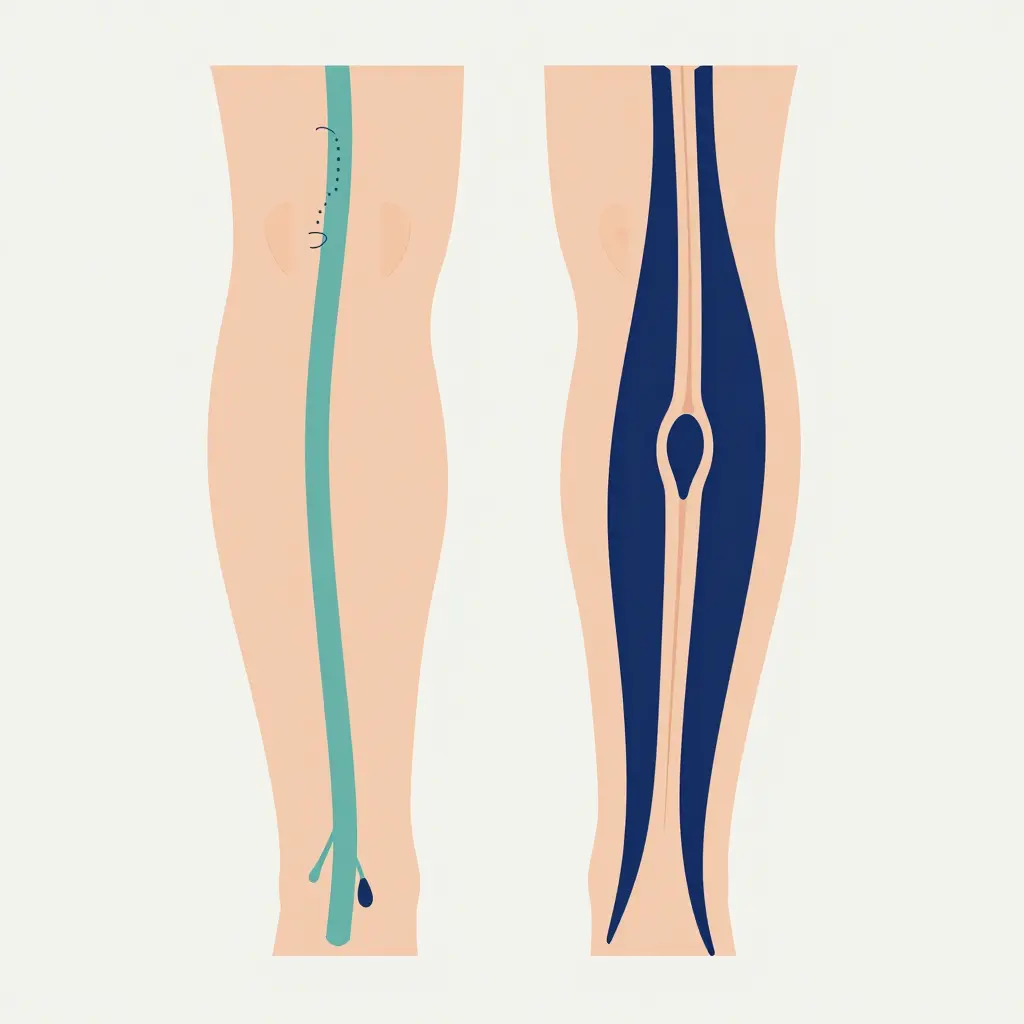
Clots in the leg are sorted by the vessels they occupy. Superficial veins run close to the skin and are named for it. Deep veins sit inside the calf muscle and further up toward the pelvis, and that is where most of the pulmonary risk lives.
| Superficial vein clot (general framing) | Deep vein clot (general framing) | |
|---|---|---|
| Typical concern level | Lower, often managed with monitoring and symptom control | Higher, watched closely for movement toward the lungs |
| Medication course | Sometimes none, sometimes a short course | More often a structured course of blood thinners |
| Return timeline | Usually measured in days to a few weeks | Usually measured against follow-up imaging |
The distinction is not cosmetic. It changes the risk conversation, the medication conversation and the return-to-play conversation, which is why the words a team or a doctor chooses get read so closely by people who treat this for a living. It also means the adjective is a statement about location, not a grade of severity.
None of it describes Hurts’ clot. It describes the terrain the word sits in. His own case belongs to his physicians, and they have not discussed it in public.
What is actually confirmed, and what is not
Confirmed: the Eagles issued a statement; Hurts is out for Sunday against Carolina. The league confirmed pregame contact with the team, which is the paperwork side of an injury, a sign that the process ran rather than a second medical opinion.
Not confirmed: how long he is out, whether he is on blood thinners, whether imaging will be repeated, whether he practices next week.
Also reported, by multiple outlets on Friday: Philadelphia planned to sign Milton off Dallas’ practice squad. Roster moves are the least sentimental information a team produces, and nobody takes a quarterback off another team’s practice squad to cover one Sunday.
How to read the restraint
Say too much and you own a timeline you cannot keep. Say too little and the guesses get worse. The statement sits in the narrow middle, which is where it has to sit while follow-up imaging is still ahead.
What “superficial” describes is where the clot is, not how bad it is. Reading it as “basically nothing” and reading it as a lost season are the same mistake in opposite directions: both fill a gap the team left open on purpose.
| Dimension | Superficial thrombosis | Deep vein thrombosis (DVT) |
|---|---|---|
| Where it forms | Veins just under the skin, most often in the leg (for example the great saphenous vein) | Deep veins of the calf, thigh or pelvis |
| Main risk | Local pain, redness and a firm cord-like vein; pulmonary embolism is uncommon but becomes a real concern if the clot grows toward the deep system near the groin | Clot growth and pulmonary embolism, plus longer-term post-thrombotic symptoms in the leg |
| Typical management | Often conservative: activity adjustment, compression, anti-inflammatory pain relief, and repeat ultrasound to watch for extension; blood thinners in selected higher-risk cases | Anticoagulation for roughly three months or longer, compression, and a period of restricted activity while the clot stabilizes |
| Typical effect on return to play | Usually days to a few weeks, guided by symptoms and follow-up imaging; rarely season-ending | Often weeks to months, and return while still on blood thinners raises its own contact-sport questions |
The table maps two different clinical neighborhoods; it does not grade Hurts’ clot. What the label leaves out is size, position along the vein, and how close the clot sits to the deep system. Those details come from imaging, and they move the estimate more than the label does.
General medical information only. This is not a diagnosis or prognosis for Jalen Hurts or any other player.

The Word Doctors Keep Slowing Down On
Within a day the story had a roster move, a backup quarterback question and a season described as hanging in the balance. Tanner McKee and Joe Milton are now part of that conversation. The adjective that decides the medical plan was missing from most of it: superficial.
Asked about the diagnosis, a former NFL team doctor put the season’s direction on that word rather than on a week count. In a headline it reads like a riddle. In a training room it is about as direct as a doctor can be without examining the patient.
Superficial and deep do not sit in the same risk tier
A clot in a vein near the skin and a clot in a deep vein get different monitoring, different drugs and different return criteria. Superficial clots are often managed conservatively, with compression, anti-inflammatory pain relief and repeat ultrasound. Deep clots more often mean a structured course of anticoagulation and close attention to any movement toward the lungs. Every clause in that paragraph needs a qualifier, generally, typically, usually, and the qualifiers are doing real work here. Lower risk is not the same as no risk, and the category describes how a clot is watched and treated, not how quickly an athlete can run back onto a field.
Anticoagulation tends to close the contact-sport door
Symptoms often improve before the medication course ends. While a player is on anticoagulation, contact football is generally not on the table, and the reason is bleeding risk after trauma rather than pain tolerance or conditioning. A report that Hurts feels fine, or is moving well, or is around the facility says very little about availability. Nobody puts a quarterback under center while the medication is still doing its job, and no amount of practice reps changes that.
The return date belongs to the imaging, not the expectations
Repeat imaging, whether the clot is resolving, and the length of the medication course set the calendar. Public expectation, a week, two weeks, until the bye, is not a variable in that equation. When coaches describe a situation as week to week, that is often an accurate account of a schedule built on scan results rather than an evasion.
Medical language holds uncertainty inside a single word. Public conversation compresses it into a verdict. Superficial gets heard as “minor,” blood clot as “serious,” and both shortcuts skip the part where a doctor is naming a category instead of issuing a forecast. That gap between what was said and what got repeated is where most injury stories go wrong.
Three Quarterbacks, One Chart
The depth-chart argument is easier to have with the 2024 numbers in front of it. Below are the 2024 regular-season passing lines for Jalen Hurts, Tanner McKee and Joe Milton.
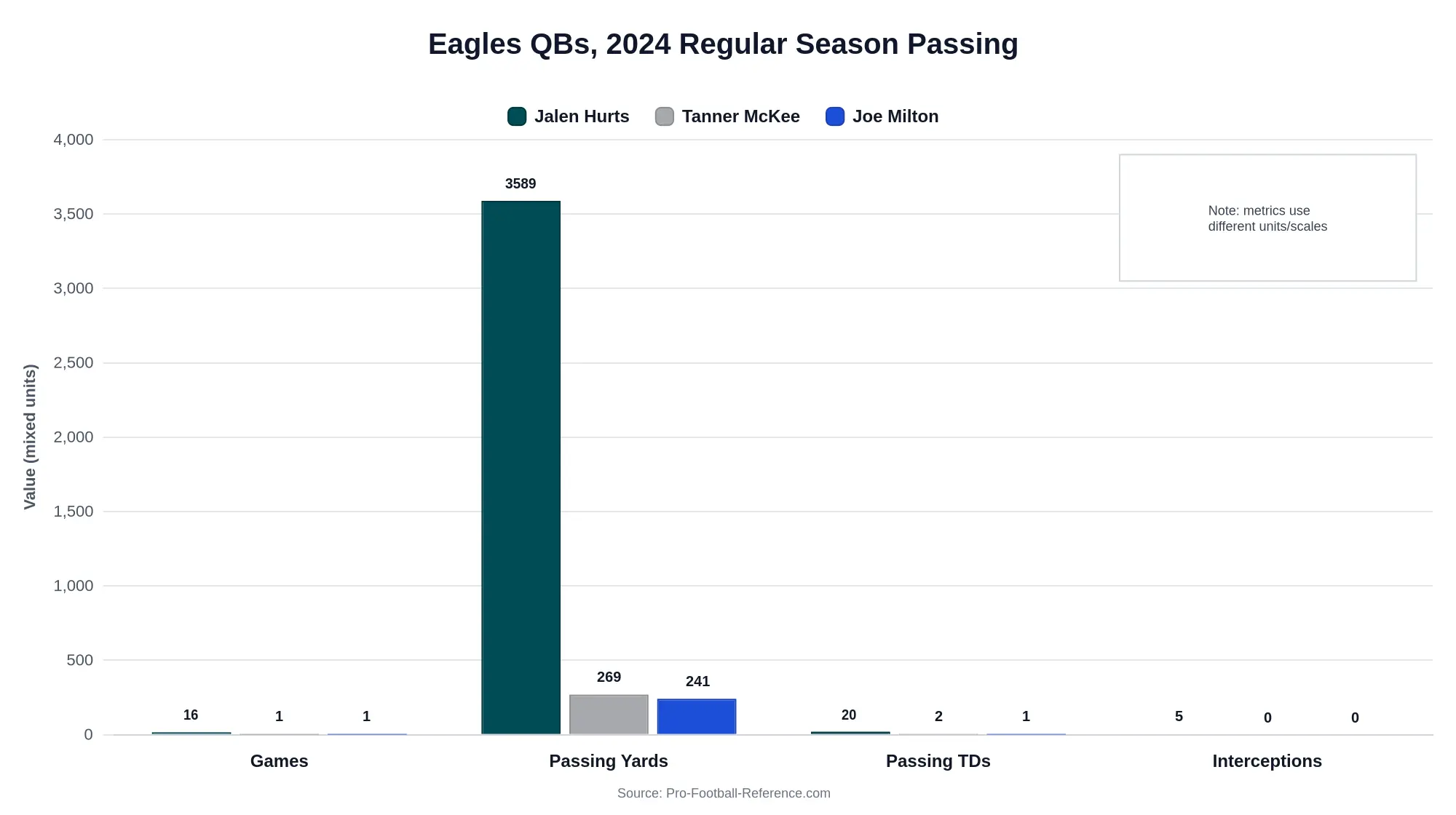
2024 NFL regular season, per Pro-Football-Reference.com. Games, yards, touchdowns and interceptions use different scales, so read each cluster on its own rather than comparing heights across clusters. McKee (one game, one start) and Milton (one game, one start, for New England) have a one-afternoon sample, reference only; their bars reflect a single game, not a season-long baseline.
Hurts’s 16-game body of work against two one-game cameos is not a ranking of who the better quarterback is. The gap is accumulated reps against ready-now experience, and that is the gap that matters this week.
Tanner McKee Is Getting an Evaluation, Not a Fill-In Week
The easy read on a backup quarterback is that he is a bridge: hold the offense together, hand the ball back, wait for the starter’s calf to behave. That undersells what is happening in Philadelphia. McKee is a third-year player the Eagles drafted, developed and kept, and this is the first time the organization gets to watch him run its offense in a game that counts with a normal week of preparation. One start does not settle a career, but it is a substantive look rather than an emergency patch.
What the file says
The background explains why the staff is comfortable handing him the offense instead of reshaping the plan around a veteran.
| Item | Detail |
|---|---|
| Draft | Round 6, No. 188 overall, 2023 |
| College | Stanford |
| 2023 depth chart | Third, after Jalen Hurts and Marcus Mariota |
| 2024 depth chart | Third, after Hurts and Kenny Pickett |
| 2025 depth chart | Backup, after Pickett’s departure |
| Starting experience | Week 18 start against the Giants (2024 season) |
The part people skip past is the time in the system. McKee has heard the same protections and the same route adjustments through three offseasons, and he has been the steadiest quarterback in Eagles preseasons the last two summers. Preseason numbers flatter almost everyone, so the traits are more telling than the stats: he gets the ball out on schedule, he throws to spots before receivers break, and he will put the ball into tight windows over the middle. Those travel from August to October.
The limits are just as real. The regular-season sample is one start, and that start came with mostly reserve lineups on both sides and nothing at stake in the standings. A game against a live pass rush, with the run game and the season both mattering, is a different exam. McKee is also not a runner. His pocket movement is functional rather than a weapon, and the Eagles’ offense has spent three years built around a quarterback who is a designed part of the running game.
The decision to add Joe Milton off the Cowboys’ practice squad is roster arithmetic rather than a depth-chart verdict. With the starter out, a third arm absorbs practice reps and covers the emergency quarterback rule. It does not open a competition for Sunday.
Where the offense bends
Expect the plan to shift toward what McKee does well rather than ask him to impersonate the starter.
- Fewer called quarterback runs and fewer run-pass options. The offense loses the threat that has kept edge defenders honest for three seasons.
- More snaps under center with play-action, which suits a quarterback who reads on rhythm and gives the line a cleaner picture, plus heavier two-tight-end and two-back groupings on early downs to keep the box light and shorten the read.
- A quicker passing game, with screens and shallow crossers, to manufacture the yards Hurts normally creates when the pocket breaks.
- More motion and tighter formations before the snap, so coverage declares itself, and a slower pace with a longer huddle while the defense and the run game carry more of the load.
A box score with 34 or 38 attempts would be a warning sign, not a compliment. The version of this that works looks like efficient volume, few turnover-worthy throws, and a running game that stays on schedule.
The honest bottom line
Whether McKee is the long-term answer in Philadelphia is a separate question from the one this month answers. After three years of development, the Eagles get a real read on a player whose contract and role both come up for a decision soon. If he manages the offense, protects the ball and moves the chains on third down, that is a successful evaluation even if the passing numbers stay modest. If the game looks too fast, the team learns that too, and it learns it in a week that was going to be difficult no matter who took the snaps.
McKee is about to get a stretch of games where the grading is specific rather than general. What should actually show up on tape:
- Getting the ball out on time from inside the pocket. The offense is built on reading the rotation and releasing at the top of the drop, so if McKee waits past three seconds for a clean picture, the protection will look worse than it is and the whole rhythm collapses.
- Keeping the intermediate throws on schedule. The 12-to-20 yard window over the middle is where a backup either moves the chains or turns into a checkdown quarterback, and it is the throw that decides whether defenses can crowd the line.
- Protecting the ball. Turnovers are the quickest way for a short-term starter to lose the huddle, and three clean games with zero giveaways will buy more trust than one 300-yard afternoon with two picks.
- Handling the pre-snap mechanics without burning timeouts. Hurts ran a lot of that himself, so if McKee needs the sideline to fix a protection or a run-pass check, the tempo and the third-and-short, red-zone situations get squeezed fast.
The Milton signing, read as what it is
The Eagles signed quarterback Joe Milton off the Dallas Cowboys’ practice squad on Friday, according to multiple reports. It landed the same week the team ruled Jalen Hurts out for Sunday’s game against Carolina with a blood clot in his calf, and alongside reporting that Hurts could face an extended absence.
Start with the mechanics, because they explain more than the headline does. Signing a player off another team’s practice squad is not a free transaction. He has to be placed on the 53-man roster, which means a spot gets spent and someone else gets moved to make room. Teams are careful with those spots in October. They don’t spend one on a third quarterback they hope never takes a snap unless the math at the position has changed.
What the math looks like now:
| Spot | Player | Status |
|---|---|---|
| 1 | Jalen Hurts | Out vs. Panthers (blood clot in calf); no timeline offered |
| 2 | Tanner McKee | In line to start Sunday; the most meaningful reps of his career |
| 3 | Joe Milton | Signed off the Cowboys practice squad Friday |
Why this isn’t a verdict on McKee
The easy misreading is that adding a quarterback means the coaching staff is hedging on Tanner McKee. The order of operations says otherwise. McKee is the starter this week. Milton arrives as the third man, with a strong arm, a handful of regular-season snaps from his rookie year in New England, and one practical function: he can absorb scout-team and backup reps so McKee’s week isn’t split between preparing to start and running someone else’s offense.
That is roster depth and risk management. Three quarterbacks on the active roster is the shape a team takes when the top of the depth chart has no return date, not the shape it takes when it has decided the second man can’t play.
What “extended absence” actually changes
The phrasing matters more than any single report attached to it. “Out this week” is a plan. “Could face an extended absence” is an open-ended planning horizon, and open-ended horizons push teams toward structures rather than patches: a third quarterback on the 53 instead of a name on a call-up list, protections assigned differently at the back end of the roster, a Sunday inactive list built with insurance in mind.
It also reshapes the hierarchy without demoting anyone. Hurts remains the starter in the building’s own framing, with no timeline attached. McKee moves from backup to bridge. Milton moves from another team’s practice squad to a seat in the room. What the move does not tell us is anything about how the locker room feels about it. Nobody outside the facility has that, and the transaction offers no hint.
What the league actually confirmed
The NFL confirmed it had pregame communications with the Eagles about Jalen Hurts’ blood clot. Read that sentence closely, because it is narrower than the headlines around it. It does not say the league cleared him, overruled anyone, or learned something late. It says conversations happened before kickoff, which is close to what the reporting process is designed to produce: a team reaches a medical conclusion, files a game status, and the league checks the paperwork.
The Eagles had already ruled Hurts out against the Panthers and issued their own statement a day earlier. The league’s confirmation arrived after that, not instead of it. Nothing in the reporting suggests a gap between what the team knew and what it said, and nothing suggests pressure in either direction.
Where the line normally sits
The injury report is a competitive-balance document, not a medical chart. Teams owe opponents and the public an accurate status: practice participation, questionable, doubtful, out. They owe the player something else, which is that a diagnosis stays between him, the team’s physicians, and whatever specialists he sees. The league’s job in that arrangement is monitoring compliance, not narrating blood work.
Superficial is the clearest illustration of why the distinction matters, and a former NFL team doctor made the point this week: a clot in a surface vein is a different problem from one in a deep vein, with a different timeline attached. Precision in that language is not spin. It is the difference between two conditions that happen to share a name.
| Confirmed | Not established in the reporting |
|---|---|
| Hurts ruled out for the Panthers game with a blood clot in his calf | How long he will be sidelined |
| The Eagles issued a statement and the NFL confirmed pregame communication | Any disagreement between team and league |
| Tanner McKee moves into the starting role | Whether the clot is superficial or deep, beyond the phrasing under discussion |
| Dak Prescott, reported to have spoken about athletes and health decisions | That his comments were directed at Hurts |
Prescott’s wider point
Prescott’s advice, reported in the wake of the news, was addressed to athletes in general rather than to one quarterback, and nothing in that reporting ties his comments to Hurts. The framing is the useful part. Health decisions in the NFL belong to players and physicians, and the public conversation around an injury runs alongside the medical one, sometimes loudly, usually without the file.
The cost of guessing
Transparency matters because it lowers the price of speculation, not because it satisfies curiosity.
When a team rules a player out, states the condition in plain language, and the league confirms the process was followed, fans, fantasy managers and call-in shows stop building theories about a cover-up and start asking questions that have answers. Who starts. How long. What the word means. In that vacuum, silence gets filled with worse information than the truth would have been, and the player ends up answering for rumors he never created.
Full disclosure is not the standard and should not be. Nobody asks a linebacker for daily updates on a clot, and no other workplace hands the public a running medical commentary. What was disclosed this week is enough to end the guessing about motive. Curiosity about the rest is natural, but it is not owed, and treating it as an entitlement turns a reasonable disclosure process into a demand for someone’s chart.
The boundary holds in both directions. Teams should say what affects availability, quickly and in words a fan can parse. Everyone else can let the rest stay where it belongs.
Where This Leaves Things
The word that keeps coming back is superficial, and it is a term about depth, not comfort. It says where the clot sits, not how long it lingers or how a body answers weeks of treatment. Everything written before the next medical update is an educated guess with a headline on it, because the calendar is set by a recheck and a medication cycle nobody outside the building can see. The Eagles can add a quarterback and McKee can look sharp in practice, and none of it moves the date.
What will actually change the picture:
- The follow-up imaging and vascular recheck. Whether the clot is resolving on schedule will matter more than any depth chart.
- McKee’s game performance. Practice reps and a live pocket are different exams, and the answer shows up in ball placement and decision speed, not in quotes.
- The roster moves that follow. Signing Joe Milton off another team’s practice squad reads as planning in weeks rather than in one Sunday.
None of this is settled yet, and nothing written this week will settle it.

Placement and spec
- Position: directly after the closing paragraph, as the final element of the article. Full-bleed width, no caption beneath it.
- Ratio: 16:9 (crop from 2400×1350); keep the horizon in the lower third if a tighter crop is needed.
- Palette: low saturation only. Dusty slate blue, faded sage, pale sand, soft graphite. No team colors, no bright accent.
- Composition notes: field lines run low and horizontal, so the frame reads as a surface rather than a scene. The geometric cluster sits off-center left and slightly high; the right third stays nearly empty, holding the pause. One shape is left unfinished, its outline breaking into dots. A single block in the foreground grass stays put and throws a long shadow, something waiting, not something leaving.
- Type: editorial illustration, grainy paper texture, soft overcast light, screen-print feel. No lettering, numerals, logos, icons, or chart marks anywhere in the frame.
- Alt text (as written above): abstract shapes over faded yard lines, one shape dissolving into dots, a lone block with a long shadow, wide empty space to the right.
Why it works here: the straight lines say structure and schedule; the soft, incomplete shapes say the timeline is not settled. Nothing in the image asks for a conclusion, which is the point: the answer is still on hold.
FAQ: What Readers Are Asking
What is a superficial blood clot, exactly?
A superficial blood clot forms in a vein close to the surface of the skin, most often in the leg, rather than in the deep veins. Doctors call it superficial thrombophlebitis, and it tends to announce itself as a tender, warm, sometimes reddish cord running along the vein. It is a different diagnosis from a deep vein thrombosis, which sits in larger veins deeper in the body and carries more serious risks.
Is a superficial blood clot dangerous?
For most people it is uncomfortable more than it is life threatening, and it often settles with rest, compression and anti-inflammatory care. The caveat is size and location: clots sitting near the junction where superficial veins meet the deep system get watched more closely, and a person’s history matters too. That is why a former NFL team doctor told reporters this week that the season hinges on one word, superficial, and why the Eagles’ medical staff, not a headline, will set the plan.
Is Jalen Hurts actually injured, and when does he come back?
Yes. The Eagles ruled him out for Sunday’s game against the Panthers with a blood clot in his calf, and the team issued its own statement confirming it. On a return date, the team and league have not given a timeline; the NFL confirmed only that it had pregame communication with the Eagles about the situation. Anyone handing you a specific week is guessing.
Who is the Eagles backup quarterback now?
Tanner McKee is the in-house backup and gets the start, the biggest opportunity of his young career after holding the QB2 job. The Eagles also moved to sign Joe Milton off the Cowboys’ practice squad, which reads as depth and insurance more than an open competition. Expect McKee to run the offense as installed while Milton catches up on the playbook.
What does this mean for the Eagles’ season?
Short term, it means at least a game of McKee, a leaner game plan and a heavier run game. Beyond that, everything depends on the medical read, and the team and league have not given a timeline, so the fair answer is that the next few weeks are on hold until that clarity arrives. The Milton signing reads as preparation for a multi-week absence, even though nobody has said so out loud.