I keep thinking about that nest cam
For a while, that nest cam was part of my morning. Coffee, laptop, the live feed from Big Bear. Jackie would be there or she wouldn’t, and either way I waited. Nobody plans to get attached to a 24-hour stream. You check in, then you check in again, and a bird in a tree thousands of miles away starts to feel like a neighbor.
So the news landed differently than I expected. Jackie, the bald eagle so many of us watched on that camera, had died in August at the Ojai Raptor Center, after more than three weeks of intensive care. Now the necropsy had a cause: highly pathogenic avian influenza. The infection produced a severe ulcer in her stomach that bled persistently, left her anemic, and let bacteria into her body. No mystery left in it. Just a virus, and a report that says so.
I didn’t know her the way a biologist would. But I knew her mornings, the way you know a neighbor’s light coming on. Silly, maybe. It’s a camera pointed at a tree, and she was just going about her day. Still, I keep coming back to it.
The report is public now, which ends the weeks of guessing. Here is what it says, and what it leaves open.
Confirmed by the necropsy:
- The California Department of Fish and Wildlife, working with the San Diego Zoo Wildlife Alliance and the Ojai Raptor Center, named HPAI the primary underlying cause of Jackie’s decline and death.
- HPAI was the primary cause, not an incidental finding. Testing also detected brodifacoum, an anticoagulant rodenticide, in her liver, but pathologists ruled it out as the primary cause.
- Officials said her remains were cremated by the U.S. Fish and Wildlife Service’s National Eagle Repository.
- There is no evidence that her mate, Shadow, or the eaglets were sick. Shadow remains in Big Bear.
Not yet established:
- How or where Jackie was exposed. The report names a cause of death, not a route of infection.
- Whether the virus reached other birds in the area, or what it might mean for the wider population.
That gap is worth sitting with. A necropsy can describe what happened inside one bird with real precision. It can’t explain a valley, or the millions of people who watched that nest from a browser tab and started to care.
What HPAI actually means
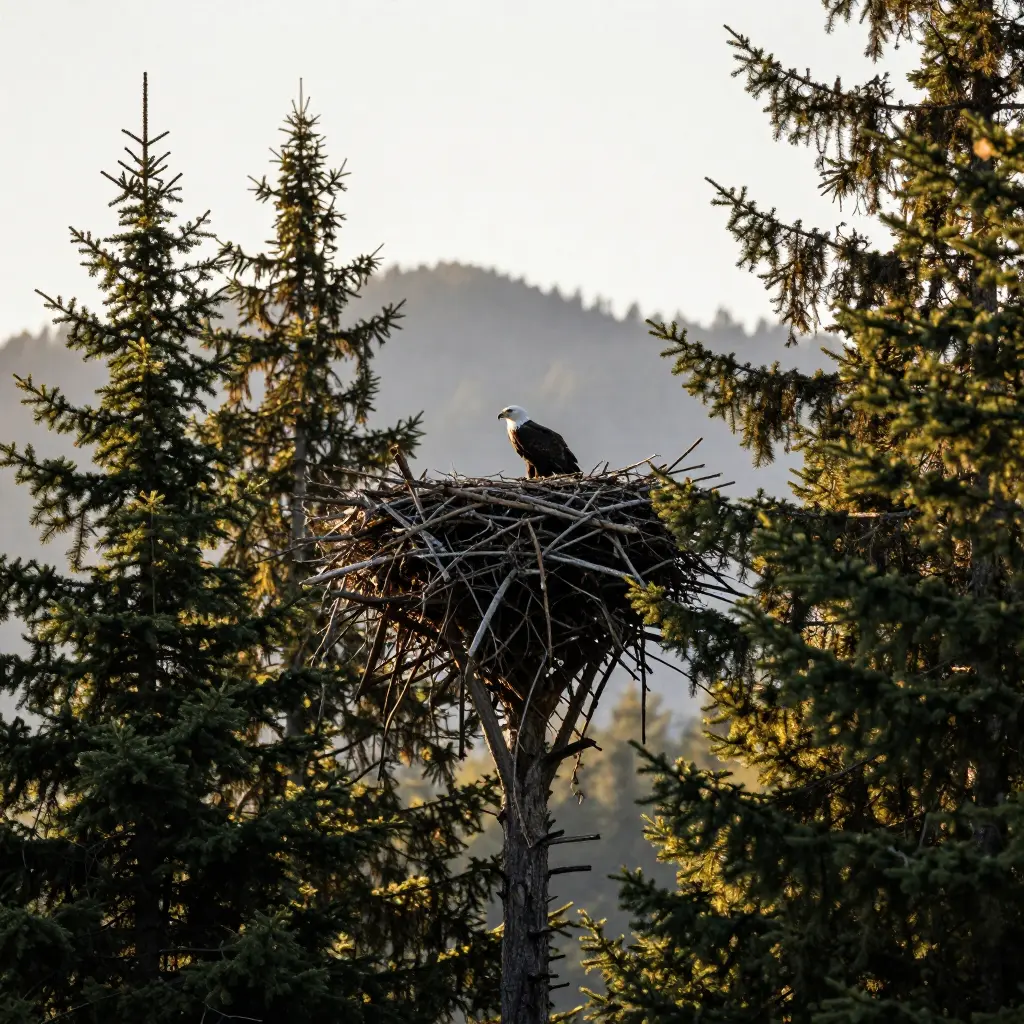
Highly pathogenic avian influenza is a severe form of bird flu. “Highly pathogenic” means one thing: it makes birds very sick, very fast.
In wild birds, it moves like this:
- Ducks and geese often carry the virus without looking sick, shedding it in saliva, mucus, and droppings.
- Those droppings land in ponds, on fields, on shorelines. A hawk can pick up the virus by standing where an infected duck stood.
- When the same virus reaches a raptor, it spreads quickly and is often fatal within days.
That contrast is the hard part. A mallard can fly off fine. An eagle catching the same thing usually doesn’t.
Raptors get hit especially hard because:
- They sit at the top of the food chain, so they eat infected prey and drink contaminated water.
- Their numbers are already thin, so losing one healthy adult matters.
Short version: a mild bug for ducks is often a killer for eagles.
Confirmed Facts, in One Place
Only what officials have confirmed, with nothing layered on top.
| Detail | Confirmed Information |
|---|---|
| Species | Bald eagle (Haliaeetus leucocephalus) |
| Location | Big Bear, California |
| Cause of death | Highly pathogenic avian influenza (bird flu), named the primary underlying cause |
| Information source | Necropsy (post-mortem) report |
| Confirmed / announced | October 14, 2026 (CDFW news release; reported nationwide the same evening and the next day) |
Everything else — how she caught it, what happens to the nest — is a question, not a fact. The table is what we can stand on.
I never met Jackie, not in any way that would hold up on paper. And still, when the news came, I felt that small particular ache of losing someone I only sort of knew.
That’s the strange gift of a nest cam. You don’t decide to care; you just start checking. A tab stays open, a bird the size of a thumb on the screen, wind pushing at the branches. One day you notice you’ve been rooting for a creature who has no idea you exist. You have learned her rhythms the way you learn a friend’s.
It isn’t friendship, exactly. I know that. But it isn’t nothing, either. Somewhere between watching and waiting, a bird becomes a someone.
When she was gone, the empty nest felt personal, almost silly in how much it stung. The stream kept running. I kept half-watching, waiting for a bird who wasn’t coming back. I didn’t lose a pet. I lost a presence I had made room for.
Maybe that’s what these cameras teach. Attention is its own kind of love. You can’t help but carry a little of what you have watched.

Some mornings the light comes in slow, and you catch yourself looking somewhere far off without meaning to. The frame says what the words keep circling: a place that is empty now, and the habit of expecting someone to be there.
Protection and the Wider Picture
We knew Jackie the way you know a neighbor through a window: not personally, but daily, and over years. Millions watched her ride out storms, guard eggs, come back to the same pine. So when HPAI was named as her cause of death, it didn’t land like a headline from a distant outbreak. It landed like something that could walk into a nest we had all been watching.
That may be the shift this loss leaves behind. Bird flu becomes real only when it touches an animal we already love. It raises a few uncomfortable points:
- Wild bird disease monitoring stays thin and reactive, often revealed only when a famous bird dies.
- Public attention to conservation spikes around a single charismatic eagle while countless unnamed birds face the same virus unseen.
- The uneven value we place on wildlife: why one nest gets a camera and most get nothing.
- What a livestream can and cannot protect. It builds empathy fast, but empathy alone doesn’t fund testing, rehab, or habitat.
Jackie’s death isn’t a warning because she was special. It’s a warning because the disease doesn’t check whether anyone is watching.
Reading the numbers behind Jackie’s illness
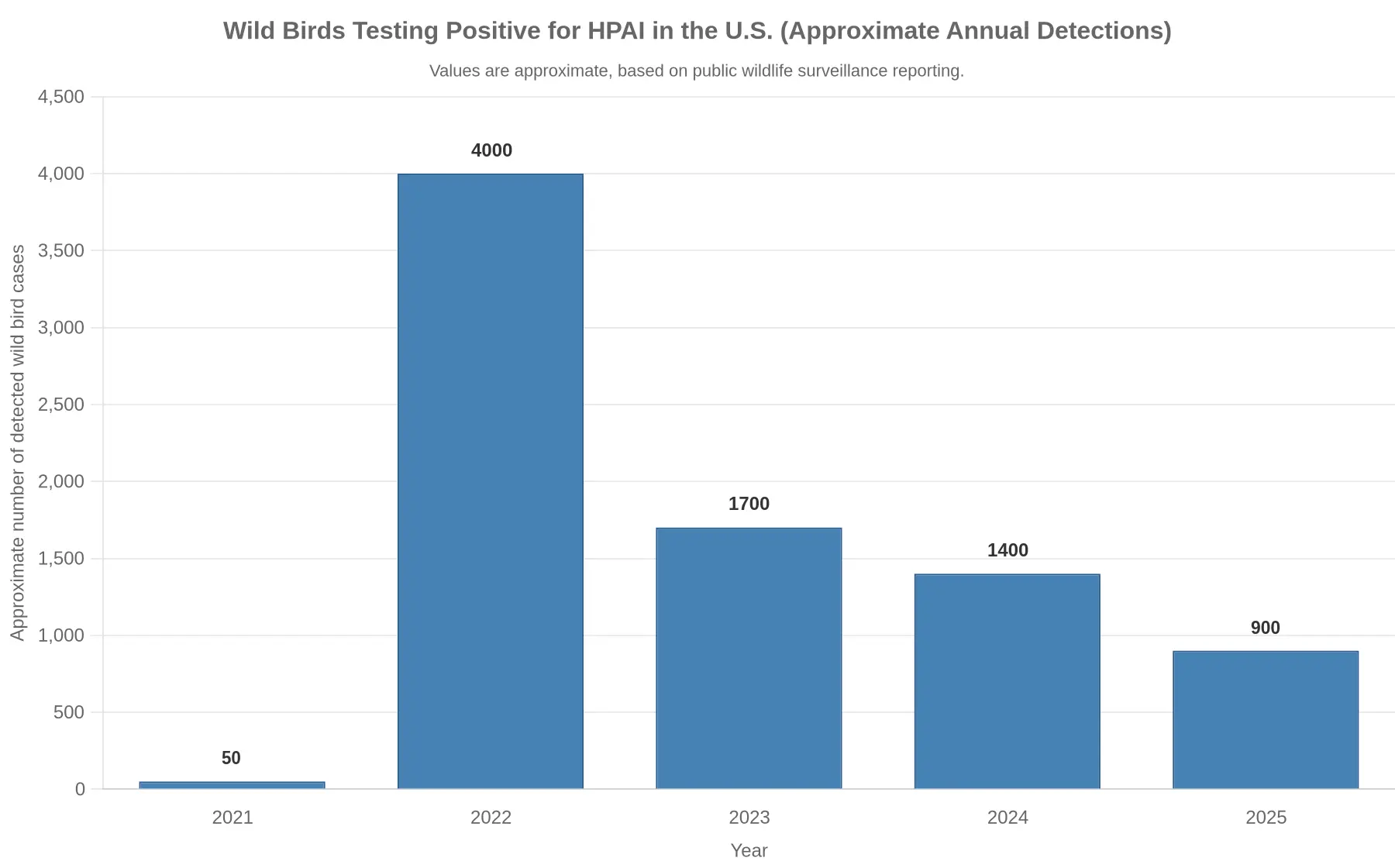
Jackie’s death feels personal to a lot of us. Millions watched that nest. Her illness also sits inside a much wider story, and a chart is the quickest way to see the scale.
How to read this chart
- Start with 2022. That tall bar is the jump most wildlife watchers remember — HPAI reached wild birds across the country in a way earlier years didn’t.
- Then follow the slope down. Later years ease off from the peak, but the numbers never return to the near-zero baseline of 2021. The virus stayed in the landscape.
- The point isn’t any single figure. It’s the shape: a quiet line, a spike, then a stubborn, lingering hum.
| Year | Approx. detected wild bird cases (U.S.) |
|---|---|
| 2021 | ~50 |
| 2022 | ~4,000 |
| 2023 | ~1,700 |
| 2024 | ~1,400 |
| 2025 | ~900 |
These figures are rough estimates meant to show scale and trend, not exact counts. Confirmed cases only ever capture a fraction of what’s out there — sick wild birds are hard to find, and not every one reaches a lab.
So when the necropsy named avian influenza, it wasn’t bad luck falling on one nest. It was a virus that has been moving through wild bird populations for years, and Jackie was one of the birds it reached.
Frequently Asked Questions
After the news broke, readers asked the same few things. Here are the short answers.
How did Jackie the bald eagle die?
The necropsy named HPAI the primary underlying cause. She died on August 9, 2026, at the Ojai Raptor Center. The Big Bear eagle, watched by millions on a live nest cam, was later cremated.
What is highly pathogenic avian influenza?
A severe form of bird flu that spreads among wild and domestic birds and can be deadly, especially to raptors like eagles, hawks, and owls. It moves through shared waterways and contact with infected birds.
Does this affect watching bald eagles in the wild?
No. The risk to people watching from a distance stays very low. Still, keep your distance and never handle sick or dead birds. If you see something unusual, report it to your state wildlife agency.
Should regular people worry?
For most of us, not much. Human infections are rare and usually tied to close contact with infected poultry. Wildlife officials are monitoring the situation, so stay informed without panicking.
One Nest Went Dark
So I keep thinking about that nest cam. The same lens that made Jackie a neighbor — a name, a daily habit, a tab I checked without thinking — can’t tell us how she caught the virus, or how many other raptors are carrying it right now. That’s the strange part of loving a wild animal through a screen: the grief is close, and the world behind it stays far away. Avian flu doesn’t know we were watching. It moves through wetlands and flocks most of us never learned to name. I don’t want to look away, or love the next one less. I’d rather this death widen the circle a little — toward the disease, the habitats, the birds no one has a camera on. One nest went dark. The sky is still bigger than that.