
A Life That Outlasted Its Era
Eva Marie Saint, who won an Academy Award for “On the Waterfront” and starred opposite Cary Grant in “North by Northwest,” died on October 6, 2026, at her home in Los Angeles. She was 102.
She was born on July 4, 1924, in Newark, New Jersey, and came up through live television before moving into film. Her screen debut, in 1954, won her an Oscar; five years later she made “North by Northwest” and became a kind of star the studio system no longer produces.
Those two films are now more than sixty years old. She was not, until this week. That is the strange arithmetic of a long life inside a young art form.
The Golden Age of Hollywood lasted only a few decades in the middle of the last century, and most of its stars now belong to the past. Saint belonged to it too, then kept working through television and the decades that followed, into a world the young actress could never have pictured.
When someone lives to 102, we tend to measure the distance from birth to death. The more honest distance may be the one between the world she helped make and the world she left behind.

A warm, dusty glow, a spinning reel, an empty row of seats: the machinery of an older Hollywood.
A Life That Outlived the Frame
Some careers fade with the era that made them. Saint’s did not. She died at 102, a number that sounds abstract until you remember what it covers: a working life that began in the glow of midcentury cinema and stretched across a century.
Her death closes one of the last direct links to the Golden Age. She arrived on screen as an Academy Award winner, for On the Waterfront, and a few years later stepped into one of the most enduring thrillers ever made, North by Northwest (1959), opposite Cary Grant. Between the two she showed she could move from gritty to polished: a young woman caught up in a story of conscience, then a cool, quick-witted companion in a chase across America.
Off screen, her life ran long and comparatively quiet. In her later years she lived in California, away from the noise of the industry, with her husband Jeffrey Hayden, who died in 2016, and their two children.
The Essentials
- An Oscar, early on. She won the Academy Award for her work in On the Waterfront.
- A Hitchcock landmark. North by Northwest (1959) paired her with Cary Grant and remains one of her best-remembered roles.
- A long life. She lived to 102.
- A quiet home base. She spent her later years in Montecito, California.
- A family of her own. She was married to Jeffrey Hayden and had two children.
What follows is a closer look at that century: the two roles most people name first, and the steady, unshowy life that carried her between and beyond them.
Across seven decades of credits, a few performances keep drawing people back. If you are meeting her for the first time, or revisiting an old favorite, this guide maps the roles that made her a name still spoken with affection.
| Film | Year | Her Most Memorable Impression |
|---|---|---|
| On the Waterfront | 1954 | Edie Doyle – the girl in white gloves who hands Brando’s Terry a reason to change. The role won her an Oscar. |
| North by Northwest | 1959 | Eve Kendall – the cool, elusive blonde seated across from Cary Grant on a train, hiding more than she shows. |
| A Hatful of Rain | 1957 | Celia Pope – a young wife holding a household together while her husband wrestles with addiction. |
| Raintree County | 1957 | Nell Gaither – the steady presence set against Elizabeth Taylor’s restless Southern belle. |
| Exodus | 1960 | Kitty Fremont – an American nurse pulled into the fight for a new nation. |
| The Russians Are Coming, the Russians Are Coming | 1966 | A small-town mother caught in the middle of a Cold War farce. |
| Superman Returns | 2006 | Martha Kent – the grounded, earthly mother of a man who flies. |
Two of those roles come from the 1950s, and that is no accident: the decade gave her Edie and Eve, and neither has aged out of the conversation. What came after was a long second act, and she kept working, on screen and off, for another fifty years.
The Oscar She Won by Standing Still
Eva Marie Saint did not win her Academy Award by taking up space. She won it by giving it away.
On the Waterfront is the evidence. In 1954, a 30-year-old actress with a live-television résumé and no feature credits walked onto a Hoboken dock and played the one person in the film who refuses to keep her mouth shut. On March 30, 1955, she stepped up to the podium at the 27th Academy Awards and took home Best Supporting Actress. The award was for Edie Doyle, and in hindsight it reads like a thank-you note for an entire way of working.
What She Actually Does in the Film
Edie is the dead man’s sister, a young woman from a church-run school who comes back to the waterfront believing that people can be decent, then finds out what it costs to say so. Kazan could have directed her as a symbol. Saint plays her as a person with a body and a temper, which is harder.
Most of her scenes are with Marlon Brando, and most of her work in them is listening. In the park sequence, the story goes, Brando picked up a glove she had dropped and, instead of handing it back, eased it onto his own hand. She stayed in the scene. So did the camera. What survives is not a line but a look: a woman deciding, in real time, to trust someone she has reason not to.
That is what the Academy recognized: not volume, but attention.
The Night, in Plain Facts
| Detail | Fact |
|---|---|
| Film | On the Waterfront (1954), directed by Elia Kazan |
| Role | Edie Doyle |
| Ceremony | 27th Academy Awards, March 30, 1955 |
| Category | Best Actress in a Supporting Role |
| Her age at the win | 30 |
| Her prior feature credits | None – it was her film debut |
| The film’s night | Eight wins, including Best Picture |
She was the only woman among the film’s winners, in a year when the category was crowded with veteran names. She was not a discovery the town had been waiting for; she was a newcomer who happened to be ready.
What It Did for Her, and What It Didn’t
The statue bought her a career, not a persona. She followed it with North by Northwest in 1959 and Exodus the next year, then with decades of steady, unglamorous, highly skilled work in television, the kind of career that does not photograph well in a headline but lasts.
It also bought her a life. She had married the director Jeffrey Hayden in 1951, before the Oscar and before the fame, and stayed married to him for 65 years, until his death in 2016. They had two children, Darrell and Laurette. Whatever Hollywood handed her in 1955, she seems to have kept it in the front room and lived in the rest of the house.
The Part That Stayed in the Fifties
Edie Doyle never left 1954. She is still standing on that pier in black and white, still young, still angry, still saying the thing nobody wants to hear. The woman who played her kept going, kept working, and outlived almost everyone she had shared a frame with, until her death at 102.
There is something fitting in that. Most actresses are remembered for a role that traps them. Saint was remembered for a role that let her walk away from it.

North by Northwest: The Role That Never Left the Fifties
Eva Marie Saint lived to be 102, which is more than a century of mornings: scripts read and set aside, grandchildren, quiet afternoons on the California coast. And yet, for most of us, she never quite aged past a train ride in 1959.
That is how Hollywood memory works. A woman outlives nearly everyone she ever shared a screen with, and the world still pictures her as the cool-eyed blonde trading lines with Cary Grant in a dining car.
Why This One Never Let Go
North by Northwest was never just a thriller. Hitchcock built something that worked its way into the culture: the crop-duster, the men in gray suits, the scramble across Mount Rushmore. It became the template for the spy movie that winks at itself and still means it.
At its center was a pairing that felt effortless. The stills that keep resurfacing, Grant in that immaculate suit and Saint with her knowing half-smile, carry an entire era inside a single frame. You don’t have to have seen the film to feel the decade pressed into it.
The Reel Ages. The Person Doesn’t.
The image never grows older. The person does.
Saint kept working and kept living: raising a family, outlasting co-stars, directors, and the studio system that made her. She became one of the last living threads to a vanished golden age. The public keeps its own key, though, and that key opens a door marked 1959.
What We’re Really Remembering
Maybe that is not a loss. To be remembered for something that still makes people lean forward in their seats more than sixty years on is a rarer gift than fame itself.
The film ends, then loops. She got the two things most performers can only choose between: a long, full life, and a role that refuses to leave the frame.
The Life She Kept Off-Screen
A career as long as Eva Marie Saint’s tends to drown out everything beside it. She won an Academy Award with her first film. She traded lines with Cary Grant on the face of Mount Rushmore. And still, when the cameras stopped, the steadier story was the one waiting at home.
A Marriage Measured in Decades
In 1951, Saint married Jeffrey Hayden, a television director and producer. It was never a romance built for the gossip columns, just a partnership that lasted. The two were together until Hayden died in 2016, a marriage of roughly 65 years.
They raised two children, a son, Darrell, and a daughter, Laurette. Saint kept her family out of the spotlight, choosing time at home over the pull of the industry. In a 2014 interview with CBS News, she said she limited herself to one film a year at most while her children were young, even after an agent told her that meant she would never be a superstar. She fired him.
Late Years by the Coast
She made her home in Montecito, California, for years, out of reach of the industry’s noise. After Hayden’s death she stayed largely out of the public eye, though in 2018 she returned to the Academy Awards stage at 93 to present the costume design award and received a standing ovation.
What lingers about Saint is not the glamour, though there was plenty of it. It is the shape of a full life: an actress who gave her talent to the screen and most of her attention to the people she loved.
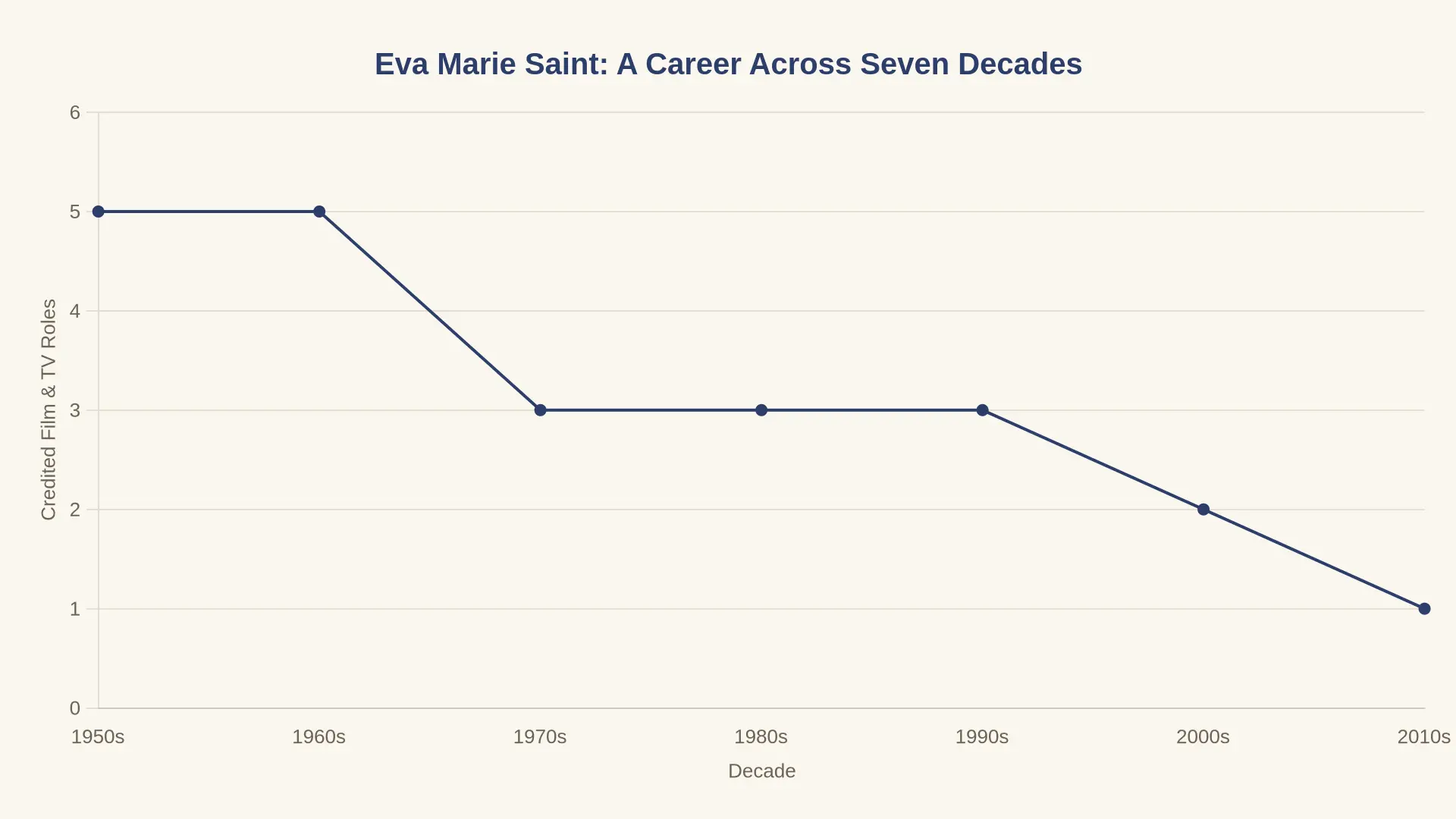
The chart below traces Saint’s screen work by decade, counting her credited film and television roles. It is not a scoreboard of fame but a way of seeing shape: the dense years of the 1950s and 1960s, when On the Waterfront and North by Northwest arrived within five years of each other, then the long, quieter tail that ran for another half century. What stands out is not the peak but the persistence. Very few careers reach from a black-and-white waterfront to a 2006 blockbuster, and even fewer manage it while staying in the business the whole time.
That long, low line on the right side of the graph is the story: the roles thinned, but they never stopped.
Eva Marie Saint Performances Worth Watching Again
An actor who works for seven decades leaves behind more than one famous scene. Here is a short list of Saint performances that hold up on a rewatch, some you know by heart and some worth discovering for the first time.
- On the Waterfront (1954) – The role that won her an Oscar: Edie Doyle, the conscience of a brutal dockside world, caught between loyalty and love.
- North by Northwest (1959) – As Eve Kendall, she trades barbs and secrets with Cary Grant on a train, cool on the surface and quietly brave underneath.
- A Hatful of Rain (1957) – A tender, unglamorous portrait of a wife holding a marriage together while addiction pulls it apart.
- Raintree County (1957) – She holds her own against Elizabeth Taylor and Montgomery Clift in a sprawling Civil War-era melodrama.
- Exodus (1960) – Cast as an American nurse in a sweeping story of nationhood, she brings warmth and steadiness to a film built on grand gestures.
- All Fall Down (1962) – A rare chance to see her play watchful and wounded in a tense family drama that simmers more than it shouts.
- 36 Hours (1964) – Opposite James Garner, she turns a wartime thriller into something with real emotional stakes.
- The Russians Are Coming, the Russians Are Coming (1966) – A light comedic detour, and proof she could land a laugh as easily as a dramatic beat.
- Nothing in Common (1986) – Decades later, she plays a mother in a fractured family, sharing scenes with Jackie Gleason and Tom Hanks.
- Superman Returns (2006) – In her eighties, she slips into the role of Clark Kent’s mother, a small part that carries the whole idea of home.
The Last Close-Up
Eva Marie Saint lived 102 years. Eve Kendall never left 1959.
That gap is the story. Real life kept moving, one year stacking on the next: an Oscar, a marriage that lasted, children and grandchildren, a long quiet stretch in Montecito. The movie did not move at all. It held her at thirty-four, stepping onto a train and glancing back at Cary Grant with a look that gave away nothing.
The screen does that. It seizes a moment and refuses to let it age. So for most of us she is not a woman of 102 but the cool-eyed stranger under the lamplight, forever in the middle of the twentieth century.
And yet she was also the one who outlived nearly everyone who stood in those frames: Grant, Hitchcock, the crew, the decade itself. She carried that vanished world forward into years none of them reached.
Maybe that is what a long life in the movies comes to. The role stays young, the person gets to grow old, and both are true at once. We keep Eve Kendall. She got to keep the years.
Eva Marie Saint: Frequently Asked Questions
How old was Eva Marie Saint when she passed away?
She was 102. She died on October 6, 2026, at her home in Los Angeles.
When and where was she born?
Eva Marie Saint was born on July 4, 1924, in Newark, New Jersey.
What was she best known for?
She is best remembered for two films: On the Waterfront (1954) and North by Northwest (1959). Both are still the roles most people picture when they hear her name.
Did she win an Oscar?
Yes. She won the Academy Award for Best Supporting Actress for On the Waterfront, in which she played Edie Doyle opposite Marlon Brando. The win came at the 1955 ceremony and was the first film role of her career.
What was her role in North by Northwest?
She played Eve Kendall, the mysterious woman who crosses paths with Cary Grant’s character in Alfred Hitchcock’s thriller.
Why does On the Waterfront matter so much?
It was her screen debut, and it earned her an Oscar right out of the gate. That kind of start is rare, and it set the tone for a career built on grounded performances rather than hype.
Who was her husband?
She was married to Jeffrey Hayden, a television director and producer. They wed in 1951 and stayed together until his death in 2016, a marriage that lasted 65 years.
Did she have children?
Yes, two. A son, Darrell Hayden, and a daughter, Laurette Hayden.
Where did she live later in life?
She spent her later years in Montecito, California, living quietly out of the spotlight.
What other films was she in?
Beyond her two best-known titles, she appeared in A Hatful of Rain (1957), Exodus (1960), and The Russians Are Coming, the Russians Are Coming (1966). She also worked steadily in television, where she won an Emmy for the 1990 miniseries People Like Us.
Where can I watch her films?
North by Northwest and On the Waterfront are widely available to rent or stream on major platforms. Both are worth watching back to back, to see how different she could be in two defining roles.