I keep coming back to the front door.
Not the hallway behind it, or what agents carried out, or how long they stayed. Just the door: an ordinary door on an ordinary D.C. street. On Monday morning, federal officers stood in front of it with a search warrant.
I’ve read the headlines a dozen times, and they all say roughly the same thing: federal agents searched Rep. Ilhan Omar’s home. A short sentence, almost routine. That is what unsettles me. A sitting member of Congress. A warrant. Agents at the door before sunrise. It looks like procedure. It reads like something else.
A door isn’t just a door. It’s the line between a public figure and a private person, between politics and the state’s power to step inside your home. When federal agents cross that line at the house of an elected lawmaker, it stops being an ordinary scene of law enforcement. It becomes a signal about where the boundary of state power sits, and who gets to move it.
Here’s what we actually know so far.
What We Know So Far
Federal agents searched the Washington, D.C., home of Rep. Ilhan Omar (D-Minn.) on Monday morning. Here are the confirmed details, based on what multiple outlets have reported:
- Who carried out the search: Homeland Security Investigations (HSI), an arm of the Department of Homeland Security, executed a search warrant at the home. (Washington Post, CNN, AP)
- When: The search took place Monday morning. Reuters described it as a predawn operation; CNN said officers executed the warrant “early Monday.” (Reuters, CNN)
- Why: HSI conducted the search as part of a criminal investigation, according to people familiar with the matter. The Justice Department said agents executed a judicially authorized search warrant in the Washington, D.C., area related to an ongoing federal criminal investigation. No charges have been announced. (BBC, NBC News, AP)
- Who Omar is: She is a Democratic U.S. Representative from Minnesota. (NBC News, CNBC)
- Reporting outlets: The search was reported by the Associated Press, the Washington Post, BBC, NBC News, CNN, Reuters, and CNBC, among others.
- Omar’s response: She said she will “not be silenced” and characterized the action as part of a campaign of “intimidation.” (AP, WBAL-TV)
- Trump’s response: He told reporters he had “nothing to do” with the search and said it was “really up to the DOJ.” (AP)
Reports are still developing, and the details above reflect the most recent updates from each outlet at the time of writing.
How major outlets covered the search at Ilhan Omar’s home, and what each one confirmed.
| Media Outlet | Core Facts Confirmed | Published |
|---|---|---|
| Associated Press | Federal agents searched Rep. Ilhan Omar’s home; she says she will “not be silenced.” | Oct. 12, 2026, live updates |
| The Washington Post | Federal agents searched her D.C. home; the search was executed by Homeland Security Investigations, an arm of DHS. | Oct. 12, 2026 |
| BBC | U.S. immigration agents searched the home of the Minnesota representative Monday morning as part of a “criminal investigation.” | Oct. 12, 2026 |
| NBC News | Federal agents searched her Washington, D.C., home Monday morning in a criminal probe, per two people familiar with the matter. | Oct. 12, 2026 |
| CNN | Federal officers executed a search warrant early Monday at her D.C.-area home. | Oct. 12, 2026 |
| Reuters | U.S. authorities conducted a predawn raid Monday on her Washington-area home. | Oct. 12, 2026 |
| CNBC | Her home was raided as part of a criminal investigation into her immigration paperwork. | Oct. 12, 2026 |
| New York Post | Omar said the Homeland Security Investigations raid on her D.C. residence was part of a targeted campaign. | Oct. 12, 2026 |
| The Hill | Live updates: federal agents raided her D.C. home. | Oct. 12, 2026, live updates |
The Agency That Showed Up
Officials call it a “criminal investigation.” The agency that executed the warrant at Omar’s home was Homeland Security Investigations, an arm of the Department of Homeland Security. It was not the FBI or a federal prosecutors’ task force. It was an immigration enforcement agency, arriving before dawn at the home of a sitting member of Congress.
That distinction isn’t a technicality.
The reported focus of the inquiry is her immigration paperwork. Vice President JD Vance has accused Omar of immigration fraud, an allegation she denies, and the administration has spent months signaling that it wanted to investigate her. Sending an immigration enforcement agency to the home of a naturalized citizen who sits in Congress is not the same as sending the FBI to examine a financial record; whatever the underlying case turns out to be, the choice of agency carries weight.
Omar’s response was blunt. She said she would not be silenced and called the search part of an “intimidation” campaign. A person rarely announces she won’t be silenced unless she believes the point was to silence her. You can treat the investigation as legitimate and still notice that.
An administration can use the neutral language of law enforcement while the choice of agency, the hour, and the target do political work. A criminal probe is a legal category. How it is carried out is a choice. This one was carried out at a particular door, at a particular hour, in the final weeks of Omar’s reelection bid.
The question is not guilt or innocence. It is whether the machinery of enforcement is aimed at conduct, or at the message a person’s example sends.

A closed door at dawn. Everything after begins somewhere near it.
Omar’s Response
Omar did not stay quiet for long. After federal agents searched her Washington, D.C., home on Monday morning, she made her position plain: she will “not be silenced.” The search, carried out by Homeland Security Investigations, was described by officials as part of a criminal investigation. Omar called it a targeted act of political intimidation and pointed the blame at Trump.
Trump, for his part, told reporters he had “nothing to do” with the search and said it was “really up to the DOJ.” Top Democrats in Congress condemned the timing, citing the Justice Department’s longstanding practice of avoiding overt investigative steps involving political candidates close to an election.
That gap between the two accounts is the whole story. One side calls it process. The other calls it pressure. In a moment when federal investigations and political rivals keep colliding, Omar’s answer is less a legal defense than a public bet that her supporters will read the warrant as a threat aimed at the person, not a routine step in a case.
In an environment where a search warrant can work as a headline and a rally line at the same time, that distinction blurs fast. People who already distrust federal agencies will take her word for it. Critics will say the paperwork is the paperwork. Whether that reading travels beyond her base is the open question. For now, she has done what she said she would do: refused to go quiet.
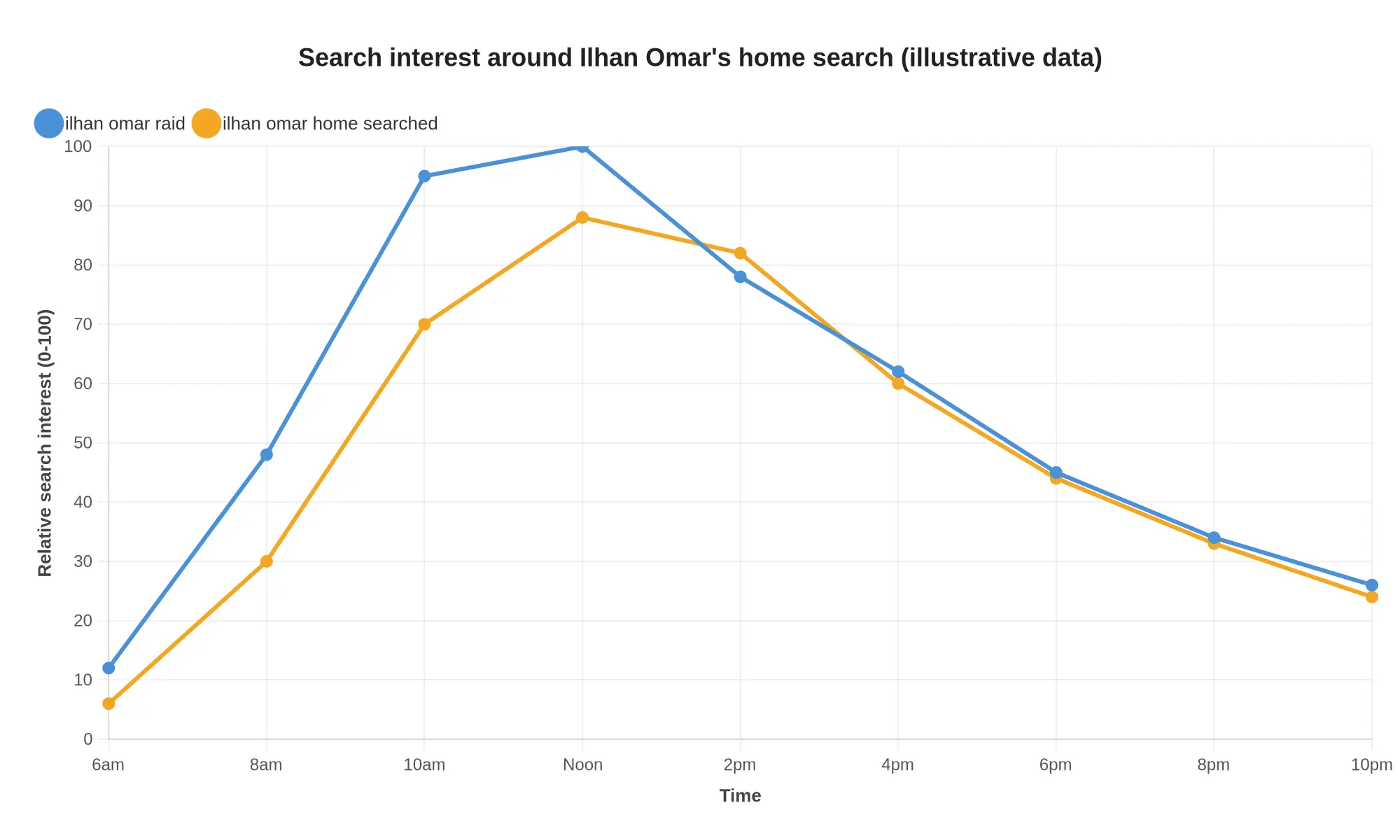
The chart above is illustrative rather than measured, but the pattern it sketches is familiar: attention spiked once word of the search broke, peaked within a few hours, and eased off through the day. The two phrases it tracks moved almost in lockstep, which suggests the interest was concentrated on the event itself rather than building slowly over the news cycle.
Step back from the front door and this is less a story about one congresswoman’s paperwork than about who decides when federal law enforcement points at an elected official.
Homeland Security Investigations, an arm of the Department of Homeland Security, executed a predawn search warrant at a sitting member of Congress’s home. That is real power, and real power runs on public trust. Immigration paperwork is the stated reason. But timing is not neutral. The search came in the final weeks of Omar’s reelection bid, as Democrats were already asking whether federal agencies are being steered toward the administration’s opponents. Omar called it intimidation. Others will call it ordinary process. Both readings can sit side by side, and that ambiguity is exactly the trouble.
The argument here is narrow, not partisan. Investigators can and sometimes should examine a lawmaker. But when the target is political, the burden on the institution grows rather than shrinks, because the appearance of weaponization does damage even when the underlying case is solid. That is a standard any democracy should hold itself to.
The outcome is unknown. The precedent is not. A federal agency searched a representative’s home on a Monday morning, and the country may file it away as routine. Maybe the case is airtight. Maybe it fizzles. Either way, the boundary moved, and boundaries like this don’t move back on their own.
The door itself didn’t change. It stood there before Monday morning, and it will stand there after the headlines move on. What changed isn’t the wood or the hinges. It’s what a front door now means.
A search warrant is a legal document, and it deserves to be treated as one: not proof of guilt, not vindication, not a verdict. The investigation into Rep. Ilhan Omar’s immigration paperwork will move forward or it won’t. Facts will surface. Courts will rule. That part isn’t mine to decide, and it isn’t yours.
But the pattern is worth watching closely. When federal power reaches into a sitting lawmaker’s home before dawn, the question isn’t only whether this case is justified. It’s whether the tools of investigation are being used to do the work of politics, and whether any of us would notice if they were.
The door is still there. Watch who it opens for next.
Frequently Asked Questions
Who executed the search on Ilhan Omar’s home?
Homeland Security Investigations, an arm of the Department of Homeland Security, carried out the search.
What was the legal basis for the search?
HSI agents executed a judicially authorized search warrant as part of an ongoing federal criminal investigation, reportedly involving her immigration paperwork. No charges have been announced.
Where and when did the search take place?
At Rep. Ilhan Omar’s home in the Washington, D.C., area on Monday morning, described in reports as an early morning or predawn search.
How has Ilhan Omar responded?
She said she would “not be silenced” and called the search part of an intimidation campaign.