On October 6, OpenAI published a large batch of mathematics results generated by an internal frontier model that the company has not released. The counts differ by outlet: 377 problems in the New York Times, 722 manuscripts in one independent tally, and roughly 4,000 problems attempted according to Interesting Engineering. Many of the proofs came with Lean formalizations, which let a computer check each step. Separately, a SentinelOne researcher used GPT-6 Astra to crack a 217-year-old Napoleonic-era cipher.
The numbers vary because each outlet is counting a different thing, and the distinction matters. A Lean-checked proof is not a new theorem, and a verified step says nothing about whether the result is significant. The New York Times, the Wall Street Journal, Scientific American, and The Verge all covered the release, and each registered uncertainty about what the pile adds up to. What is not in dispute is that OpenAI has put hundreds of papers into public view, and mathematicians are reading them.
The release landed on October 6, 2026, with follow-up coverage continuing through October 7. Here is what the reporting establishes.
The Release Window
- OpenAI published its mathematics update on October 6, 2026, with follow-up coverage continuing through October 7.
- Its own blog post, plus reporting from The New York Times, The Verge, Scientific American, and The Wall Street Journal, landed within roughly a day of each other.
- The clustering made the release feel like a single event rather than a slow rollout.
The Scale, as Reported
- Outlets describe the release at different sizes, largely because each is counting a different thing.
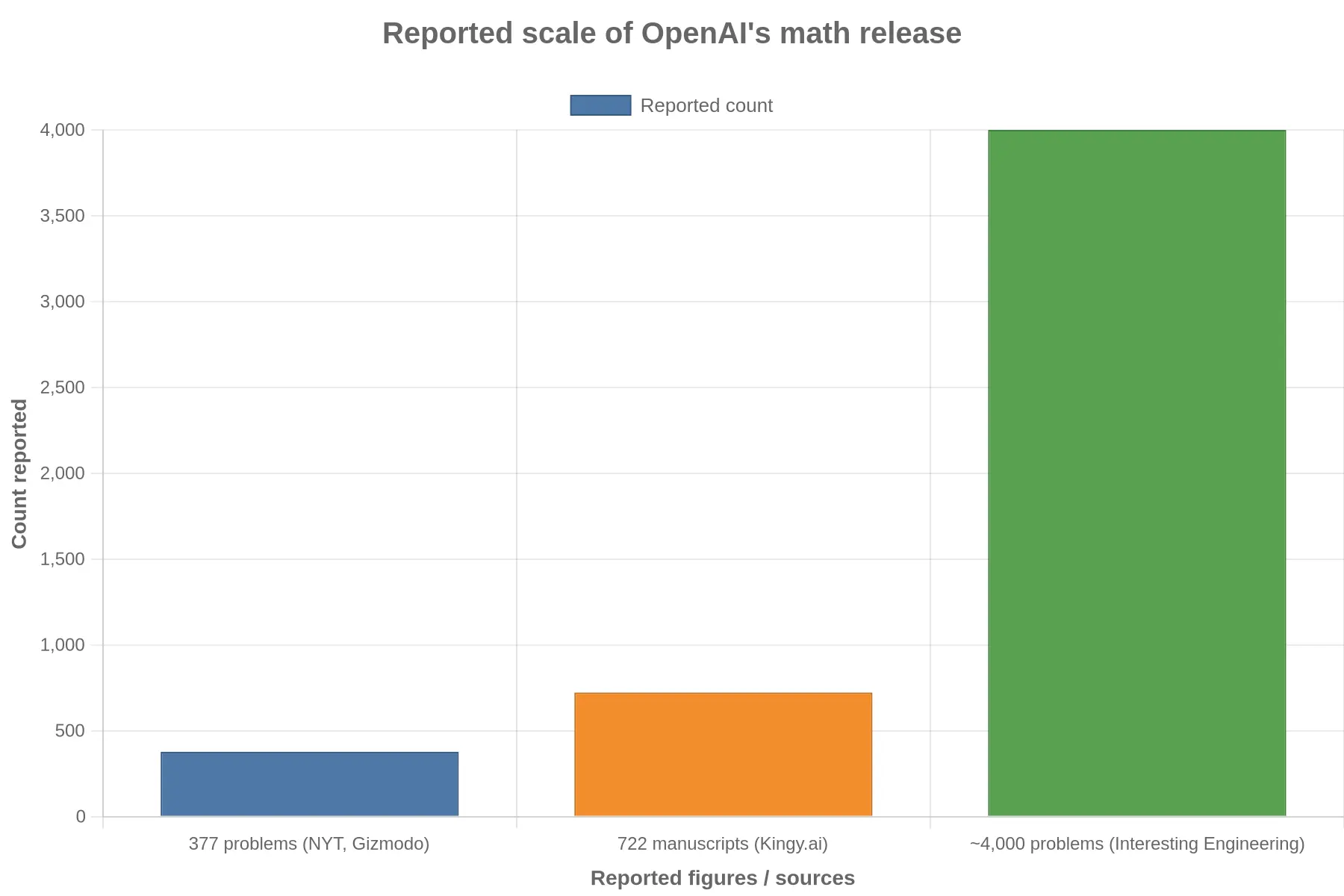
- The New York Times and Gizmodo cite 377 math problems, kingy.ai counts 722 manuscripts, and Interesting Engineering describes roughly 4,000 problems attempted.
- No single unit has been agreed on for what was released.
How It Was Presented
- A portion of the results arrived as proofs formalized in Lean, meaning they can be machine-checked rather than taken on trust.
- The model behind the results is unreleased. GPT-6 Astra belongs to a separate demonstration: a SentinelOne researcher used it to decipher a 217-year-old Napoleonic cipher.
- Together, the archive and the demonstrations were read as a statement of capability.
Coverage of the same release varied widely depending on who was writing about it. Here is how the numbers, the verification claims, and the headline results line up.
| Source | Reported scale | Verification | Representative result |
|---|---|---|---|
| OpenAI (official blog) | “Progress in mathematics” | Lean formalization | Quasi-Riemann hypothesis work (disputed) |
| Interesting Engineering | ~4,000 problems | Lean-checked proofs | Largest release so far |
| kingy.ai | 722 manuscripts | Lean | Compute and cost breakdown |
| The New York Times | 377 problems | Lean-assisted | Field “further roiled” |
| Gizmodo | 377 results on GitHub | Lean | Paired with reflective blog post |
| Chosun.com | – | – | GPT-6 Astra cracked 217-year-old cipher (separate from the math release) |
OpenAI’s own framing stays abstract, while aggregators reach for the largest number they can attach to it. The cipher sits in a different lane: it has little to do with proof checking, and a lot to do with how one concrete win gets folded into a larger narrative about what these models can do.
Branching structures held together by a shared lattice: human proof and machine process in one frame.
The Bottleneck Moved
For most of its history, the scarce thing in mathematics was production. A good theorem was hard to find, and finding one could take a decade. That scarcity is no longer the binding constraint.
The release shows the shape of it. One batch put 377 problems on GitHub; other tallies count 722 manuscripts and roughly 4,000 problems attempted, with Lean formalizations attached to many of the proofs. Reporting on the same batch brought up a disputed claim about the quasi-Riemann hypothesis and, separately, the Napoleonic cipher cracked with GPT-6 Astra.
A Lean check tells you a proof is formally correct. It does not tell you whether the theorem matters, whether the idea generalizes, or whether anyone outside the formalism can follow it. Those questions still take a human months, sometimes years.
The results are arriving faster than the field can verify, absorb, and assign meaning to them.
The shift is not that mathematics is suddenly finished. It is that the field’s slowest step has moved from discovery to digestion, and nothing in this release speeds that step up.
Why the Numbers Don’t Match
The same release reads as three different sizes depending on who’s counting. 377 is the tally of specific problems touted in press coverage; 722 counts the full set of manuscripts bundled in the repository; roughly 4,000 reflects every problem the team touched, verified or not. So the smallest figure tracks headlines, the largest tracks raw scope. None is wrong, but each answers a different question. When a release is this big, the number you quote says as much about your frame as about the work itself.
How the Mathematics and Tech Communities Are Reacting
The Institute for Advanced Study’s Advisory Group on Mathematics and Artificial Intelligence, which OpenAI consulted, said it does not endorse the practice. In a statement, the group warned that AI can now produce mathematical arguments “without the human who prompted it being able to understand the arguments, verify them, or take responsibility for them,” and it asked labs to grant “equitable access” to their models, arguing that proprietary internal models “risks creating a two-tier system where labs outrun the rest of the field, effectively alienating the mathematical community from its own discipline.”
- One recurring question is what “verified” actually guarantees when the volume of results outruns the field’s capacity to check them.
- Tristan Buckmaster, a mathematician at New York University, told the New York Times that prompters may supply information that helps a model reach a result: “There’s likely to be a bunch of results where they take someone’s work and then take it to completion.”
- Others debate whether a machine-checkable Lean proof settles mathematical validity or merely confirms that a statement follows from its assumptions.
- A third thread reflects on how automated theorem proving might reshape research itself, from credit and authorship to which problems feel worth pursuing.
- More pragmatic voices acknowledge the efficiency gains, noting how quickly these tools can surface candidate results, drafts, and partial proofs.
- Still others caution that strong outputs on hard problems say little yet about generalization, genuine novelty, or the field’s longer-term direction.
A precise lattice meets a softening edge: verification on one side, interpretation on the other.
A Mathematician’s Unease
The immediate question is not whether the proofs hold. Lean can settle that. The harder question is who keeps the right to say so.
Several hundred results now arrive faster than any referee queue can absorb. Verification, once a shared ritual of trust, narrows into a technical checkbox. A machine can confirm that a proof is syntactically valid; it cannot confirm that the theorem was worth proving.
That gap matters because authorship and credit rest on conventions: who posed the question, who found the insight, who carried it to the end. Each assumes a human hand did the carrying. When a model supplies the closing step, the ledger grows muddier, and contribution gets attributed to a process that cannot be fully inspected.
Motivation is the quieter worry. Mathematics was never only about answers. Problems are chosen because they reshape how we think, and a system tuned for solvable targets may quietly pull attention toward what it can close rather than what it can open.
None of this argues for refusal. The tools are here, and some of the work is genuinely good. But a discipline that outsources its judgments of significance risks mistaking throughput for progress. The open question is whether mathematicians keep deciding what deserves to be known.
Where This Leaves Us
The hundreds of manuscripts landed on a field already arguing with itself, and the cracked cipher arrived almost as a footnote. The count isn’t the story. The story is who, or what, now takes the first pass at a stubborn problem, and who is left to check the work.
Some of these proofs will be read, audited, and quietly corrected. Mathematics has absorbed worse. What’s genuinely new is the arrangement: machines can now generate candidate results faster than any community can verify them, which makes verification, not discovery, the bottleneck.
The judgment worth holding is narrow. AI has become a real participant in mathematical work, not a replacement for the people who decide what a proof means. The relationship moved from tool to collaborator, an uneven and sometimes unreliable one. Reading these proofs is now part of the job.
FAQ: OpenAI’s Math Release
Are all of these math results formally verified in Lean?
Not all of them. OpenAI says a portion of the results were checked in Lean, the formal proof assistant that verifies each logical step, while others remain informal. Lean gives a stronger, machine-checkable guarantee where it was applied, but the release is explicit that it mixes verified and unverified material.
Why do different reports cite different numbers of problems?
Different outlets count different things. Some headline the 377 problems released on GitHub; others describe roughly 4,000 problems attempted or 722 manuscripts. The differences reflect whether a report counts individual problems, manuscripts, or the wider set of results. The GitHub release is the most reliable place to resolve the discrepancy.
How does GPT-6 Astra cracking the 217-year-old cipher relate to the math results?
The two are separate. The 217-year-old Napoleonic cipher was broken by a SentinelOne researcher using GPT-6 Astra, as evidence of the model’s general reasoning ability. The mathematics release centers on proofs and manuscripts from a different, unreleased internal model. OpenAI presents both as signs of one underlying capability rather than a single connected result.
What impact will these results actually have on mathematics research?
Mathematicians are still assessing them, and the field was already absorbing earlier AI contributions. These results add hundreds of new statements that need checking, and they raise practical questions about verification, credit, and how proofs are reviewed. OpenAI frames the work as a step toward useful AI collaborators, not a replacement for human mathematicians.
Where can I find the actual results and proofs?
OpenAI published the materials on GitHub and posted a companion write-up on its website about AI progress in mathematics. The repository contains the manuscripts and Lean-checked proofs, so readers can inspect the work directly rather than relying on summaries.