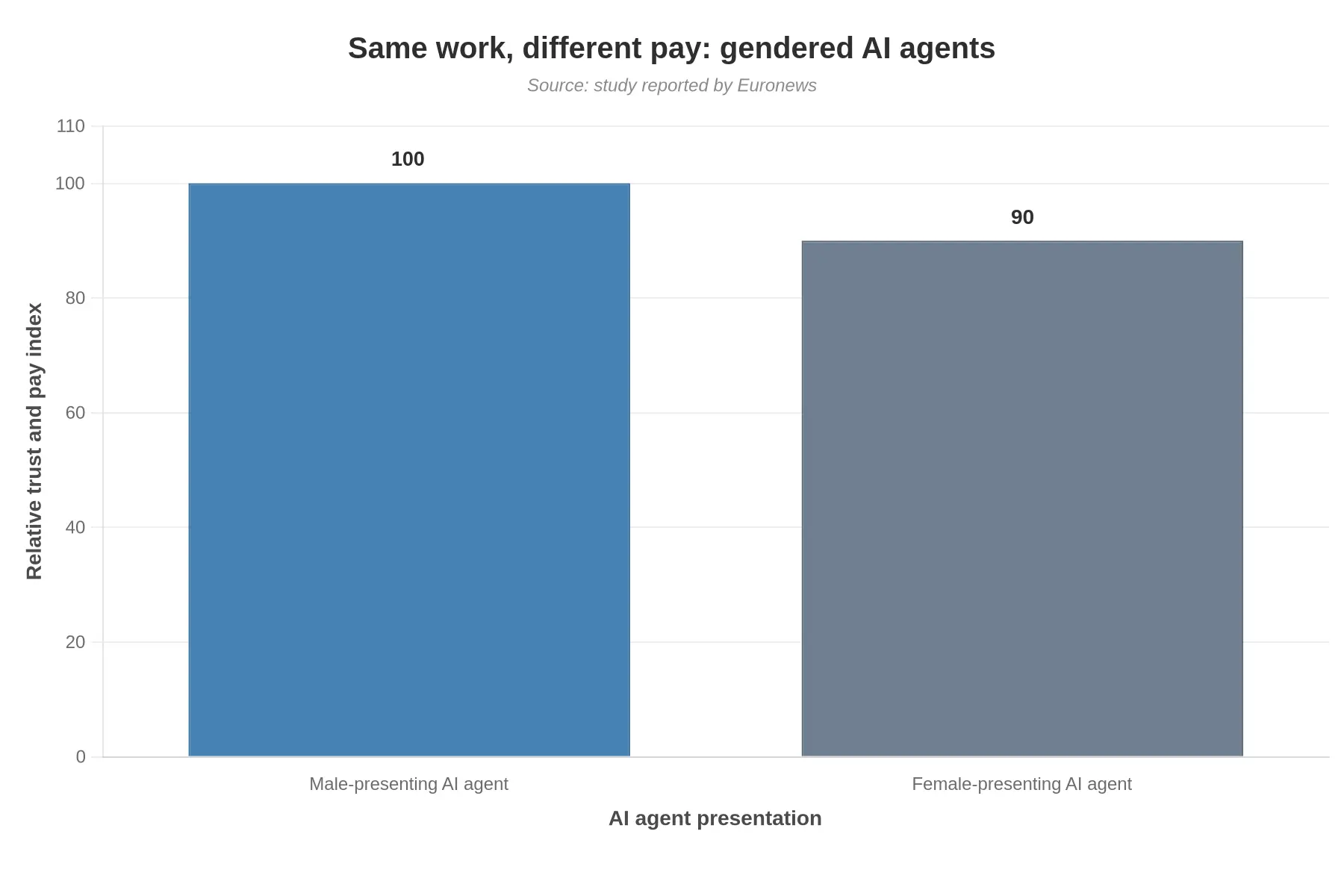
A study published this week by the University of Limerick found that people paid a female-presenting AI agent about 10% less than a male-presenting one for identical work. The two human-like agents ran on the same underlying model, produced work of the same quality, and were rated about equally well. Johan was trusted slightly more than Johanna, but the difference was not statistically significant. The pay gap was.
AI has no gender of its own: no body, no history, no experience of being read one way or another. Give it a name, a voice, and a manner, and it inherits ours. That 10% is not a decision a machine makes. It is a mirror held up to the people using it.
The claim this article starts from is simple: AI carries no gender. When we give it one, the technology does not invent our biases. It reflects them. What follows looks at what the study actually measured, why gendered assistants exist in the first place, and what our preferences say about the assumptions we bring to software and to each other.
How the study worked
The study, reported by Euronews, put 189 people in a virtual-reality office and had them work alongside four AI assistants: a text chatbot, a desk robot, and two human-like agents named Johan and Johanna. All four had the same capabilities and ran on the same model, OpenAI’s gpt-4-1106-preview. The only thing researchers changed was presentation. Participants then rated the agents’ work and paid them with real money.
One variable was enough to move the result.
The pay gap followed the label
Both human-like agents were rated about the same, and the trust difference between them was marginal. The money was not. Both men and women paid Johanna roughly 10% less than Johan for the same work. Nothing about the job was harder or easier on either side. The number moved because the label did, which suggests the valuation was settled before the agent had done anything to earn it.
What 10 percent actually measures
The 10% is not a signal about cost, speed, or quality. The model underneath is the same code, and the gap exists only in the people doing the judging. What we are looking at is not an AI that earns less but a bias that travels. The wage gap we have spent decades arguing about in offices and boardrooms reappears the moment we hand software a gender.
The AI didn’t earn 10 percent less. We decided it should.
If the machine has no gender of its own, then the difference we measure is never the technology’s. It is ours, reflected back at us at the moment we thought we had automated the judgment away.
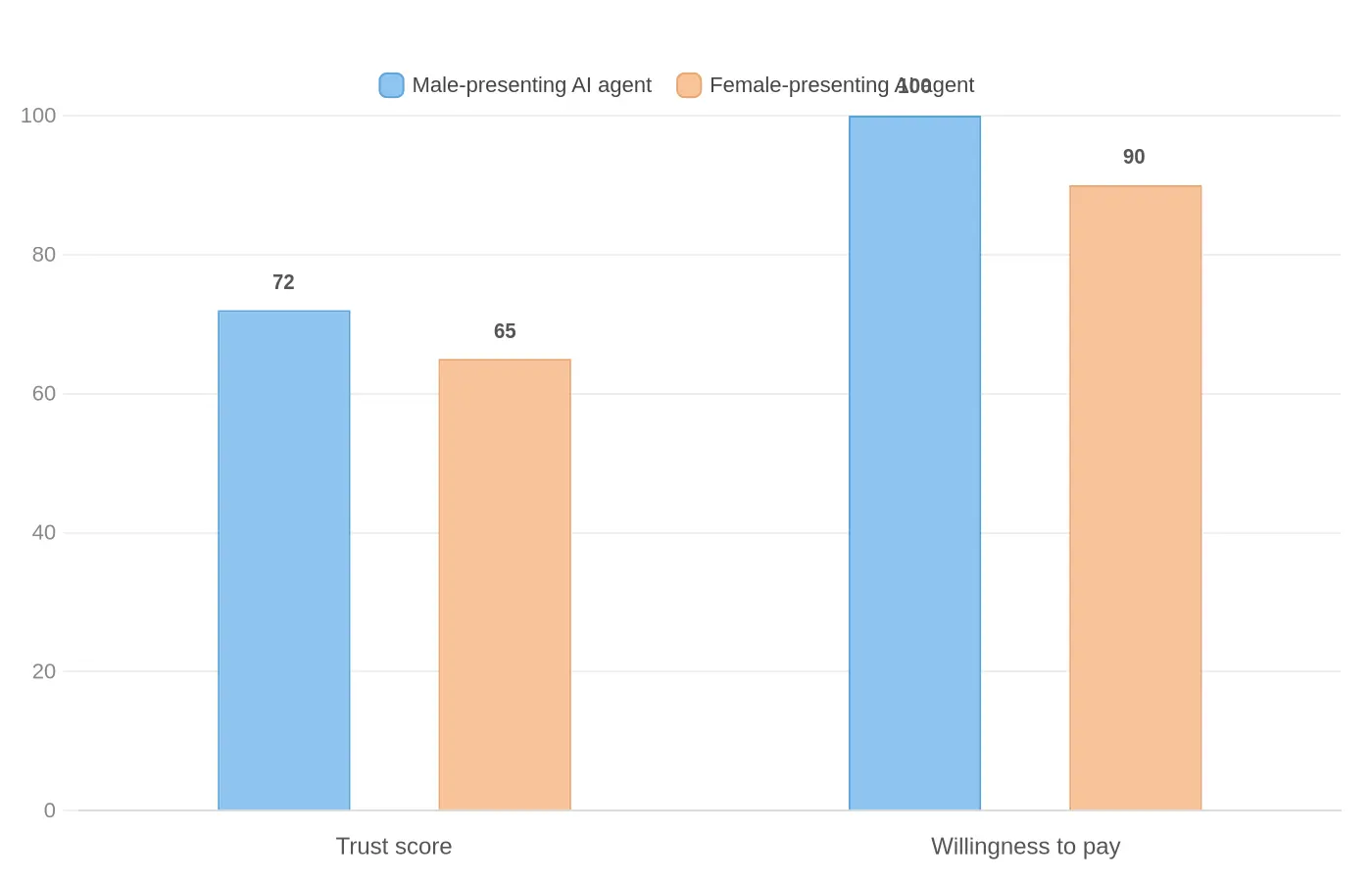
Caption: The male-presenting agent was paid about 10 percent more for the same work. Where the output was identical, the difference was in the label.
Where does AI’s gender come from?
The 10% gap is a reminder of a question we rarely stop to ask: why does the assistant in our phones, our speakers, and our browsers have a gender at all? The answer is not hiding inside the algorithms. It was written into them, deliberately, by people making choices in a particular cultural moment.
The default voice was usually female
Most of us met our first AI as a voice coming out of a small speaker on a kitchen counter.
- Siri, Alexa, and Cortana all shipped with female default voices.
- Google Assistant’s original US default was feminine; the male option came later.
- Microsoft retired Cortana in 2023, ending a name and voice it had marketed for years.
The reasons designers gave were practical, almost mundane: female voices tested as warmer, more helpful, and less threatening. That is not a technical finding. It is a preference, dressed up as one and repeated until it looked like a fact about the product rather than a fact about us.
A name is a persona, and personas carry gender
Giving a product a human name is itself a design decision, and most human names arrive pre-loaded with gender.
- Alexa and Siri read as feminine on first hearing; Cortana borrowed from a female AI character in a video game.
- Naming a system after a person invites us to treat it like one, which makes a gendered voice and manner easier to accept.
- Neutral names exist, but they tend to arrive later, offered as an option rather than a starting point.
The naming choice and the voice choice reinforce each other. Once a system has a name and a warm tone, users address it like a colleague and expect it to answer like one.
Market research closes the loop
The loop is comfortable for everyone involved.
- Early tests reflected existing expectations: users rated female voices as more pleasant, so companies shipped more of them.
- Those products trained a new generation of users to expect a female assistant, which the next round of testing then confirmed.
- Because the choice read as “what users want,” it rarely got revisited. When it did, the fix was framed as adding options rather than questioning the default.
None of this required anyone to be consciously biased. It only required people to follow the data, and the data was already shaped by the culture it came from.
Gender is designed in, not found in the machine
A voice, a name, and a persona are all interface choices. They live in design documents and marketing decks, not in neural weights or training sets. If a model can be reached through a male voice as easily as a female one, the gender is not coming from the technology. It is coming from the people deciding how we should hear it.
That distinction matters. A machine that “happens to” sound like a woman is a curiosity. A machine built to sound like one, shipped at scale, and then paid less for the same work says something about whose preferences get encoded as normal. The bias is not in the silicon. It is in the room where the decision was made.

Technology is a mirror, not a manufacturer
The usual worry is that AI will bring bias into the world. There is a quieter version of that thought, and it is harder to shake: AI rarely invents much. Mostly it repeats what we already do, faster and to far more people at once. That changes where we point the finger.
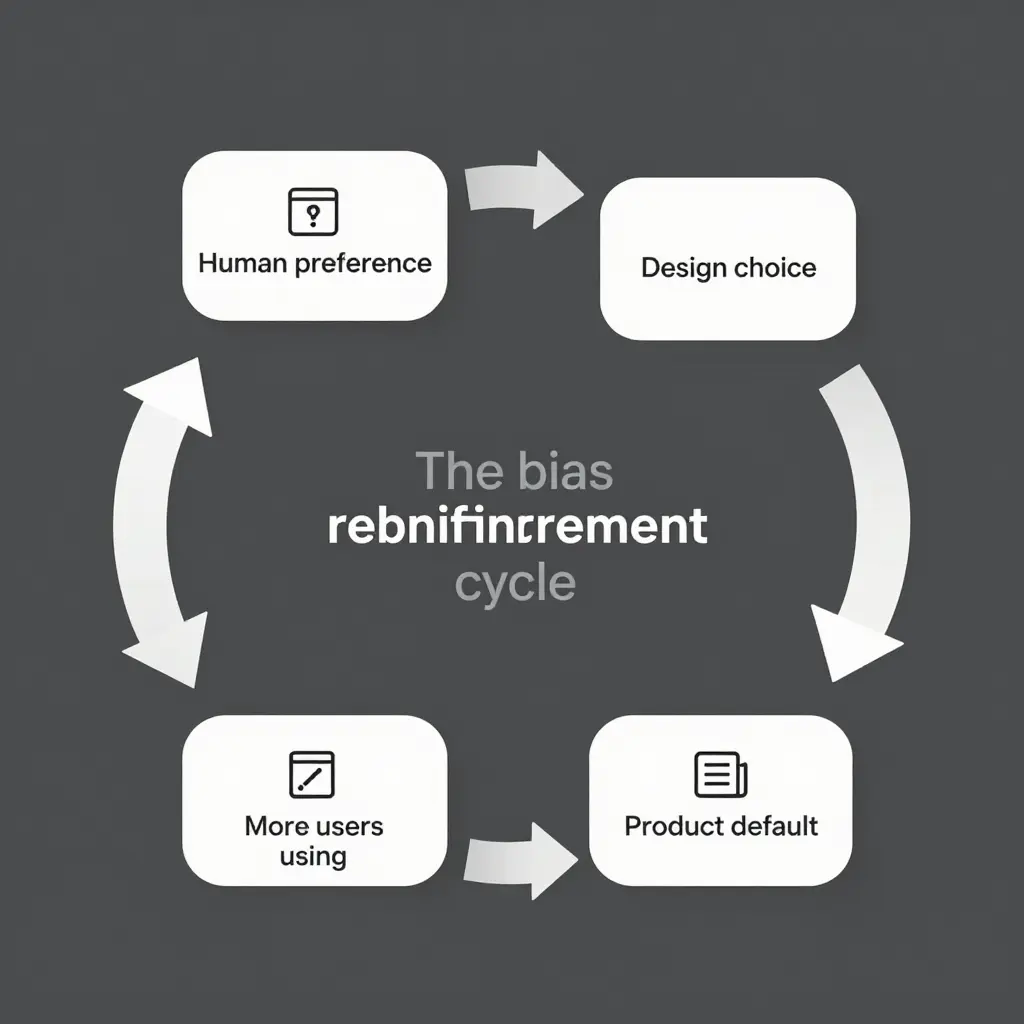
The loop that quietly polishes our habits
A preference doesn’t stay one person’s private bias for long. Watch how it travels:
- Human preference – Say we tend to trust a confident, male-sounding voice a little more.
- Design choice – A builder encodes “confident” as “male-presenting.”
- Product default – The assistant ships that way, out of the box.
- Scale – Millions interact with it, and the habit gets filed away as simply natural.
Nothing in that chain is malicious. Every step looks reasonable on its own, which is exactly what makes it stick.
What the numbers hint at
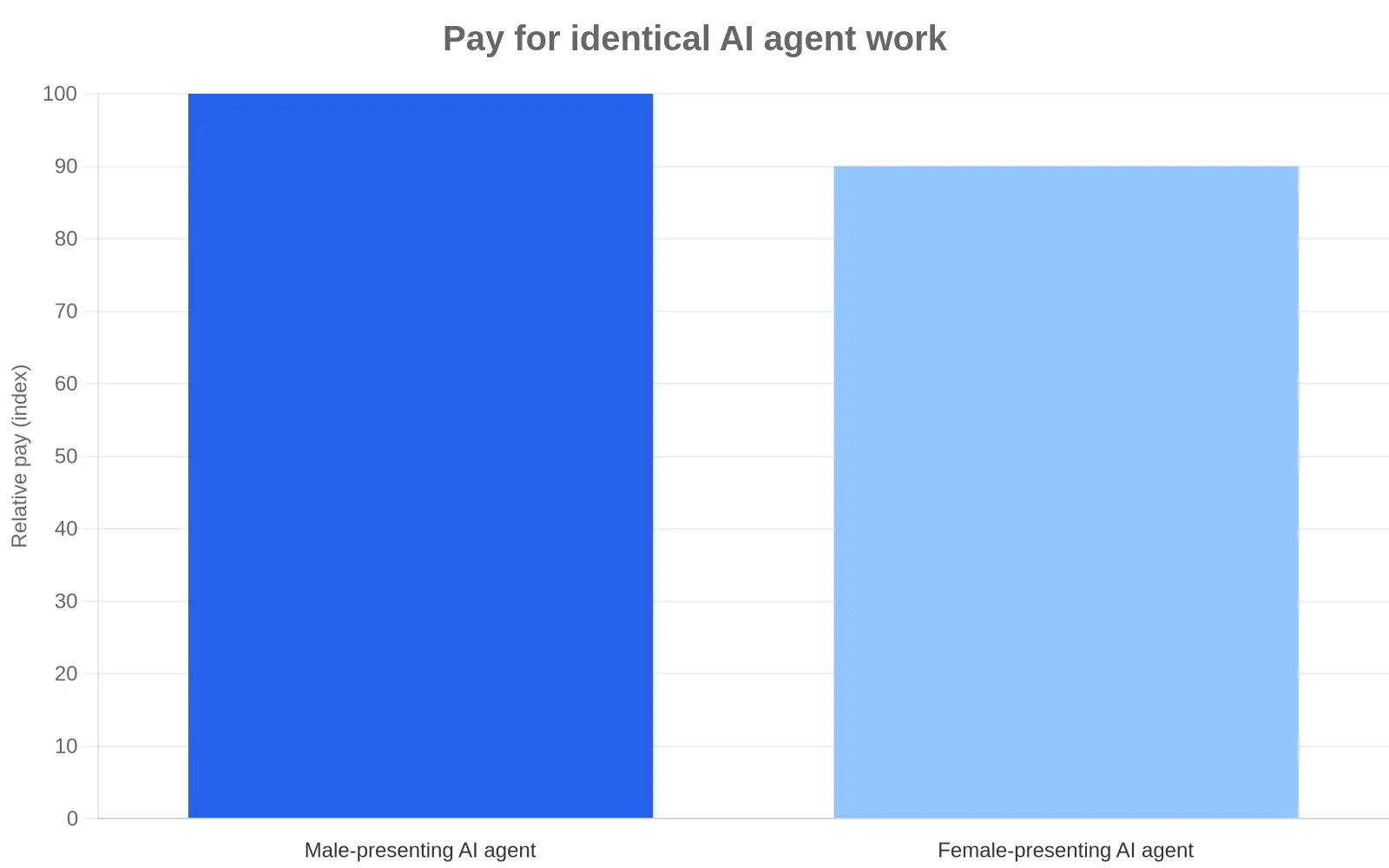
Participants in the Limerick study paid the female-presenting agent roughly 10% less for identical work. That gap doesn’t come from inside a server rack; it arrives with the user, and it gets written into the design brief.
The mirror test
Before we rush to “fix” AI, there is a harder question: fix it toward what? The model sits downstream of the choice, the choice sits downstream of the preference, and the preference is ours. If the technology is a mirror, flinching at the reflection doesn’t clean the glass. It only tells us where to look first.
Bias doesn’t stay in the lab
It would be easy to file the Euronews study under interesting, but a bit theoretical. The rest of this week’s tech news argues otherwise.
In roughly a single news cycle, Anthropic brought Claude into Google Docs, Sheets, and Slides through a sidebar, so an assistant drafts and edits alongside people while they work. Apple is working with LG on smart home accessories – a doorbell, a lock, and cameras among them – meant to plug into its upcoming home hub. Different companies, same direction: AI is moving out of demos and into everyday routines, at the desk and at home.
Assistants rarely show up as blank utilities. Products give them names, voices, and a tone so that using them feels natural, and once an assistant sounds like a person, it usually sounds like a specific kind of person, including a gender. The Limerick finding fits that pattern: identical work, a 10% pay gap, and no meaningful difference in how well the work was rated.
| Factor (identical work) | Male-presenting AI agent | Female-presenting AI agent |
|---|---|---|
| Relative trust | Slightly higher, not statistically significant | Lower by the same margin |
| Willingness to pay | Baseline | About 10% less |
The arithmetic keeps this from staying small. One biased interaction is a rounding error. But an assistant in every document, a hub in every living room, helpers baked into phones and watches: each is a place where our ideas about gender get rehearsed, hundreds of millions of times a day. Scale doesn’t invent bias. It decides how far bias travels.
None of this is an argument that these products are doing something wrong. It is that they are arriving at the moment when the question of who AI “sounds like” has stopped being abstract and quietly become routine.
-
Think of the last AI agent you trusted with a task. Before it replied, did you picture it as male or female? Where did that image come from?
-
Open your most-used voice assistant and look at the default voice. Who chose it, and was the choice ever discussed as a design decision rather than a convenience?
-
If your product gives AI personas names, avatars, or pronouns, check the defaults. A default is a decision, and someone made it.
-
Give the same request to two versions of one assistant, one with a male-sounding name and one with a female-sounding name. Watch how you and your teammates rate the answers.
-
Ask whether the same trust and spending thresholds apply to an agent no matter how it sounds. If they don’t, name the gap out loud instead of smoothing it over.
-
Notice how you speak to a female-voiced assistant versus a male-voiced one. Do you interrupt one more, or stay politer to the other?
-
When a tool reads your tone or your voice, find out who stores the result, for how long, and whether you can delete it.
-
Ask a vendor, plainly, whose voices, faces, and writing sit inside the model you depend on.
-
If you build AI characters, write down the gender assumptions in the brief before design starts. Naming them early is easier than untangling them later.
-
Read the terms once and find the sentence about what happens to your conversations. If it isn’t there, that becomes your question.
-
Notice whose labor AI is replacing and whose work it values less. The 10 percent gap in the study is a symptom, not the whole story.
-
When you rate an AI agent, compare it against a colleague of each gender in your mind. Would your rating shift? That answer is the honest one.
FAQ: When AI gets a gender
Does AI really have a gender?
Not biologically. But users assign one within seconds. A name like “Alexa” or a warm, higher-pitched voice is enough for most of us to file an assistant as “she,” and that label shapes how much we trust it. The gender is not in the model; it is in the exchange between the tool and the person using it.
How did the study arrive at a 10% gap?
Researchers put 189 people in a virtual-reality office with four assistants that shared the same capabilities and underlying model. The two human-like agents, Johan and Johanna, were presented with male and female appearances. Participants rated the work and paid the agents with real money, and the female-presenting agent received about 10% less. That number measures perceived worth, not a real payroll, which is exactly why it is revealing.
Why was the female-presenting agent paid less?
The study cannot isolate a single cause, and the trust ratings between the two human-like agents were not significantly different. The pay gap echoes biases people already hold toward one another: a voice read as female tends to be heard as less authoritative, especially on technical or high-stakes tasks. AI did not invent that reflex. It gave it a new surface to land on.
What can individuals do about it?
Start by noticing which voices you instinctively trust or dismiss, and question that reaction the next time you delegate a task. Then look upstream: ask who designed a system, whose voice it borrows, and whether anyone tested for this. Awareness won’t fix the bias on its own, but it is where change begins.
We keep asking whether AI will inherit our prejudices. The study reported by Euronews already answered the more interesting question. Handed two agents doing identical work, one presenting as male and one as female, people paid the male one about 10% more. No model invented that gap. It was sitting in the room the whole time, in us.
A mirror does not decide what you look like; it refuses to flatter you. Every time we hand a gender to a machine, we hand over a bundle of expectations we never fully examined, and the machine gives them back, polished and at scale.
The honest place to start is not the algorithm. It is the assumptions we carry into it. Keep tuning the model, auditing the data, adding fairness metrics; all of that matters. But none of it holds if the people building, buying, and trusting these systems have not first looked at what they are asking the machines to reflect. The update we need is not in the code. It is in the mirror.