
American Airlines has ended nonstop service to three destinations in 2026: Doha, Qatar; Santa Maria, California; and Tijuana, Mexico. Each route ran into its own trouble and stopped on its own timetable. What they share is the outcome: the flights are gone, and the aircraft that flew them have been reassigned elsewhere in the network.
They are not three versions of the same place. Doha was the longest route American flew from Philadelphia, a 6,798-mile trip to Hamad International that took roughly 14½ hours on a Boeing 787-9. Tijuana is a Mexican border city of nearly two million, 290 miles from Phoenix. Santa Maria is the smallest of the three: a regional airport in Santa Barbara County, California, that American served from Phoenix with a SkyWest CRJ900. The common thread is the decision the airline made about them. The planes could earn more elsewhere.
That decision is part of a broader reshuffling. In 2026, American has dropped or suspended nine routes, suspended six domestic routes over high jet fuel costs, and moved six routes out of LaGuardia while adding two at JFK. Not every change removes flying: the same airline launched six new transatlantic routes and nine new routes on a single day in June. American is recalculating its network, and not always by subtraction.
For a hub such as Philadelphia or Phoenix, dropping a route is an adjustment. The airport absorbs it and the network moves on. For a place like Santa Maria, the same decision lands harder. The schedule changes once, but the consequences keep going: how people get to work and to family, how local businesses reach customers and suppliers, how a town is seen by the outside world.
So the question is what a small city loses when the flight itself is only the first thing to go.
Why Routes Get Cut: The Numbers That Decide
American is the largest airline in the United States by passengers carried and scheduled seats. It flew about 224 million passengers last year and has scheduled roughly 290 million seats for this one. When a carrier that size leaves a city, it often leaves no nonstop service behind, and residents face a long drive to the nearest hub.
The destinations differ, but most route decisions trace back to the same handful of forces: fuel, aircraft, hubs, and the season.
Fuel sets the floor
Jet fuel is the cost airlines watch most closely. It moves fast, and it is the hardest expense to hedge away completely. When it climbs, carriers have a familiar set of responses:
- Raise base fares on the routes that can bear it
- Add temporary surcharges
- Cut capacity – fewer flights, smaller aircraft, or both
The third response is where routes die. A flight has to cover fuel, crew, gate and landing fees, and maintenance before it earns anything, and it also has to beat what the same aircraft could earn flying somewhere else. When a thin route can’t clear that bar, pulling the plane is straightforward math, even from a city that has flown with American for years.
The aircraft is a scarce resource
A plane can only be in one place at a time, so every route an airline keeps is one it gives up somewhere else. That trade shapes three things beyond fuel:
- Hub strategy. American concentrates capacity at a small set of hubs and protects the connecting traffic built around them. Point-to-point flying competes for the same aircraft as the hub network, and usually loses.
- Aircraft reallocation. A plane pulled off a weak route doesn’t vanish; it gets redeployed. American has been adding transatlantic service and relaunching domestic routes at the same time it drops others. For a small city, the hard part is that “somewhere better” is usually a bigger market.
- Seasonal demand. Not every cut is an exit. Ski and leisure links can run in winter and pause in the shoulder months. A suspension is often a wait, not a goodbye.
Why a big carrier’s decision lands hard
- Thin margins cut both ways. Small markets rarely generate the volume to absorb a fuel spike, so they’re often the first capacity to go.
- No easy substitute. Lose the nonstop, and the next option is usually a drive or a connection, both of which cost the traveler time and the town business.
- Scale concentrates the blow. American’s size means its route map helps set the baseline for what service a community can expect. For some towns, that baseline is the only one there is.
None of this arrives as a decision about a place. It arrives as a schedule change.
Set the cuts side by side and the pattern is easier to read.
| Destination / Route | Status | Time | Pressure or Reason |
|---|---|---|---|
| Philadelphia-Doha (Qatar) | Cancelled – all flights | March 2026 | Middle East instability and weak financial performance; Qatar Airways now operates the route |
| Phoenix-Santa Maria (California) | Cancelled – all flights | May 7, 2026 | Low demand; Allegiant is now the airport’s only carrier |
| Phoenix-Tijuana (Mexico) | Cancelled – all flights | August 2026 | Low demand on American’s shortest international route, 290 miles |
| Nine routes (not itemized in the report) | Dropped and suspended | Reported October 5, 2026 | Network and capacity review across the schedule |
| Six domestic routes | Suspended | Announced June 2026 | High jet fuel costs |
| Six New York routes cut, two added | Swapped between LaGuardia and JFK | Reported October 7, 2026 | Capacity shifted between airports; Bozeman moved from LaGuardia to JFK |
Different dates, different airports, same habit: American walks away from the links it cannot make pay. Almost every route on that list sits at the edge of the network, while the additions announced alongside them land in the middle – transatlantic flagships, high-yield international destinations, core hubs that feed everything else. Aircraft, crews, and gates are finite, and when they move, they move toward where they earn the most. That is the story underneath the cancellations. Not one city losing one flight, but where an airline decides its future sits, and which places get pulled into the center of that map rather than left at the rim. For the communities now on the rim, the consequences rarely stay inside the airport.
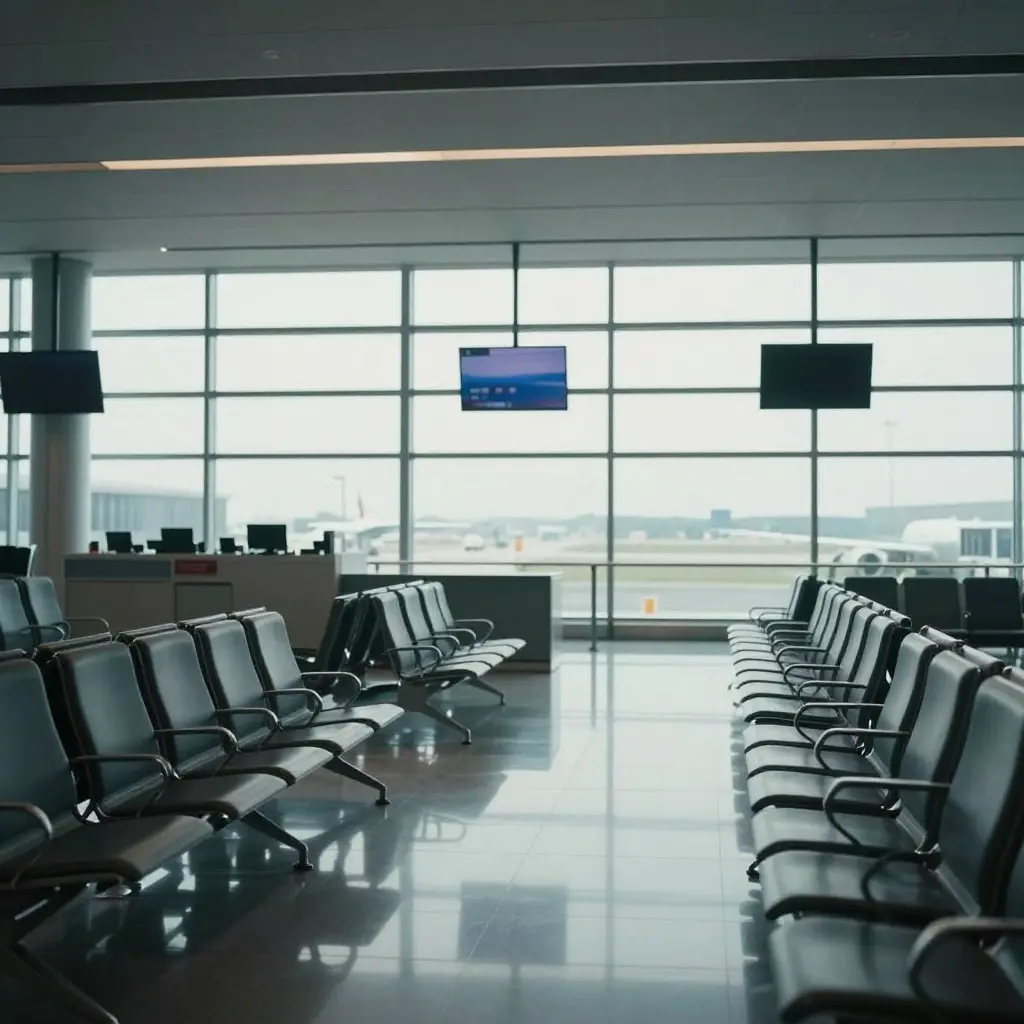
What a Small City Loses When the Flight Goes Away
A dropped route looks tidy on a map: one line disappears, and one aircraft moves to a busier market.
For the city left behind, the line was never just a line. It was infrastructure, and pulling it out ripples through the local economy in ways a press release rarely mentions.
The arithmetic isn’t hidden. When fuel costs climb and a route can’t fill enough seats at a high enough fare, cutting it protects the wider network. American, Delta, and United have each trimmed, suspended, or reshuffled routes in recent months for exactly these reasons. Seen from the network level, the decision is rational. On the ground, it lands differently.

The jobs that never make the press release
An airport is an employer before it is a departure board: gate agents, baggage handlers, fuel crews, security officers, custodial staff, and the coffee counter that opens before dawn.
When a route is cut, those hours thin out faster than the route itself. Fewer flights mean fewer shifts, and the losses fall hardest on part-time workers who were already closest to the margin.
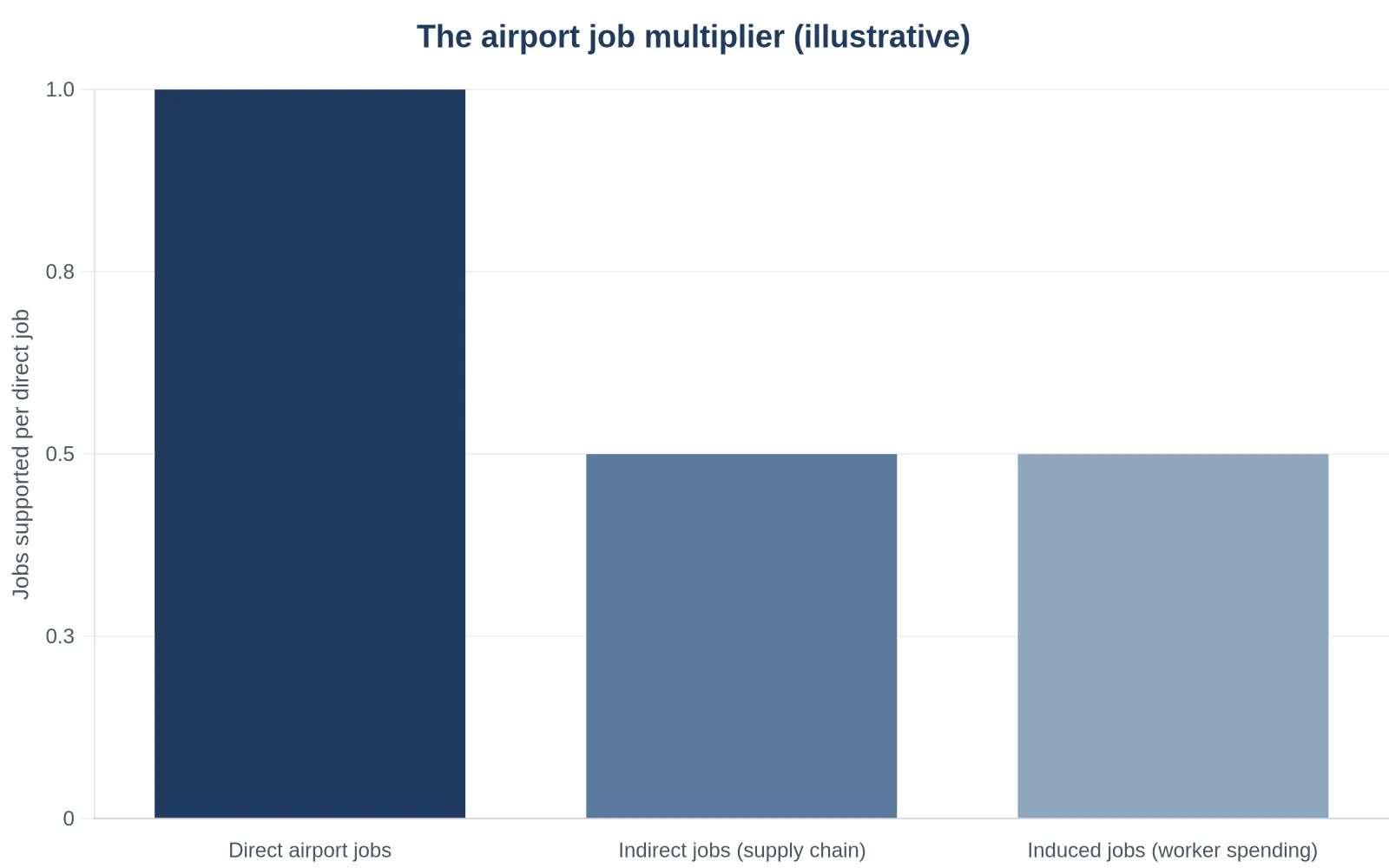
The larger loss is the multiplier. One airport job supports others: the hotel that hosts a delayed passenger, the restaurant near the terminal, the contractor who services equipment, the driver who runs the shuttle. Remove the passengers and you remove the reason those jobs exist. Industry impact studies often estimate that each direct airport job supports roughly one more job locally, though the ratio varies by airport and region.
When business travel becomes a two-day trip
For many small cities, the nonstop was the difference between a meeting and a two-day trip. Losing it doesn’t stop business; it taxes it. Sales teams fly out less often, clients visit less often, and the friction is easy to ignore on any single trip but large enough to change how a company plans a year.
Companies weigh that friction when they decide where to grow. A clinic, a manufacturer, or a software firm comparing two towns will notice which one sits an hour from the nearest hub, and which one sits five.
The visitors who quietly stop coming
Tourism and conferences are discretionary in a way that jobs are not. A convention planner books a city that is easy to reach, and a tourist weighing a weekend away rarely picks the harder itinerary. When the flight goes, some visitors reroute and others choose somewhere else. The difference shows up slowly, in occupancy rates and thinning event calendars.
Getting to a specialist, a campus, a first day
Sometimes the stakes are personal. A direct flight can be the difference between a same-day medical appointment and a journey that takes two days, a relative’s help, and a missed shift. The same holds for a student heading to a campus several states away, or a parent flying out for a first day at a new job.
For people with money, time, and good health, the drive absorbs the loss. For everyone else, it becomes a reason not to go.
The unchecked box on every expansion shortlist
Economic development is competitive, and air service is one of the first filters. When a company shortlists locations, “distance to a major airport” is rarely the deciding line, but it is almost always on the page. A city without a flight isn’t disqualified outright; it starts the conversation explaining itself.
That is the cost that never makes a headline: a persistent, low-grade handicap in decisions the community never gets to make.
Why it keeps happening
None of this is a scandal. It is a business responding to real pressures: fuel prices, thin margins on regional routes, and networks that concentrate where demand is thickest.
The pattern is older than any single airline: service consolidates toward hubs, and smaller markets feel it first. Routes can return when the economics change. The habits and choices that formed around their absence often don’t.
The ripple, at a glance
| What changes | Shows up first as | Shows up later as |
|---|---|---|
| Airport jobs | Fewer shifts for ground and concession staff | A weaker local tax base |
| Business travel | Longer trips, canceled client visits | Deals and expansions that go elsewhere |
| Tourism and events | Empty rooms, quiet venues | Planners booking other cities |
| Medical and school access | Longer drives, missed appointments | Fewer specialists willing to travel in |
| Everyday travel | Longer drives to a hub, overnight stays | Higher costs for those with the least flexibility |
| Site selection | One box left unchecked | A town that keeps explaining itself |
The thing that is hard to price
An airline measures a route in seats sold and dollars per mile. A community measures it in things that don’t fit a spreadsheet: whether a child can reach a specialist, whether a small company can chase a big client, whether the town feels connected to anywhere but itself.
When a route disappears, the airport loses more than a line on the schedule. The costs settle into daily life slowly, and often out of sight. They build in small increments – one missed connection and one delayed shipment at a time – until a town realizes what its airport used to hold together.
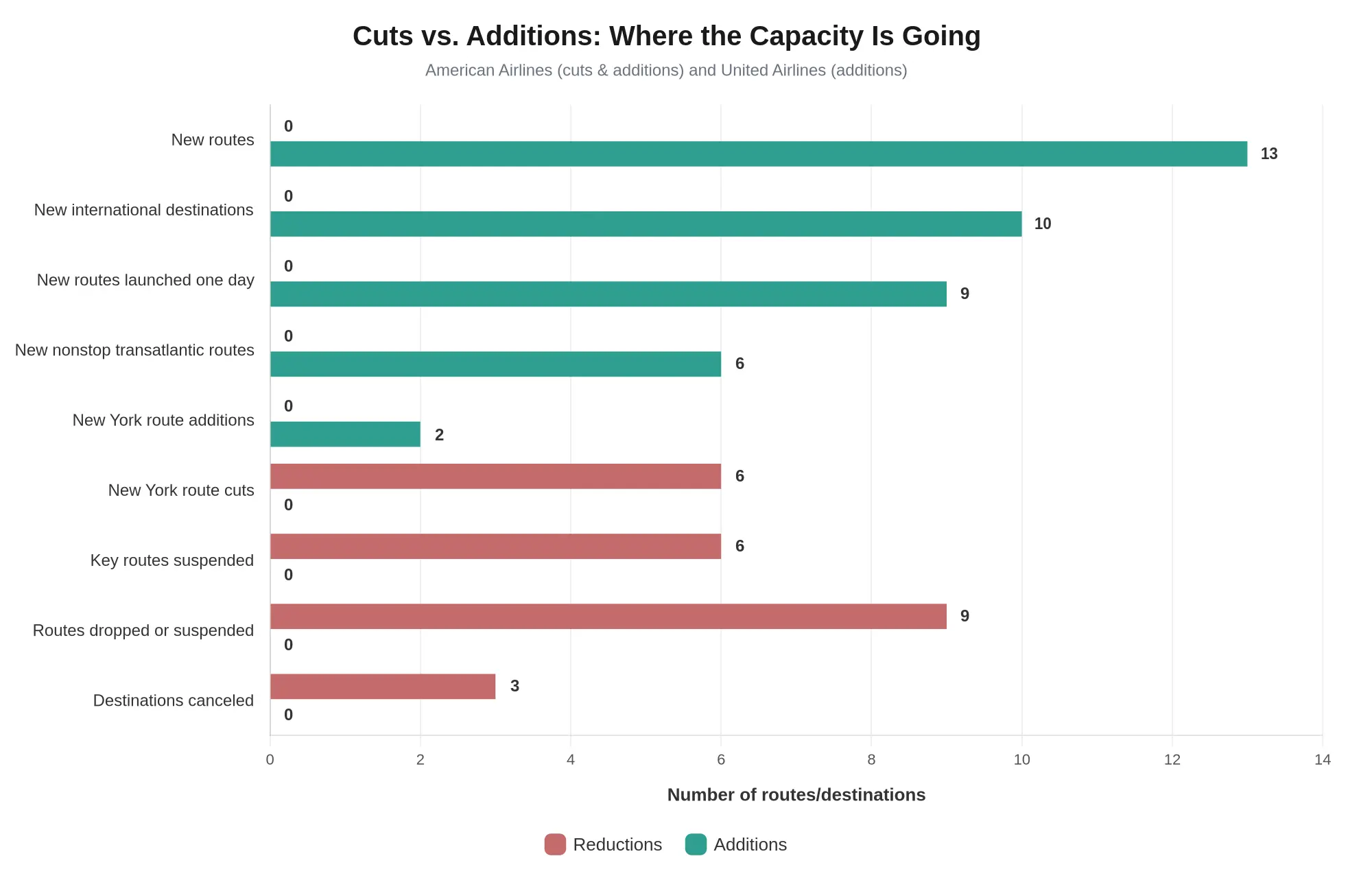
Cuts vs. Additions: Where the Capacity Is Going
American Airlines is trimming its map on one side while drawing new lines on the other, and it is not the only carrier moving planes around.
The moves reported so far: three destinations ended, nine routes dropped or suspended, six domestic routes suspended over fuel costs, and six routes trimmed in the LaGuardia and JFK swap. Against those, American added two New York routes, six transatlantic routes, and nine routes on a single day in June. United, for its part, has announced 10 new international destinations for 2027, which it called the largest international expansion in its history.
The picture is less retreat than reallocation. Aircraft pulled off routes like Phoenix-Santa Maria and Phoenix-Tijuana go into longer, higher-yield flying. For a small city, the distinction barely matters: a reallocated plane still means one fewer option and a longer drive to the next departure.
The Other Side of Airline Strategy
The cuts are real. They are also only half the story.
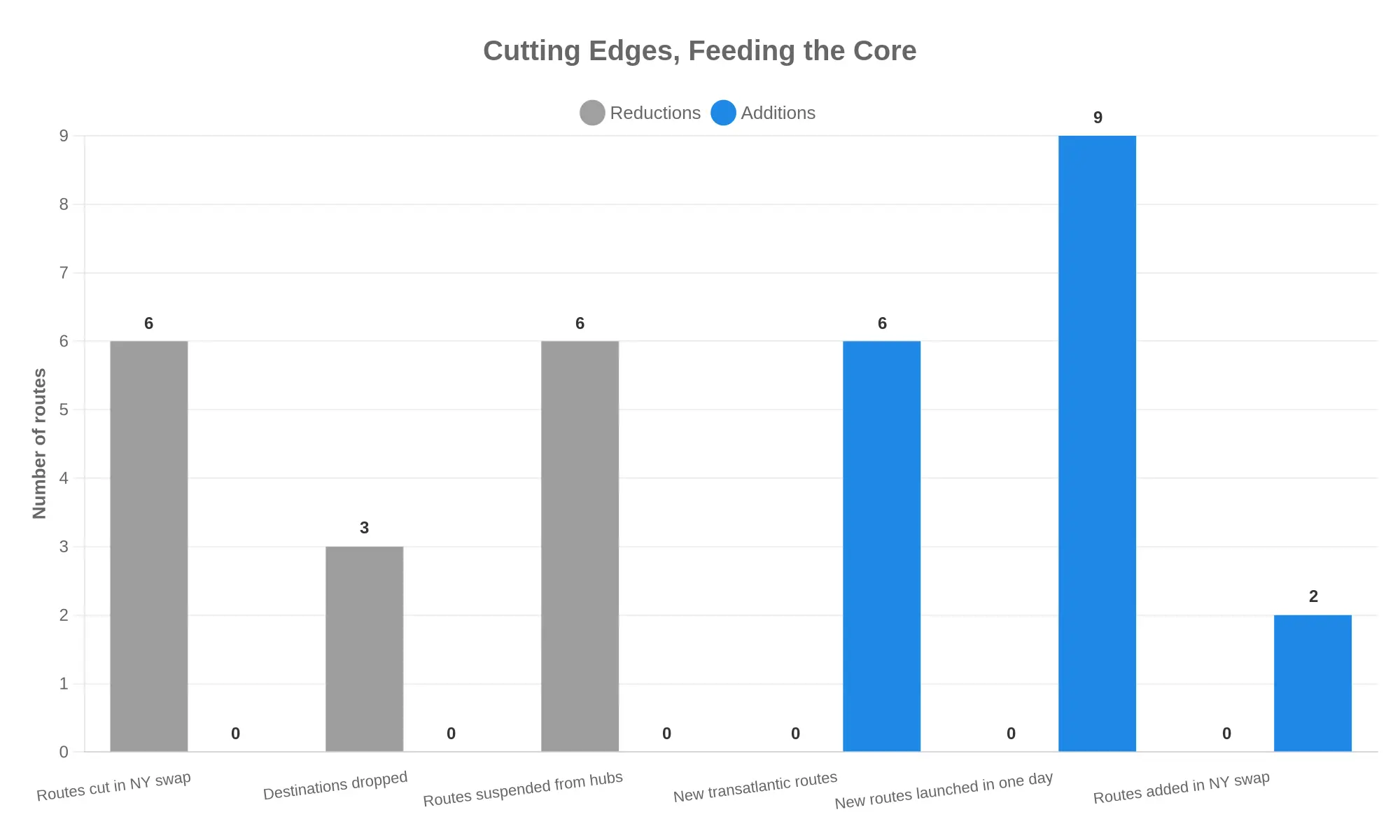
While American trims service to Doha, Santa Maria, and Tijuana, it keeps building elsewhere. In 2026 the carrier launched six new nonstop transatlantic routes, linking US hubs to Edinburgh, Budapest, Prague, Athens, Zurich, and Milan. On a single day in June, nine new routes began or resumed. That is not an airline in retreat; it is an airline re-sorting where its airplanes go.
New York shows the mechanics. American cut six routes and added two in a swap between LaGuardia and JFK, moving seasonal flying such as Bozeman to the airport where it fits better. Fewer cities were dropped than seats were moved. The point was better-placed capacity, not less of it.
The pattern amounts to a strategy: pull back from the edges and invest in the core. Long-haul flying to major European cities and busy hub-to-hub links earn more per seat than thin regional routes, and when fuel costs climb, those margins matter more. The aircraft pulled from a struggling small-city pair rarely disappears. It turns up on a transatlantic run.
What that means for small cities
For a small community, this is the hard part. Its route rarely goes for lack of local demand alone; it goes because the same plane can make more money elsewhere.
That puts small cities first in line when capacity is reallocated, not because they did anything wrong but because a single aircraft is worth more where the yield is higher.
The same decision that fills a European route can empty a regional gate. One is framed as growth; the other appears as a line in a schedule update.
American is not abandoning small cities out of spite. The logic is simpler and colder: when the core needs feeding, the edge is the first place to look. In the airline’s math, small cities don’t lose a flight by accident. They lose it by design.

Frequently Asked Questions
Which three destinations did American Airlines cut?
The carrier ended nonstop service to Doha in Qatar, Santa Maria in California, and Tijuana in Mexico. The three ended for different reasons. American suspended the Philadelphia-Doha route in March 2026 amid Middle East instability and weak financial performance, and Qatar Airways now flies it. The Phoenix-Santa Maria and Phoenix-Tijuana routes were cancelled in May and August 2026 after failing to draw enough passengers. None justified keeping the aircraft assigned there.
Is American leaving these markets for good, or just pausing?
The wording matters. Airlines often label cuts as “suspensions,” which keeps the door open to return if demand and economics improve. But a suspension can quietly turn permanent. Once a route leaves the schedule, crews, gate slots, and sales effort shift elsewhere, and restarting service becomes a heavy lift. So read “suspended” as “not now,” not “never.”
Why cut small domestic routes while adding international ones?
Because airlines fly a fixed number of planes. A widebody on a long-haul transatlantic route can earn far more per seat than a regional jet on a short hop with modest demand. When the same aircraft has a better-paying option, the thin route loses. Recent months show the pattern clearly: carriers have announced new international and transatlantic service even as they trim domestic and regional flying.
How do fuel costs tip route decisions?
Jet fuel is one of the largest line items in an airline’s budget. When prices climb, routes that were only marginally profitable turn negative first, usually short flights with low passenger loads. Carriers respond with higher fares, fuel surcharges, or fewer flights, and the weakest routes are typically the ones dropped. Fuel is not the only factor, but it is often the trigger.
What can a small city do after losing a route?
There is no single fix, but there are concrete moves. Work with the remaining carriers to protect existing links. Check eligibility for Essential Air Service subsidies. Improve ground connections to a larger hub. And build local demand through business and tourism partnerships. Some communities also court low-cost or regional entrants. Realistically, restoring service takes years of data, lobbying, and patience.
What a Small City Actually Loses
When American drops a destination, the paperwork is small: one route, a handful of seats, a line removed from a timetable. What a community loses is harder to tally. It’s the lived fact of being connected – the ability to reach a client, a patient, or a grandchild without adding a day and a drive to the trip.
These changes rarely make headlines. There’s no ceremony for a suspension, no banner for a city that simply stops appearing in the booking system. And because the arithmetic looks minor – a longer route, one more connection – the damage compounds without much notice: fewer business trips, thinner tourism, a fading sense that this place still matters to the networks that carry everyone else.
The airline’s logic isn’t unreasonable. Fuel climbs, aircraft are finite, and capacity follows the routes that fill. But that logic prices what the market rewards, not what a town depends on. The job that never gets created, the investment that goes elsewhere, the family that drifts toward a bigger airport – none of it shows up on a route map.
That is why the loss of a single flight is rarely only about flying. It’s about the distance that opens when a link closes, and how long it lingers after the headlines have moved on.